For decades, the foundations of the global digital economy have rested on a single mathematical assumption: that certain math problems are simply too difficult for any computer to solve in a reasonable amount of time. Every time you log into your bank, send an encrypted message, or transmit sensitive corporate data, you are relying on algorithms like RSA and Elliptic Curve Cryptography (ECC) to act as an unbreakable digital padlock.
But that unbreakable padlock is about to be shattered.
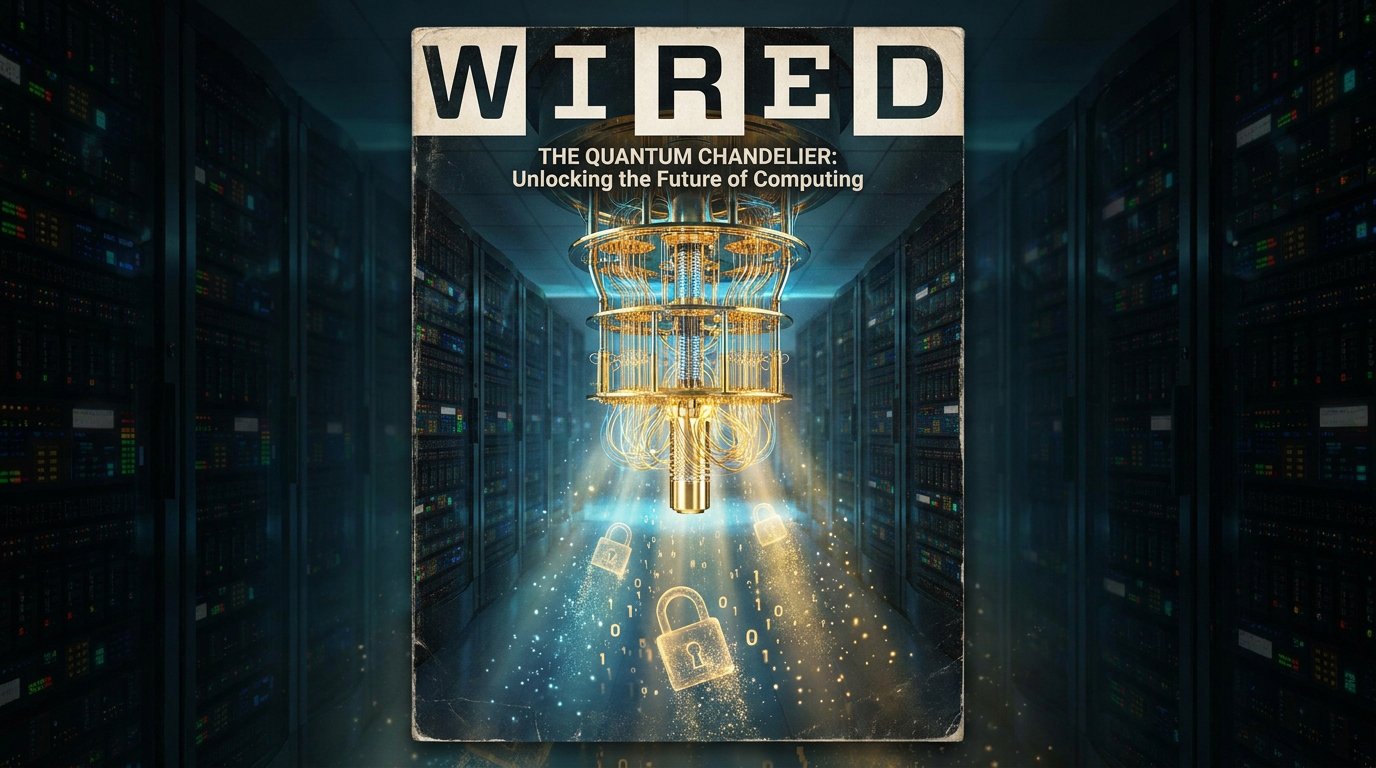
The rapid development of cryptographically relevant quantum computers (CRQCs) has accelerated the timeline for what cybersecurity experts are calling “Q-Day” or “Y2Q.” We are standing on the precipice of a monumental shift in digital security. The quantum computing encryption crisis is no longer a theoretical thought experiment confined to university physics departments; it is an active, impending reality that has governments, financial institutions, and tech giants scrambling to rewrite the rules of internet security.
The Mechanics of the Breakdown: Shor’s Algorithm
To understand the severity of the quantum computing encryption crisis, we must first look at the weapon that will cause it. In 1994, mathematician Peter Shor developed a quantum algorithm—now known as Shor’s Algorithm—that proved a quantum computer could easily find the prime factors of large numbers.
Classical computers process information in binary bits (0s or 1s). Brute-forcing a 2048-bit RSA encryption key with a classical supercomputer would take billions of years. Quantum computers, however, use qubits, which can exist in multiple states simultaneously thanks to superposition and entanglement. This allows them to evaluate vast numbers of possibilities concurrently.

When a fault-tolerant quantum computer reaches a sufficient scale (likely requiring thousands of stable, error-corrected logical qubits), Shor’s Algorithm will allow it to slice through our current public-key infrastructure in a matter of hours. The moment this machine powers on, the quantum computing encryption crisis officially begins, rendering the cryptographic foundation of the internet entirely obsolete.
(For a deeper dive into the underlying physics, check out this excellent resource on how quantum hardware is scaling up).
The Invisible Theft: “Harvest Now, Decrypt Later”
You might assume that because a fully scaled CRQC does not yet exist, we have time to relax. This is a fatal misconception that sits at the very core of the quantum computing encryption crisis.
Adversaries, particularly state-sponsored hacking groups, are currently engaging in a strategy known as “Harvest Now, Decrypt Later” (HNDL). They are actively intercepting and siphoning massive amounts of encrypted internet traffic—everything from intellectual property and military secrets to sensitive medical records and financial data.

Right now, this stolen data is useless to them. It is locked behind AES and RSA encryption. But data storage is cheap. Adversaries are hoarding these encrypted files in vast server farms, waiting patiently for Q-Day. The moment a viable quantum computer comes online, they will retroactively decrypt decades’ worth of stolen global intelligence.
Because of HNDL, the quantum computing encryption crisis is not a future event; the data exposure is happening today. If your organization’s data needs to remain secret for the next 10 to 20 years, it is already compromised if it is moving across networks protected only by classical encryption.
NIST and the Race for PQC Standards
The cavalry, fortunately, is already here. The response to the quantum computing encryption crisis has been a monumental, decade-long effort led by cryptographers worldwide.
In August 2024, the U.S. National Institute of Standards and Technology (NIST) officially released the first three Post-Quantum Cryptography (PQC) standards: FIPS 203 (ML-KEM), FIPS 204 (ML-DSA), and FIPS 205 (SLH-DSA). These new algorithms do not rely on the prime factorization vulnerabilities that Shor’s algorithm exploits. Instead, they are built on entirely different branches of mathematics, such as lattice-based cryptography, which are believed to be immune to both classical and quantum attacks.

These standardized algorithms give the world the tools needed to survive the quantum computing encryption crisis. However, standardizing the math was the easy part. The true challenge lies in the deployment. Ripping out and replacing the core cryptography of every server, browser, IoT device, and cloud network on Earth is a logistical nightmare akin to changing the engines on a commercial jet while it is flying at 30,000 feet.
(To understand how businesses are prioritizing this shift, read our internal guide on Building Enterprise Cybersecurity Frameworks).
The Shrinking Timeline: When is Y2Q?
When exactly will the quantum computing encryption crisis reach its climax? The timeline is shifting rapidly.
Just a few years ago, experts predicted Q-Day was 30 to 50 years away. However, recent breakthroughs in logical qubit error correction and silicon-based manufacturing have compressed that timeline. Cybersecurity Ventures recently predicted that Y2Q could arrive on or around January 1, 2031. Major tech players are setting aggressive internal deadlines; for example, Google recently announced a 2029 timeline to secure its infrastructure through PQC migration.

Furthermore, in June 2026, the U.S. government issued executive orders setting hard federal civilian deadlines, mandating that agencies migrate their key establishment systems to post-quantum standards by 2030 and their digital signatures by 2031. For national security systems governed by CNSA 2.0, the hard deadline for full migration is 2035.
The message is clear: the window to mitigate the quantum computing encryption crisis is closing over the next five to eight years.
The Mandate for Crypto-Agility
How can organizations survive the quantum computing encryption crisis? The answer is a paradigm shift known as “crypto-agility.”
Historically, developers hardcoded cryptographic algorithms directly into software applications. When an algorithm was broken, updating it required rewriting vast amounts of code. Crypto-agility requires rebuilding systems so that cryptographic protocols act like plug-and-play modules. If a vulnerability is found in a PQC algorithm (and because these mathematical frameworks are relatively new, some will likely be found), a crypto-agile system can swap out the compromised algorithm for a new one without taking the system offline.

To prepare for the quantum computing encryption crisis, organizations must take the following steps immediately:
- Conduct a Cryptographic Inventory: You cannot protect what you cannot see. Security teams must map every instance of public-key cryptography across their networks, APIs, and third-party vendor applications.
- Prioritize High-Value Data: Identify which data has a long shelf life (like trade secrets, health records, or classified intel) and prioritize its migration to PQC immediately to mitigate the HNDL threat.
- Implement Hybrid Encryption: Rather than abandoning classical cryptography overnight, organizations should use hybrid models—wrapping data in both traditional algorithms (like ECC) and new PQC algorithms (like ML-KEM). If the PQC standard contains an undiscovered flaw, the classical encryption still holds back traditional attacks.
The Dawn of a Quantum-Safe Future
The quantum computing encryption crisis represents one of the most profound technological inflection points of the 21st century. It is a slow-motion Y2K, but with vastly higher stakes and no definitive midnight to count down toward.
The technology to break the internet is being built right now. But so is the technology to save it. By embracing NIST’s PQC standards, investing in crypto-agility, and recognizing that the quantum computing encryption crisis requires immediate action to prevent present-day data harvesting, the global community can ensure that when Q-Day finally arrives, the digital world will not shatter, but simply continue to turn.
Frequently Asked Questions (FAQ)
1. Does the quantum computing encryption crisis mean all encryption is broken?
No. The crisis specifically threatens asymmetric (public-key) encryption, such as RSA and ECC. Symmetric encryption algorithms, like AES-256, are considered “quantum-resistant.” While a quantum algorithm (Grover’s Algorithm) can theoretically weaken AES, simply doubling the key size to 256 bits restores its security against quantum attacks.
2. What does “Harvest Now, Decrypt Later” mean?
This is a strategy where cybercriminals or hostile nations steal and stockpile encrypted data today. While they cannot read it now, they are saving it until a powerful quantum computer is built, at which point they will decrypt and exploit the information.
3. Are there post-quantum cryptographic standards available today?
Yes. In August 2024, NIST released three final PQC standards: FIPS 203 (ML-KEM), FIPS 204 (ML-DSA), and FIPS 205 (SLH-DSA). Organizations can and should begin deploying these algorithms in hybrid setups immediately.
4. When exactly is Q-Day (or Y2Q)?
There is no fixed calendar date, as it depends entirely on hardware breakthroughs. However, regulatory and industry consensus points toward a highly critical risk window opening between 2030 and 2035.
5. How much will it cost to fix the quantum computing encryption crisis?
The transition will be incredibly resource-intensive, requiring organizations to audit and upgrade essentially all digital infrastructure. While total global costs are hard to calculate, they are expected to be in the tens or hundreds of billions of dollars, far exceeding the costs of the Y2K bug remediation.
Click this link to read our important and interesting articles as soon as they are published!