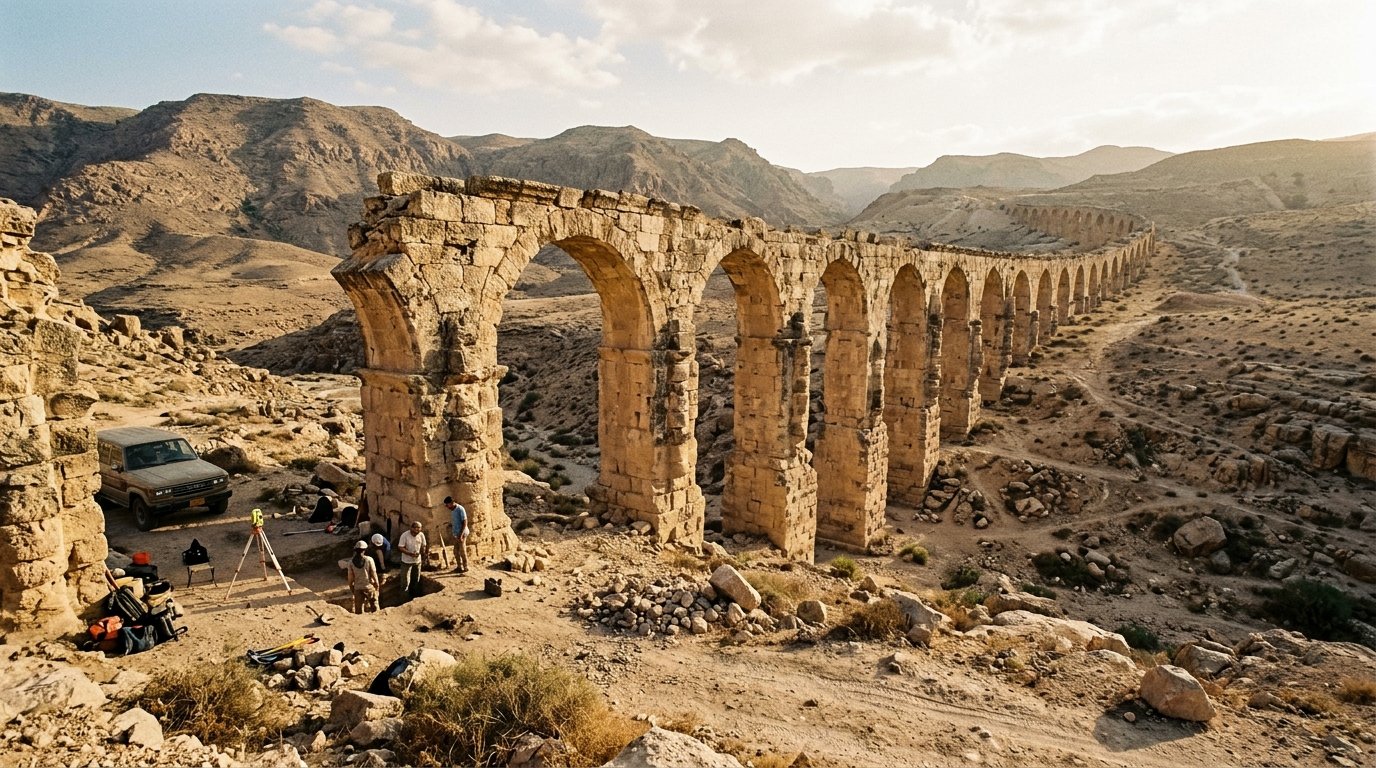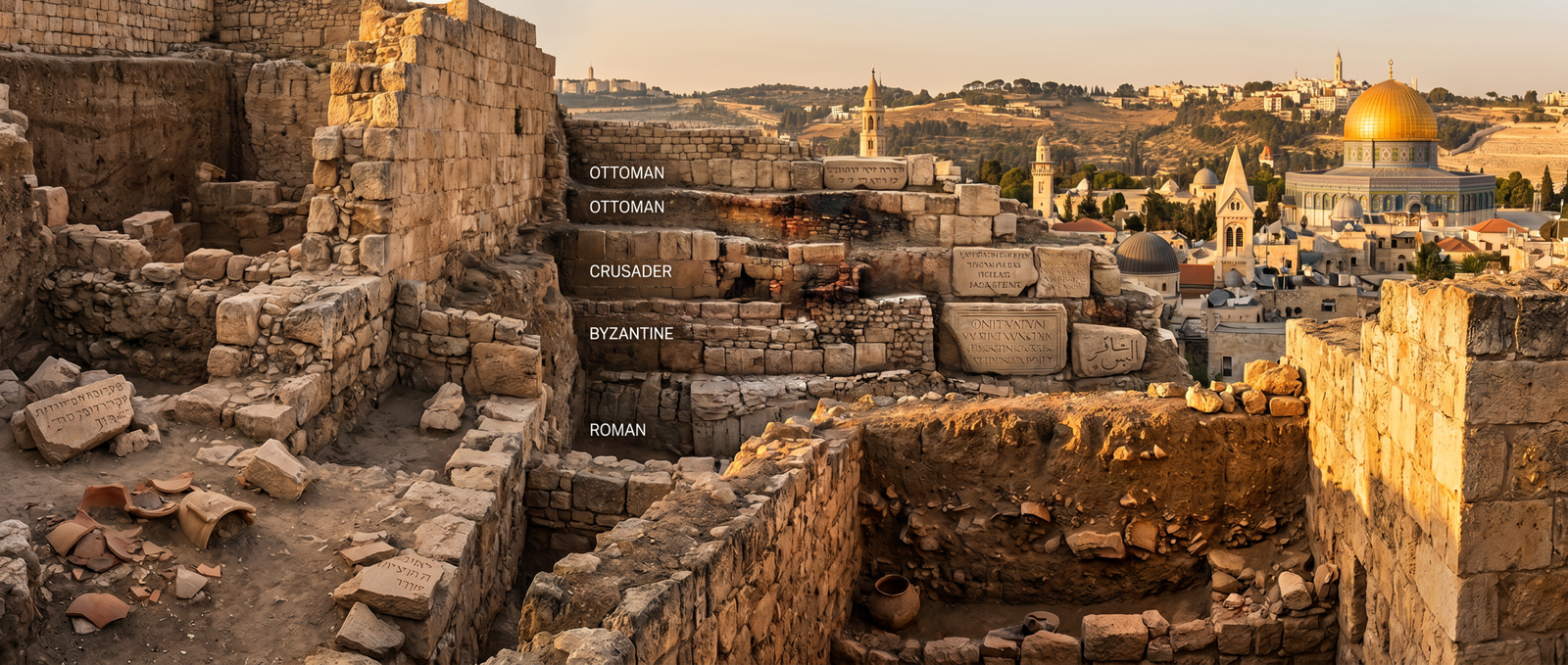
Few cities on Earth carry a weight like Jerusalem’s. Besieged 23 times, attacked 52 more, captured and recaptured 44 times — yet it still stands, still argued over, still sacred. This is not mythology. It is a story written in stone walls, pottery shards, burned temples, and ancient inscriptions, each layer of rubble pressed down by the next civilization that chose to plant its flag on the same small ridge in the Judean hills.
What follows is that story, drawn from the archaeological record and cross-referenced with documentary evidence — from Egyptian hieroglyphics and Assyrian tablets to Roman coin finds and Ottoman building surveys.
The Oldest Traces: Copper Age to Early Bronze Age (c. 4000–2000 BCE)

Jerusalem’s story does not begin with King David, nor with any single faith. It begins with water.
The earliest traces of human settlement in the area — found on a hill to the southeast of what is now the Old City — date to the late Chalcolithic Period (Copper Age) and the Early Bronze Age, around 3000 BCE. Excavations at the Mount Ophel and City of David site, which have been ongoing since 1978, have revealed evidence of occupation from this era, including pottery shards embedded in the natural bedrock. The earliest of these fragments have been dated to approximately 4000 BCE, suggesting that even before any organized settlement, people were sheltering on this ridge.
The reason was simple: the Gihon Spring. One of the only reliable freshwater sources in the region, it gushed from the hillside and made permanent habitation viable. Archaeological work has uncovered a very early pool and channel connected to the Gihon, dated to the Middle Bronze Age period (roughly 2000–1550 BCE) — the same era in which, according to the biblical account, Abraham met the priest-king Melchizedek at a place called Salem.
The name Jerusalem itself appears in historical documents far earlier than its biblical prominence. Egyptian Execration Texts — ceramic vessels inscribed with the names of enemies and then ritually smashed — mention a city called *Rushalimum* as early as the 20th century BCE (around 2000 BCE). In these texts, Jerusalem is listed alongside only a handful of other Canaanite cities: Ashkelon and Rehob. The name translates roughly as “founded by [the god] Shalem” — though the Hebrew association with *shalom*, meaning peace, has clung to the city ever since.
Canaanite Jerusalem and Egyptian Vassalage (c. 1700–1200 BCE)

By the 17th century BCE, the Canaanites had transformed Jerusalem into a fortified urban centre. Archaeological evidence confirms that they constructed massive defensive walls on the eastern side of the city — built from boulders weighing up to five tons, reaching heights of around 26 feet — specifically to protect their water system and the Gihon Spring below.
By approximately 1550–1400 BCE, Jerusalem had come under Egyptian control. The New Kingdom Pharaohs Ahmose I and Thutmose I had expanded Egypt’s reach deep into the Levant, and Jerusalem — strategically placed on the caravan routes between Egypt and Mesopotamia — became one of their vassal city-states.
The most vivid documentary window into this period comes from the Amarna Letters, a remarkable cache of clay tablets discovered in Egypt in 1887. Dating to around 1350 BCE during the reign of Pharaoh Akhenaten, these tablets include correspondence from a man named Abdi-Heba, the ruler of *Urusalim* — Jerusalem. He writes repeatedly to the Pharaoh, complaining of raids, internal unrest, and the withdrawal of Egyptian troops. The letters confirm Jerusalem’s administrative reality as a small but strategically important city-state, dependent on Egyptian backing.
The Jebusite City and the Rise of Israelite Jerusalem (c. 1200–900 BCE)

The collapse of Bronze Age civilisations around 1200 BCE — caused by a combination of drought, migrations, and the upheaval of the so-called Sea Peoples — reshaped the entire eastern Mediterranean. Egypt’s grip on Canaan weakened. New people moved in.
According to the biblical account, Jerusalem at this time was inhabited by the Jebusites. Around 1000 BCE, King David captured the city, renamed it the City of David, and made it the capital of a united Kingdom of Israel. The Bible records that David’s forces entered through a water shaft — a detail archaeologists have long debated, since the Gihon Spring and its approaches were heavily fortified.
Physical dating using organic material from excavations shows that Jerusalem was relatively densely inhabited during the 12th through 10th centuries BCE, and that the city underwent significant westward expansion beginning in the 9th century BCE. Whether this expansion reflects the Davidic or Solomonic kingdoms remains contested among archaeologists. Eilat Mazar has argued that her excavations uncovered large stone buildings from the correct period consistent with a royal administrative centre; Israel Finkelstein disputes both the interpretation and the dating.
What is not disputed is the Siloam Tunnel — also called Hezekiah’s Tunnel — which connects the Gihon Spring to the Pool of Siloam inside the city walls. Cut through solid rock, measuring over 500 metres in length, it is one of the great engineering achievements of the ancient world. A Hebrew inscription found inside the tunnel in 1880 describes the moment the two teams of workers, cutting from opposite ends, heard each other’s voices and broke through. It has been dated to the reign of King Hezekiah (late 8th century BCE), consistent with the biblical account that Hezekiah fortified Jerusalem’s water supply before an Assyrian siege.
Assyrian Threat, Babylonian Destruction, and Persian Restoration (721–332 BCE)

In 721 BCE, the Assyrians under Sargon II destroyed the northern Kingdom of Israel. Jerusalem, capital of the southern Kingdom of Judah, survived — partly through tribute and partly through what the Bible describes as divine intervention during the siege of Sennacherib in 701 BCE. Assyrian records, including the Sennacherib Prism now held in the Oriental Institute of Chicago, independently corroborate a siege of Jerusalem, though they stop short of claiming conquest.
The city’s luck ran out with Babylon. In 586 BCE, King Nebuchadnezzar II of Babylon besieged Jerusalem, broke through its walls, destroyed the First Temple — the one traditionally attributed to Solomon — and deported much of the population to Babylon. This event left physical evidence: excavations in the City of David have uncovered a destruction layer from this period, including burned wooden beams, arrowheads, and a collection of clay seal impressions (*bullae*) inscribed with Hebrew names.
The Babylonian Exile lasted until the Persian King Cyrus the Great conquered Babylon in 539 BCE and issued his famous decree allowing exiled peoples to return to their homelands. The Cyrus Cylinder, discovered in Babylon in 1879 and now in the British Museum, corroborates this policy, though it does not specifically name Jerusalem. The returning Jewish community rebuilt the city walls and constructed the Second Temple, completed around 516 BCE.
Hellenistic Jerusalem and Maccabean Revolt (332–63 BCE)

Alexander the Great took Jerusalem in 332 BCE without significant resistance. After his death, the city passed between his successors — first the Ptolemies of Egypt, then the Seleucids of Syria. The Seleucid king Antiochus IV Epiphanes made a fateful miscalculation in 167 BCE: he banned Jewish religious practice, installed a pagan altar in the Second Temple, and triggered the Maccabean Revolt. The Jewish forces, led by Judas Maccabeus, eventually retook the Temple in 165 BCE — the event celebrated annually as Hanukkah.
The Hasmonean dynasty that followed expanded Jerusalem dramatically. Archaeological surveys have confirmed that the city grew from its original 12 or so acres to encompass the entire ridge of Mount Zion during this period, with new residential quarters, administrative buildings, and extended fortifications.
Roman Jerusalem: Herod, the Second Temple, and Destruction (63 BCE–135 CE)

Rome arrived in 63 BCE when General Pompey captured Jerusalem after a siege. The city entered Rome’s orbit, and from that relationship emerged one of history’s most ambitious builders: Herod the Great, appointed King of Judea by the Roman Senate in 37 BCE.
Herod’s reconstruction of the Second Temple was extraordinary by any standard. He doubled the size of the Temple Mount by constructing massive retaining walls — including what we now call the Western Wall — and filling the space inside with earth and rubble to create a vast platform. The Western Wall, still standing, consists of stones weighing up to 500 tonnes. Herod also built the Antonia Fortress, an amphitheatre, a hippodrome, and the palace that bore his name, portions of which are still visible in today’s Old City.
The Jewish revolt against Rome began in 66 CE. In 70 CE, Roman forces under Titus broke through Jerusalem’s walls after a siege, burned the Second Temple, and sacked the city. The destruction is depicted on the Arch of Titus in Rome, which shows soldiers carrying off the Temple’s menorah — a scene confirmed by coin evidence and Roman military records of the period. The Jewish historian Josephus, who was present, provides the most detailed contemporary account.
After a second revolt led by Simon bar Kokhba (132–135 CE), the Emperor Hadrian razed the remaining city, expelled Jews under pain of death, and rebuilt the site as a Roman colony called Aelia Capitolina — its street grid still visible in the Old City’s layout today.
Byzantine Jerusalem: Christianity Takes Root (324–638 CE)

When the Emperor Constantine converted to Christianity and consolidated power in 324 CE, Jerusalem’s identity shifted again. Constantine’s mother, Helena, visited the city and identified — or perhaps designated — the sites of the Crucifixion and the Resurrection. The Church of the Holy Sepulchre was begun around 326 CE on that spot. During the Byzantine period, Jerusalem filled with churches, monasteries, and pilgrims. Excavations from the Temple Mount Sifting Project have yielded mosaic pieces, ceramics, and coins from this era consistent with large Byzantine structures on and around the Temple Mount.
The Byzantine Cardo — a major colonnaded commercial street running north to south — was built in the 6th century CE and has been partially excavated and reconstructed in the Jewish Quarter. It remains one of the most tangible physical remnants of Byzantine urban planning in the Old City.
In 614 CE, the Persians under Khosrow II captured Jerusalem, slaughtering thousands and carrying off the relic known as the True Cross. The Byzantines recaptured the city in 629 CE under Emperor Heraclius, only to lose it again nine years later.
Islamic Jerusalem: The Dome of the Rock and Al-Aqsa (638–1099 CE)

In 638 CE, Caliph Omar ibn al-Khattab entered Jerusalem and accepted its surrender peacefully from the Byzantine Patriarch Sophronius. Omar is said to have visited the site of the destroyed Jewish temples and ordered it cleared of refuse — the Temple Mount had been neglected, possibly deliberately, by the Byzantines.
The Umayyad Caliph Abd al-Malik completed the Dome of the Rock in 691 CE, one of the oldest surviving Islamic monuments in the world. Its octagonal design, Byzantine mosaics, and gilded dome mark the spot where Islamic tradition holds that the Prophet Muhammad ascended to heaven during the Night Journey. The nearby Al-Aqsa Mosque was completed by his son, Caliph al-Walid, around 701 CE.
Both structures still stand. Both are among the most significant and contested buildings on the planet.
Under the Abbasid Caliphate, Jerusalem remained a major pilgrimage destination for Muslims. The city’s multi-faith composition — documented in contemporary accounts — included significant Jewish and Christian populations living under Islamic administration.
Crusader Jerusalem and Saladin’s Reconquest (1099–1260 CE)

On July 15, 1099, Crusader forces under Godfrey de Bouillon stormed Jerusalem after a five-week siege. The conquest was accompanied by a massacre of the city’s Muslim and Jewish populations. The Kingdom of Jerusalem, a Crusader state, was established.
The Crusaders converted the Dome of the Rock into a church and the Al-Aqsa Mosque into a palace and later a headquarters for the Knights Templar. They also built extensively in the Jewish Quarter, including the Church and hospital of the Teutonic Order — remains of which were excavated and identified in the 20th century.
Saladin retook Jerusalem on October 2, 1187, after defeating the Crusader army at the Battle of Hattin. Unlike the Crusader conquest, his recapture involved no general massacre. He allowed Christians to continue visiting their holy sites and invited Jews to resettle in the city. A treaty signed with Richard I of England in 1192 granted Christians access to Jerusalem while leaving the city under Muslim control.
The city changed hands several more times — taken by Khawarizmian Turks in 1244, then by the Egyptian Mamluks in 1260 — before entering a long period of Mamluk rule.
Ottoman Jerusalem: Suleiman’s Walls (1517–1917 CE)

The Ottoman Empire took Jerusalem in 1517 under Sultan Selim I. His successor, Suleiman the Magnificent, undertook the most significant physical reshaping of the city in centuries: between 1537 and 1541, he rebuilt Jerusalem’s walls from scratch. Those walls — with their 34 towers and eight gates — are precisely the walls visitors walk along today. Their construction is documented in Ottoman administrative records, and physical analysis confirms the 16th-century date of the surviving stonework.
Under Ottoman rule, Jerusalem maintained its traditional division into four religious quarters — Jewish, Christian, Muslim, and Armenian — a configuration that solidified during this period and persists in the geography of the Old City. The 400-year Ottoman period saw the city remain relatively quiet by historical standards, though it was struck by the Black Death in 1348 and periodically shaken by factional violence.
By the 19th century, European interest in Jerusalem intensified dramatically. The Palestine Exploration Fund, founded in 1865, sponsored systematic surveys and excavations — many of which were conducted initially to locate sites mentioned in the Bible, but which in practice established the foundations of modern archaeology in the region.
British Mandate, Partition, and the Modern City (1917–Present)

British General Edmund Allenby entered Jerusalem on foot on December 11, 1917 — a gesture of deliberate humility compared to the cavalry entries of conquering generals before him. Britain now held a Mandate over Palestine, formalized by the League of Nations in 1922.
The following three decades saw escalating tension between Jewish and Arab populations as Jewish immigration increased, particularly in the wake of the Holocaust. The United Nations proposed a partition plan in 1947. Jerusalem, under the plan, was to be an international city — a *corpus separatum* administered by the UN.
The plan was rejected by Arab leadership. War followed Israel’s declaration of independence on May 14, 1948. When the fighting ended in 1949, Jerusalem was divided: West Jerusalem under Israeli control, East Jerusalem — including the Old City and all its holy sites — under Jordanian control. The 1967 Six-Day War changed that. Israeli forces captured East Jerusalem, and Israel subsequently announced the unification of the city under its control. That unification has never been recognized by the United Nations or most of the international community.
Today, Jerusalem remains one of the most archaeologically active cities on Earth. The Temple Mount Sifting Project continues to recover artifacts from soil removed from the Temple Mount. City of David excavations regularly uncover new inscriptions, structures, and objects spanning the full breadth of the city’s history. Every layer of earth disturbed generates both knowledge and controversy — because in Jerusalem, archaeology and politics have never been fully separated.

Reference – en.wikipedia.org
britannica.com
zondervanacademic.com
jstor.org
AI Image Generated by Grok.com and lovart.ai
Click this link to read our important and interesting articles as soon as they are published!