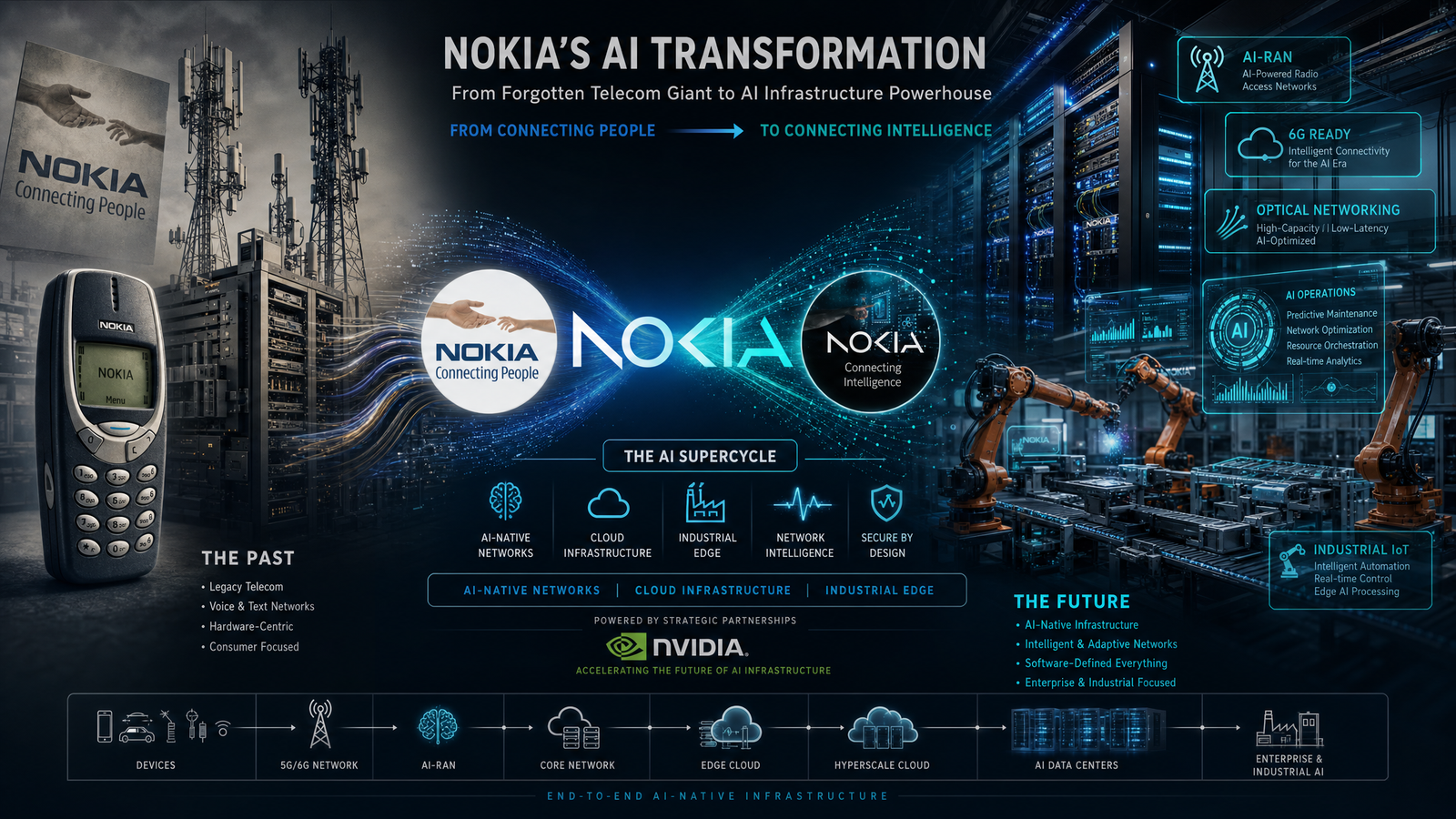
There was a time when Nokia was a punchline. The company that once dominated the mobile phone market — selling more handsets than anyone on the planet — spent years watching rivals eat its lunch while it scrambled to reinvent itself. By the early 2020s, most investors had written it off entirely.

That story is now officially over.
Nokia’s AI transformation has turned the Finnish networking giant into one of Europe’s most talked-about large-cap stocks in 2026. With a stock price that climbed from roughly $6.60 in January to above $16.50 by early June — a gain of more than 150% in under six months — Nokia is no longer a relic. It’s a comeback story the entire tech world is paying attention to.
How Nokia Became an AI Infrastructure Play
Nokia’s AI Transformation

The turning point didn’t happen overnight. It was the product of several years of strategic repositioning, capped by two landmark moves that repositioned Nokia squarely inside the AI infrastructure boom.
The first was the $2.3 billion acquisition of Infinera, a California-based optical networking firm whose technology sits at the heart of the data center interconnects that power AI workloads. The deal closed in February 2025. At the time, it looked like a bold but uncertain bet on optical networking’s future. In hindsight, it looks like one of the smartest strategic calls in European tech in years.
The second move arrived in October 2025: a $1 billion strategic investment from Nvidia, co-designed to develop AI-native mobile networks and 6G infrastructure. When that deal was announced, Nokia’s U.S.-listed shares jumped more than 22% in a single session — their biggest one-day gain in nearly a decade. It wasn’t just the money. The signal was unmistakable: Nvidia, the company that effectively bankrolled the entire generative AI wave, was choosing Nokia as a network infrastructure partner. That endorsement changed how Wall Street looked at the Finnish company.
The Numbers Behind Nokia’s AI Growth

Numbers tell the clearest story. In Q1 2026, Nokia reported 49% growth in net sales from AI and cloud customers year-over-year, with nearly €1 billion in new AI and cloud orders — approximately $1.16 billion — coming primarily from optical networks.
Those aren’t the numbers of a company pivoting to AI in press releases while the real business stays flat. That’s real top-line growth in exactly the segment investors care about most right now.
Nokia also reorganized its business structure at the start of 2026 to reflect its new direction. The company split into two primary segments: Network Infrastructure, positioned to capitalize on the AI and data center build-out, and Mobile Infrastructure, which focuses on AI-native networks and 6G standards. The Network Infrastructure segment — housing Optical Networks, IP Networks, and Fixed Networks — is widely seen as the segment driving the current investor excitement.
To further cement its AI credentials, Nokia opened an AI Networking Innovation Lab in Sunnyvale, California, a dedicated facility for data center networking related to AI training and inference. Partners at the lab include AMD, Keysight, Lenovo, and Supermicro, all working within an open-standards framework. The lab isn’t a marketing move. It’s a physical proof point that Nokia is building the plumbing of AI, not just talking about it.
Why Investors Are Repricing Nokia as an AI Company
Here’s where the story gets complicated — and interesting.
Nokia’s AI Transformation

Despite the genuine revenue growth, Nokia’s AI and cloud business still accounted for just 8% of total sales in Q1 2026. Yet the market has more than doubled the stock’s forward price-to-earnings ratio over the same period, moving from roughly 17x at the start of the year to approximately 36x by late May.
That’s the market making a bet. Investors aren’t paying a premium for what Nokia is today. They’re paying for what Nokia could become: a dominant supplier of the optical and wireless infrastructure that AI-scale computing demands.
The bull case is straightforward. AI data centers require massive, low-latency optical interconnects. Nokia, post-Infinera, is one of a small number of companies that can actually deliver those at scale. As hyperscalers like Amazon, Alphabet, and Microsoft continue their multi-hundred-billion-dollar infrastructure build-outs, Nokia sits in an increasingly favorable supply position.
The question every analyst who has upgraded the stock is trying to answer is whether that 8% of AI revenue becomes 20%, 30%, and eventually the dominant part of Nokia’s revenue base — or whether the multiple re-rating has already priced in growth that the fundamentals will take years to justify.
Nokia’s 6G and AI-Native Network Vision
Nokia’s AI Transformation

Nokia’s AI ambitions extend well beyond today’s data center networking deals. The company has positioned itself as a foundational architect of 6G infrastructure, with the Nvidia partnership specifically targeting AI-native mobile networks — networks designed from the ground up to serve AI applications rather than adapted from earlier generations.
As Nokia’s CEO Justin Hotard has stated, as AI moves toward physical AI, networks need to become AI-native by design for both 5G Advanced and 6G. That’s not a distant aspiration. It’s a roadmap that Nokia is actively funding, staffing, and building today.
The appointment of Emma Falck as President of Mobile Infrastructure, effective September 2026, signals that Nokia is bringing fresh transformation leadership into the division responsible for executing on that 6G-AI vision. Falck arrives from Siemens with a background in automation, software, and connected devices — exactly the operational and technological profile needed to build AI-native mobile infrastructure at scale.
Risks and Realities: What Could Go Wrong
No transformation story is without risk, and Nokia’s is no exception.

The most immediate concern is valuation. A P/E ratio of 36x is aggressive for a company where AI revenues represent a small fraction of the total business. If Nokia’s AI growth decelerates — due to competition from rivals like Ciena, Cisco, or new entrants — the current multiple is difficult to defend.
There’s also execution risk. The Infinera integration is complex. Merging two large, technically sophisticated businesses while simultaneously accelerating growth in a fast-moving market is hard. Nokia has a mixed historical record on large acquisitions, and investors are right to watch integration progress carefully.
Geopolitical risk adds another layer. Nokia operates across markets including China, the United States, and Europe, where telecom infrastructure is increasingly caught in the crossfire of trade and technology policy disputes. Supply chain disruptions or regulatory headwinds could slow delivery timelines even if demand remains strong.
Finally, the 6G timeline is uncertain. While Nokia is positioning itself as a 6G leader, commercial 6G networks are still several years away. Capital committed today to 6G AI-native infrastructure is a long-duration bet that depends on standards, spectrum policy, and operator investment cycles aligning in Nokia’s favor.
What Nokia’s Comeback Means for European Tech
Nokia’s AI Transformation

Beyond the stock chart and the quarterly earnings figures, Nokia’s AI transformation carries a broader significance for European technology.
Europe has long struggled to produce large-scale technology winners that can compete with U.S. and Chinese giants in transformative technology cycles. Nokia’s repositioning — from struggling telecom vendor to credible AI infrastructure player, backed by a partnership with the most powerful company in AI hardware — suggests that legacy European tech companies can navigate structural transitions if they commit to them decisively.
From a mobile phone powerhouse in the 1990s to a networking technology firm, via several reinventions in between, Nokia has lived many corporate lives. This latest reinvention may be its most consequential yet, precisely because the underlying technology wave — AI infrastructure — is so large and so durable.
Nokia’s story is also a reminder that transformation requires strategic patience. The Infinera deal was agreed in 2024. The Nvidia partnership was announced in late 2025. The earnings impact showed up in Q1 2026. The stock reaction came after all three data points were on the table. Investors who saw the full picture early were rewarded. Those who dismissed Nokia as a legacy telecom story missed one of Europe’s biggest tech rallies of the decade.
The Road Ahead: Can Nokia Sustain the Momentum?
Nokia’s AI Transformation

Whether Nokia can maintain its momentum depends on a few critical variables.
First, optical network order intake needs to keep growing. The Q1 2026 figures were strong, but hyperscaler infrastructure spending cycles are notoriously lumpy. A quarter or two of slower orders — even if driven by timing rather than fundamentals — could trigger a sharp pullback in a stock priced for continued acceleration.
Second, Nokia needs to show progress on AI-native mobile network commercialization. The Nvidia partnership must generate visible products, commercial pilots, and eventually revenue — not just innovation lab press releases.
Third, the 6G standards race matters. Nokia’s long-term positioning depends on its ability to shape and win in the 3GPP standards process that will define 6G architecture. That’s a game Nokia has played before and won. But competition is fierce, and the stakes are higher.
For now, the scoreboard is clear. Nokia’s AI transformation has delivered one of Europe’s most dramatic large-cap stock turnarounds of 2026. The harder work — turning 8% of revenue into a majority business — is still ahead.
FAQ: Nokia’s AI Transformation Explained
Q: What is driving Nokia’s AI transformation? Nokia’s transformation is driven by three core moves: the $2.3 billion acquisition of Infinera (optical networking), a $1 billion strategic investment from Nvidia to co-develop AI-native mobile networks, and a deliberate restructuring of the company around AI and data center infrastructure demand.
Q: How much has Nokia’s stock grown in 2026? Nokia’s U.S.-listed shares climbed from approximately $6.60 following January 2026 earnings to above $16.50 by early June 2026, a gain of more than 150% in under six months, making it one of Europe’s best-performing large-cap stocks of the year.
Q: What percentage of Nokia’s revenue comes from AI? As of Q1 2026, AI and cloud customers accounted for approximately 8% of Nokia’s total net sales. However, that segment posted 49% year-over-year growth, with nearly €1 billion in new orders in the quarter alone.
Q: What is Nokia’s role in 6G development? Nokia is positioning itself as a foundational architect of 6G AI-native networks. The Nvidia partnership specifically targets co-development of AI-native mobile infrastructure designed for both 5G Advanced and future 6G deployments, with Nokia’s Mobile Infrastructure segment leading that effort.
Q: Is Nokia a good investment after its 2026 rally? This is not financial advice. Nokia’s valuation has expanded significantly, with the forward P/E ratio more than doubling in 2026. Investors should weigh strong AI revenue growth and strategic partnerships against execution risks, valuation stretch, and the long timeline to 6G commercialization. Consulting a qualified financial advisor is recommended.
Reference –
- Nokia Q1 2026 Financial Results — Nokia Investor Relations
- Nokia Infinera Acquisition Details — Nokia Press Release
- Nokia Nvidia Strategic Partnership — Nvidia Newsroom
- Nokia 2026 Reorganization — SEC Filing, Nokia 6-K, January 2026 — SEC EDGAR
- Nokia AI Networking Innovation Lab — Nokia Network Infrastructure
- Artvoice Analysis: Nokia Stock 140% Rally — Artvoice
- Stocktwits/Nokia AI Pivot Analysis — Stocktwits
- Nokia Emma Falck Leadership Appointment — SEC Filing, Nokia 6-K, June 2026 — SEC EDGAR
AI Image Generated by ChatGPT and lovart.ai
Click this link to read our important and interesting articles as soon as they are published!