When we look at the soaring steel skylines of modern megacities, it is easy to succumb to the illusion of chronological snobbery—the belief that advanced intellect and engineering prowess are exclusively modern traits. Yet, long before the advent of the steam engine, internal combustion, or hydraulic cranes, our ancestors shaped the earth with staggering precision. The pre-industrial engineering marvels scattered across the globe stand as silent testaments to human ingenuity, resilience, and a profound understanding of physics and materials.
From the gravity-defying terraces of the Andes to the sprawling water networks of Rome, ancient architects achieved what modern builders still marvel at today. This article delves into the breathtaking pre-industrial engineering marvels that forged empires, exploring the historical evidence, the materials used, and the sheer willpower required to bend nature to human will without a single drop of diesel.
Rome: The Alchemy of Volcanic Ash and Gravity
If all roads lead to Rome, it is because Roman engineers laid the strongest foundations the world had ever seen. The Roman Empire was not merely built on military conquest; it was cemented through infrastructure. Central to their pre-industrial engineering marvels was the mastery of water management and the invention of revolutionary building materials.
The Secret of Opus Caementicium
Modern concrete is designed to last perhaps 50 to 100 years before requiring significant reinforcement. Yet, the dome of the Pantheon remains perfectly intact nearly two millennia after its construction. The secret lies in opus caementicium—Roman concrete.
Recent material science studies have revealed that the Romans mixed volcanic ash (pozzolana) with lime and seawater. This created a chemical reaction that formed rare minerals like aluminous tobermorite. When seawater breached Roman seawalls, rather than eroding the structure, it dissolved the volcanic ash and caused new minerals to grow, effectively making the concrete stronger over time. This self-healing property is a cornerstone of why so many Roman structures remain the most famous pre-industrial engineering marvels today.
Rivers in the Sky: The Aqueducts

No discussion of ancient ingenuity is complete without the Roman aqueducts. Supplying water to public baths, fountains, and private villas required moving millions of gallons of water across vast distances using nothing but gravity.
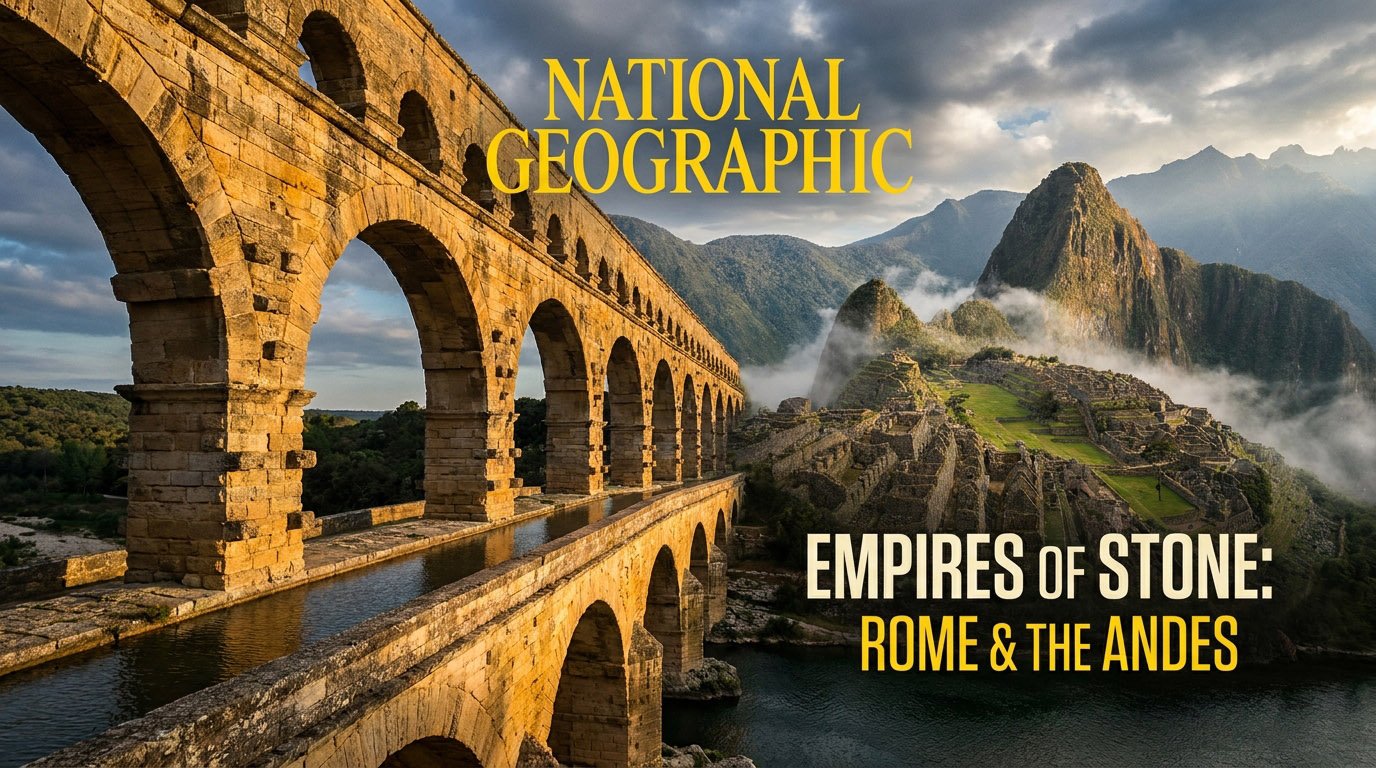
The Pont du Gard in France, built in the 1st century AD, descends a mere 17 meters over its entire 50-kilometer length—a gradient of just 1 in 3,000. Achieving this required surveying instruments like the chorobates (a long wooden beam with water levels) and the groma (used for straight lines and right angles). The sheer precision required to maintain a continuous, exact slope across valleys and mountains makes these water systems some of the most meticulously planned pre-industrial engineering marvels in human history.
(For a deeper dive into how ancient cities sustained themselves, explore our guide on Ancient Urban Agriculture Techniques).
The Incan Empire: Conquering the Vertical World
While the Romans mastered the plains and valleys of Europe, the Incas faced a drastically different challenge: the punishing, vertical terrain of the Andes Mountains. Without the use of the wheel, iron tools, or a written language, the Incas constructed an empire that stretched from modern-day Colombia to Chile. Their ability to manipulate stone and landscape resulted in some of the most baffling pre-industrial engineering marvels ever discovered.
The Qhapaq Ñan (Great Inca Road)

The Qhapaq Ñan was a staggering 30,000-kilometer network of roads traversing some of the most hostile terrain on Earth. Because the Incas relied on llamas and human runners (chasquis) rather than wheeled carts, their roads didn’t need to be flat; they needed to be efficient.
Engineers carved steep staircases into mountainsides, built retaining walls to prevent landslides, and constructed floating bridges over marshes. Perhaps the most daring of their pre-industrial engineering marvels were the suspension bridges made entirely of woven ichu grass. The Q’eswachaka bridge, spanning the Apurimac River, is the last remaining bridge of its kind, and the local communities still rebuild it annually using the exact techniques passed down over 600 years.
Ashlar Masonry: Stones That Dance with Earthquakes

At sites like Machu Picchu and the fortress of Sacsayhuamán, the Incas utilized a dry-stone technique known as ashlar masonry. Massive granite blocks, some weighing over 100 tons, were cut and fitted together so perfectly that a piece of paper cannot slide between them.
Because Peru is highly seismically active, mortar would have cracked and crumbled during an earthquake. Instead, the Incan stones were designed to “dance.” When tremblers strike, the precisely cut stones bounce and resettle perfectly into their original positions. This brilliant adaptation to environmental hazards makes Incan architecture a crowning jewel among pre-industrial engineering marvels.
Ancient China: Reshaping the Earth’s Geography
The engineering philosophy of ancient China was defined by its breathtaking scale. If the state needed a mountain moved or a river redirected, the state commanded the labor of millions to make it happen. The resulting structures are among the largest pre-industrial engineering marvels visible from low-Earth orbit.
The Grand Canal

While the Great Wall often steals the spotlight, the Grand Canal is arguably the more impressive feat of utilitarian engineering. Connecting the Yellow River in the north to the Yangtze River in the south, it is the longest artificial river in the world, stretching roughly 1,776 kilometers.
Initiated during the Sui Dynasty (581–618 AD), the canal required millions of conscripted laborers. The engineers had to overcome drastic elevation changes between the river systems. To solve this, the Chinese invented the pound lock in the 10th century—a system of gates that allowed boats to be raised and lowered safely in water-filled chambers. This invention predated European lock systems by centuries and solidifies the canal’s status among the greatest pre-industrial engineering marvels.
According to UNESCO’s World Heritage documentation, the Grand Canal formed the backbone of the empire’s inland communication system, enabling the transport of millions of tons of grain to feed the capital and its armies.
India: The Subterranean Palaces of Water
In the arid regions of Rajasthan and Gujarat in India, the challenge was not redirecting rivers, but capturing every precious drop of monsoon rain to survive the blistering dry seasons. The solution gave birth to a unique architectural form that blended religious devotion with hydraulic engineering.
The Stepwells (Baoris and Vavs)

Indian stepwells are subterranean water-harvesting systems that look like inverted pyramids plunging deep into the earth. The Chand Baori in Rajasthan, built over 1,000 years ago, drops 13 stories (30 meters) into the ground, featuring 3,500 perfectly symmetrical, narrow steps.
These structures were not merely wells; they were highly sophisticated pre-industrial engineering marvels designed as climate-controlled communal spaces. The ambient temperature at the bottom of a stepwell is reliably 5 to 6 degrees cooler than at the surface. During brutal summer months, they served as gathering places for communities. By turning a basic survival necessity into a structurally complex, artistically magnificent civic center, ancient Indian architects created pre-industrial engineering marvels that beautifully married form and function.
The Legacy of the Master Builders

Modern engineering relies heavily on computer-aided design (CAD) software, heavy machinery, and standardized synthetic materials. Yet, when we study the pre-industrial engineering marvels of the Romans, Incas, Chinese, and Indians, we find a different kind of sophistication. Their genius lay in profound observational science—an intimate understanding of the tension of grass, the chemical reactivity of volcanic dirt, and the flow of gravity.
These structures were built to outlast empires. They are physical manifestations of human ambition, proving that with enough time, labor, and brilliance, humanity can conquer any landscape. As we face modern challenges of sustainable building and climate adaptation, there is much we can learn from looking back at these timeless pre-industrial engineering marvels.
Frequently Asked Questions (FAQ)
1. How did ancient empires move massive stones without heavy machinery? Most pre-industrial societies relied on the mechanical advantage of simple machines—levers, pulleys, inclined planes, and rollers. Combined with an immense, highly organized workforce (often consisting of thousands of laborers), they could slowly maneuver stones weighing dozens of tons into place.
2. Why do many pre-industrial engineering marvels outlast modern buildings? Ancient builders often over-engineered their structures because they lacked modern mathematical stress tests. Furthermore, they utilized locally sourced, highly durable natural materials (like granite, basalt, and self-healing Roman concrete) rather than modern reinforced steel concrete, which can rust and degrade over a few decades.
3. What is considered the greatest of all pre-industrial engineering marvels? While highly subjective, many structural engineers point to the Great Pyramid of Giza for its mathematical precision, the Roman aqueducts for their vast scale and public utility, and the Incan road system for overcoming some of the planet’s harshest geography without the use of wheels.
4. Did these ancient empires share engineering knowledge with one another? For the most part, no. The Romans, Incas, and Chinese developed their monumental pre-industrial engineering marvels entirely independently of one another, isolated by vast geography and time periods. This makes their parallel discoveries of arches, masonry, and hydro-engineering all the more fascinating.