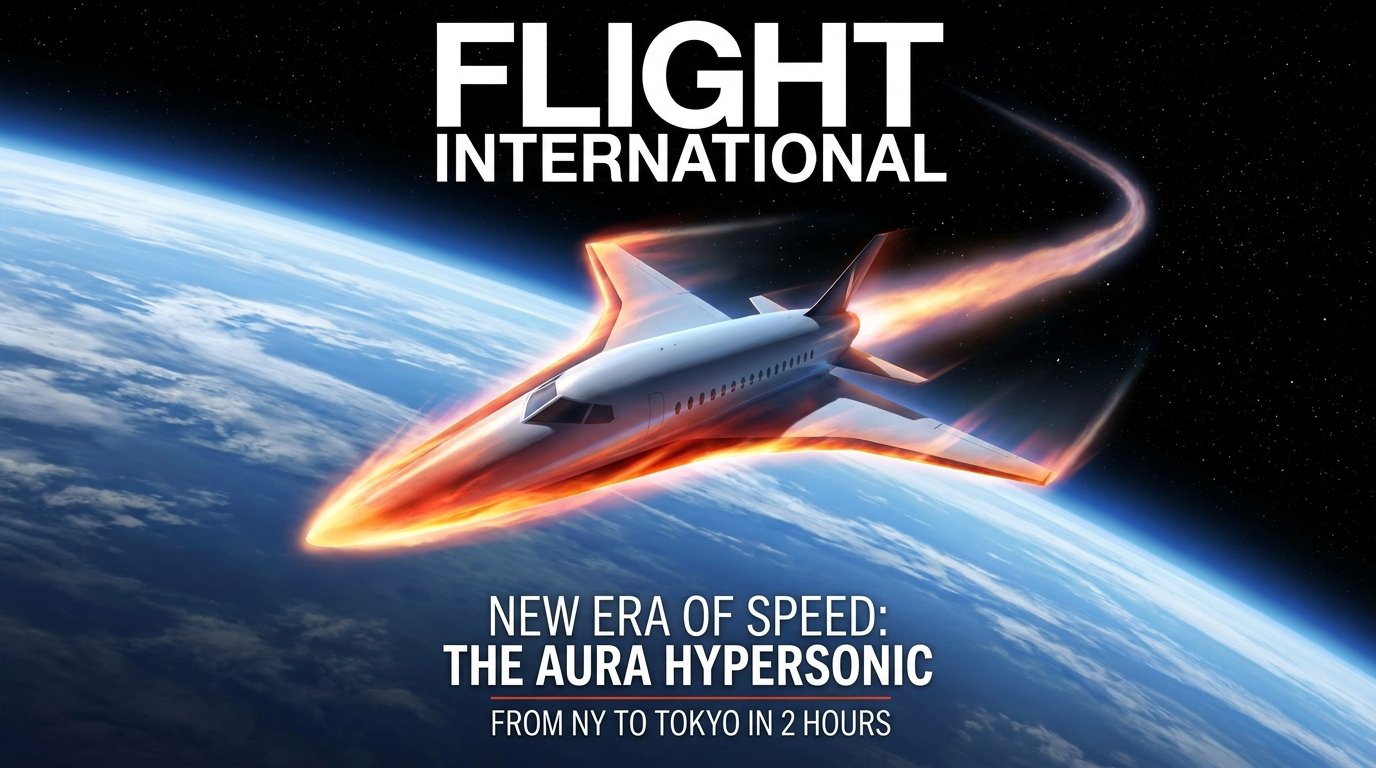
For decades, the holy grail of aviation has been speed. From the moment the Wright brothers first achieved powered flight, humanity has been in a relentless race to fly higher and faster. We conquered the sound barrier in 1947, and decades later, the iconic Concorde gave civilians a taste of supersonic travel. But today, the aerospace industry is looking past the supersonic realm and gazing into an entirely new frontier. We are entering the era of Mach 5 and beyond.
Welcome to the mind-bending, physics-defying world of hypersonic aerodynamics.
When an object travels at five times the speed of sound (approximately 3,800 mph or 6,100 km/h), the very air it flies through stops behaving like a normal gas. At these extreme velocities, the air molecules simply cannot move out of the way fast enough. They are violently compressed, superheated, and chemically ripped apart. Engineering a vehicle to survive and maneuver in this environment is one of the most formidable challenges in modern science. In this comprehensive guide, we will explore the science, the evidence, and the exciting future of hypersonic flight.
What Exactly is Hypersonic Aerodynamics?

In standard aviation, aerodynamicists study how air flows gracefully over a wing to create lift. But hypersonic aerodynamics is less about fluid grace and more about brute-force physics.
The boundary of “hypersonic” flight is generally defined as Mach 5, but it isn’t a magical line where physics suddenly flips a switch. Instead, it represents a transition zone where certain physical phenomena—which are negligible at lower speeds—become the dominant forces acting on the aircraft.
At Mach 5, the kinetic energy of the speeding aircraft is converted into immense thermal energy. The air doesn’t just get hot; it changes its chemical state. Oxygen and nitrogen molecules in the atmosphere begin to dissociate (break apart into individual atoms), and electrons are stripped away, creating a field of electrically charged plasma. Therefore, mastering hypersonic aerodynamics requires a deep understanding of not just traditional fluid dynamics, but also thermodynamics, chemistry, and electromagnetism.
The Thermal Barrier: Surviving the Inferno

The most immediate enemy of any hypersonic vehicle is heat. When a passenger jet flies at 600 mph, the friction warms the skin of the aircraft slightly. But when a vehicle crosses the Mach 5 threshold, it hits what engineers call the “thermal barrier.”
Contrary to popular belief, the majority of this heat isn’t caused by the friction of air rubbing against the hull. It is caused by shockwave compression. The vehicle is moving so incredibly fast that the air in front of it is squeezed into a fraction of its normal volume. Compressing a gas violently raises its temperature. At Mach 5, the leading edges of an aircraft can easily reach temperatures exceeding 2,000°F (1,100°C). At Mach 10, those temperatures can surpass the surface temperature of the sun.
Standard aerospace materials like aluminum and titanium would melt and vaporize in seconds. To combat this, hypersonic aerodynamics leans heavily on advanced material science. Engineers utilize Ultra-High-Temperature Ceramics (UHTCs) and carbon-carbon composites. In many experimental vehicles, active cooling systems are employed. In these systems, the vehicle’s own cryogenic fuel is pumped through veins in the outer hull to absorb the heat before it is injected into the engine to be burned.
Breathing Fire: The Scramjet Revolution

Rockets have been flying at hypersonic speeds for decades, but rockets must carry heavy tanks of liquid oxygen to burn their fuel. To make sustained hypersonic flight viable for airplanes, we need air-breathing engines. Enter the Scramjet (Supersonic Combusting Ramjet).
In a normal jet engine, rotating turbine blades compress incoming air before fuel is added and ignited. But at Mach 5, moving parts would shatter or melt. A scramjet relies entirely on the forward motion of the aircraft to compress the air. The internal geometry of the engine acts as a funnel, squeezing the hypersonic airflow until it is highly pressurized.
The challenge of hypersonic aerodynamics here is monumental. Because the air is moving through the engine at supersonic speeds, injecting fuel and keeping it lit is famously described by engineers as “trying to keep a match lit in a hurricane.” The fuel must mix and burn in milliseconds before being blown out the exhaust. Hydrogen and highly specialized hydrocarbon fuels are the only viable options to react quickly enough to provide thrust.
The Plasma Problem: Flying Blind

Another bizarre hurdle in hypersonic aerodynamics is the plasma sheath. As the extreme heat breaks down air molecules into charged ions and electrons, the vehicle becomes wrapped in a bubble of plasma.
Plasma is highly conductive, and it possesses a frustrating side effect: it absorbs and reflects radio frequencies. This leads to a “communications blackout.” Historically, NASA astronauts experienced this during the Apollo reentry phase, suffering minutes of terrifying radio silence. For modern hypersonic gliders and missiles, losing telemetry and GPS targeting data mid-flight is unacceptable.
Recent research into hypersonic aerodynamics involves using powerful magnetic fields to part the plasma sheath, or relying on ultra-high-frequency optical communication (lasers) that can penetrate the ionized field, ensuring the vehicle doesn’t fly blind.
Current Evidence and Future 2026 Breakthroughs

While the math behind hypersonic aerodynamics has existed since the Cold War, real-world testing has historically resulted in spectacular failures. Materials simply weren’t ready. However, the 2020s have seen an explosive renaissance in research and development.
Military applications have driven much of the funding. The US, China, and Russia have all demonstrated working Hypersonic Glide Vehicles (HGVs). Unlike ballistic missiles that follow a predictable arc into space, HGVs use the principles of hypersonic aerodynamics to surf the upper atmosphere, maneuvering unpredictably to evade radar and interceptors.
On the civilian side, programs like the NASA X-43 and Boeing X-51 Waverider proved that scramjet engines could generate positive thrust in flight. As of 2026, researchers are utilizing advanced Artificial Intelligence to run trillions of fluid dynamic simulations, effectively solving the scramjet combustion problem in virtual wind tunnels before ever building a prototype.
For a deeper dive into how AI is accelerating these engineering marvels, you can explore the advanced aerospace AI applications guide on wikimess.com, an expanding resource for the evolving digital and scientific landscape. By bridging AI with fluid dynamics, scientists are shaving decades off the R&D timeline.
Future R&D: When Can I Buy a Ticket?

The ultimate dream of hypersonic aerodynamics isn’t just defense—it is revolutionizing global transit. Imagine boarding a spaceplane in New York and touching down in Tokyo just two hours later.
Startups like Hermeus and Stratolaunch are aggressively working toward commercializing hypersonic technology. However, several massive hurdles remain for civilian R&D:
- The Sonic Boom: Hypersonic vehicles create devastating sonic booms. R&D must focus on aerodynamic shaping to soften the shockwaves so these jets can legally fly over populated landmasses. (For context on how NASA is currently tackling supersonic booms, check out NASA’s Quesst Mission).
- Passenger Safety: Enduring the G-forces of acceleration and the intense thermal environment requires failsafe life-support systems.
- Sustainable Fuels: Scramjets burn fuel at an astonishing rate. For commercial viability, engineers must develop green hydrogen infrastructure to ensure this high-speed future doesn’t come at a catastrophic cost to the climate.
Conclusion
Hypersonic aerodynamics represents the pinnacle of modern engineering. It is a discipline where air becomes plasma, where metal wants to turn to liquid, and where engines must breathe fire in a hurricane. By pushing the boundaries of what materials and computers can achieve, scientists aren’t just designing faster airplanes; they are actively rewriting the limits of human possibility. The leap from Mach 1 to Mach 5 will change our world just as profoundly as the transition from the horse to the jet engine.
Frequently Asked Questions (FAQ)
Q: What is the difference between supersonic and hypersonic? A: Supersonic refers to any speed faster than the speed of sound (Mach 1 to Mach 4.9). Hypersonic aerodynamics specifically deals with speeds of Mach 5 and above, where the physical and chemical properties of the air fundamentally change due to extreme heat and compression.
Q: How hot does an aircraft get at Mach 5? A: Depending on the altitude and exact speed, the leading edges of an aircraft can experience temperatures between 2,000°F and 3,500°F. The core study of hypersonic aerodynamics is finding ways to manage and survive this intense thermal load.
Q: Why don’t hypersonic planes use normal jet engines? A: Normal jet engines use fan blades to compress air. At Mach 5, the air is moving too fast; it would destroy the moving blades. Hypersonic aerodynamics relies on Scramjets, which use the vehicle’s sheer speed and internal shape to compress the air without moving parts.
Q: When will civilian hypersonic flights be available? A: While military applications are active now, passenger travel is still in the R&D phase. Most industry experts predict that small VIP commercial hypersonic flights could be viable by the late 2030s, provided the challenges of sonic booms and fuel efficiency are resolved.
Click this link to read our important and interesting Technology articles as soon as they are published!