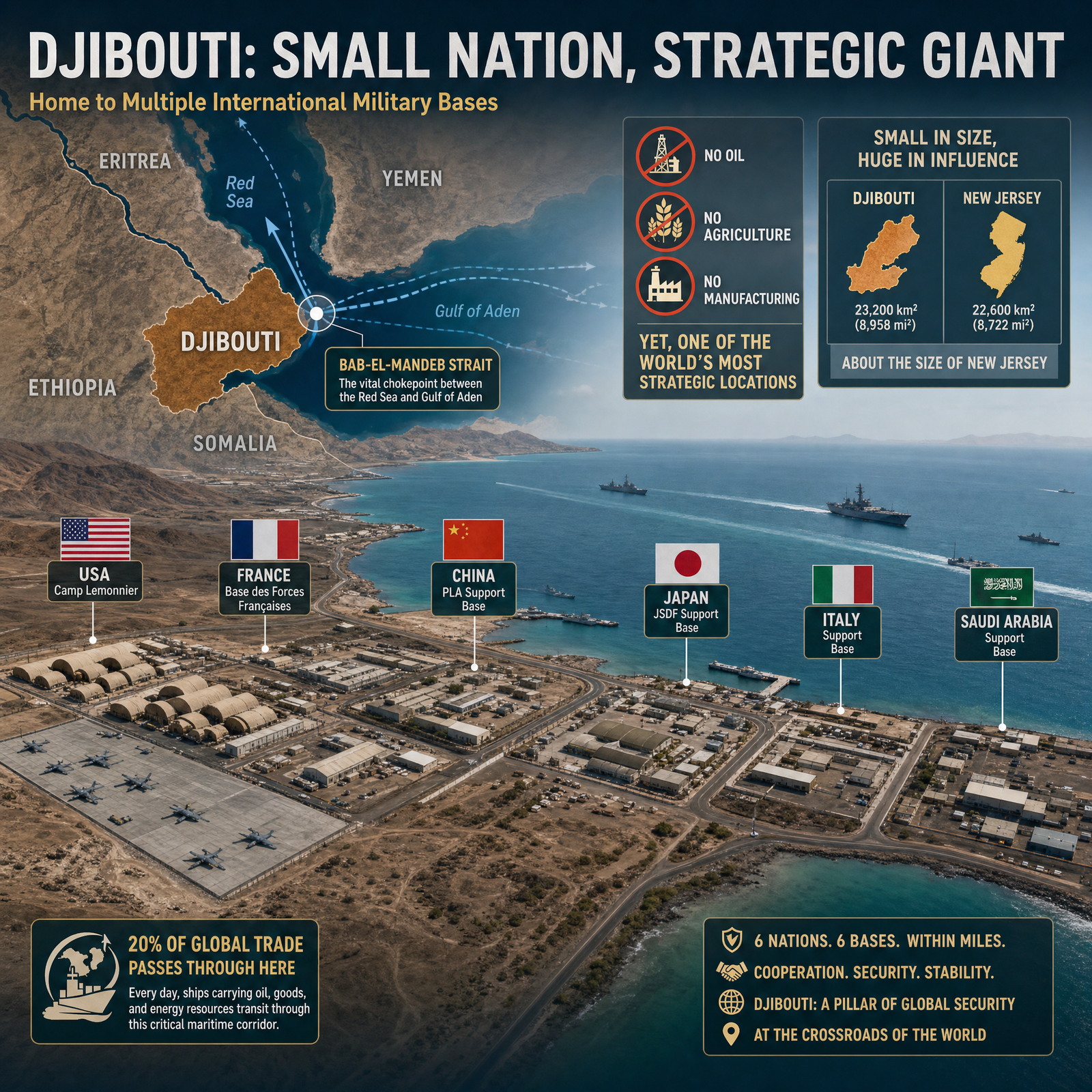
Djibouti is a country smaller than the state of New Jersey. It has no oil. No large agricultural land. No major manufacturing industry. Yet it hosts the military bases of the United States, France, China, Japan, Italy, and Saudi Arabia — all at the same time, on the same coastline, within miles of each other. No other country on Earth can make that claim.
This is not an accident. This is geography as destiny.
Right now, as the world watches the 2026 Iran–Israel–USA war reshaping global trade routes, Djibouti has become more critically important than at any point in its modern history. Understanding why requires going back to the beginning.
What Is Djibouti? A Nation Built on Location.

Djibouti is a small republic in the Horn of Africa, bordering Eritrea to the north, Ethiopia to the west and southwest, Somalia to the south, and the Gulf of Aden to the east. Its total area is approximately 23,200 square kilometres, and its population is just over one million people.
The capital, Djibouti City, sits at the entrance to the Bab-el-Mandeb Strait — the Arabic name meaning “Gate of Tears.” This narrow corridor, barely 30 kilometres wide at its tightest point, connects the Red Sea to the Gulf of Aden. Every ship travelling between Europe and Asia through the Suez Canal must pass through it.
The Numbers That Explain Everything

Djibouti commands the Bab-el-Mandeb Strait — a chokepoint through which roughly 10% of global seaborne trade passes daily. Other estimates put this figure even higher. At least 90% of Europe–Asia internet capacity runs through fibre-optic cables laid along the same undersea route. SubstackAl Jazeera
Normally, 22% of EU imports pass through the Red Sea and the Suez Canal. For Asia, the percentage is far higher. This single corridor connects the energy markets of the Persian Gulf with the consumer markets of Europe and East Asia. Block it, and the global economy bleeds. EEAS
Djibouti’s History From Colonial Outpost to Global Military Hub
French Colonisation and the Suez Effect (1862–1977)

The boundaries of the present-day Djibouti state were established as the first French establishment in the Horn of Africa during the Scramble for Africa. The March 11, 1862, agreement with the Afar sultan sold lands surrounding Obock to France. The French were interested in having a coaling station for steamships, which would become especially important upon the opening of the Suez Canal in 1869. Wikipedia
The Suez Canal’s opening instantly transformed the Bab-el-Mandeb from a regional waterway into one of the most critical maritime passages on Earth. France recognised this immediately. It expanded its territorial claims throughout the late 19th century, signing further treaties with the Issa Somali sultans in 1885, creating what became French Somaliland, then the French Territory of the Afars and Issas.
Independence, French Defence Treaty, and the Base Economy

Djibouti gained full independence on June 27, 1977. But France did not leave. The African country gained independence from France in 1977 and signed a mutual defence treaty with it in 2011, under which the Forces Françaises Stationnées à Djibouti (FFDj) are deployed in various strategic sites, including the Djibouti-Ambouli International Airport, the Chabelley military airport, and the Héron naval base. Med-Or
President Ismail Omar Guelleh — who has governed since 1999 — turned this legacy military relationship into a deliberate national strategy. His famous phrase: “Our geography is our oil.”
The Defence Alliance Structure — Who Has Military Bases in Djibouti and Why

The US has the largest foreign military contingent in Djibouti with Camp Lemonnier — the sole permanent American base in Africa — hosting some 4,000 personnel. The second-largest foreign military presence is that of France, with about 1,900 troops. Japan has about 600 members of its Maritime Self-Defense Force. China and Saudi Arabia have also established military facilities. The Interpreter
United States — Camp Lemonnier
The US took over Camp Lemonnier from France in 2002, in the aftermath of the September 11 attacks. It became the primary hub for US counterterrorism operations across East Africa and the Arabian Peninsula. Today, it serves as the critical forward base for US Naval Forces Central Command operations across the Red Sea region.
China’s First Overseas Military Base
In 2017, China opened its first-ever overseas military base in Djibouti. China, which built its first overseas military base in Djibouti in 2017, also struck a $3 billion investment agreement with Djibouti in December 2020 through China Merchant Group for expansion of Djibouti’s port infrastructure. African Arguments
China’s trade with the EU amounts to US$1 billion daily, most of which is seaborne and must use the Gulf of Aden–Suez Canal route. Protecting that sea lane is an existential economic interest for Beijing. The Interpreter
Japan, Italy, and Saudi Arabia
One-fifth of Japan’s vehicle exports and roughly 1,800 Japan-linked commercial vessels traverse the Bab-el-Mandeb annually. Japan’s base is dedicated to maritime patrol and anti-piracy operations. Italy maintains the military support base “Amedeo Guillet,” established in 2012. Saudi Arabia has established a logistics hub tied to its military campaign in Yemen against Houthi forces.
France’s Renewed Commitment in 2024
French President Emmanuel Macron recently described Djibouti as sitting at the “heart” of France’s Indo-Pacific strategy. France has a mutual defence pact with Djibouti which was renewed in 2024. Al Jazeera
The Red Sea Defence Alliance — Operation Prosperity Guardian and Operation Aspides

The Houthi attacks on Red Sea shipping that began in November 2023 created the conditions for the first formal multinational defense coalitions specifically protecting this corridor since World War II.
Operation Prosperity Guardian — led by the United States under the Combined Maritime Forces — brought together naval assets from the UK, Bahrain, Canada, France, Italy, the Netherlands, Norway, and others. Djibouti served as the primary logistics and refuelling hub.
Operation Aspides — the European Union’s independent maritime security mission — launched in February 2024. Six EU Member States deployed frigates to the region, and 15 EU Member States contributed personnel to the headquarters. The operation was launched in record time — its principle was approved at the end of December 2023 and it began operations in February 2024. EEAS
Countries in the Red Sea Defence Coalition

The nations that formally participated in Red Sea maritime defence operations include: the United States, United Kingdom, France, Italy, Germany, Greece, Netherlands, Norway, Canada, Bahrain, Spain, Denmark, Belgium, New Zealand, and Australia. Djibouti itself did not deploy naval vessels but provided the land infrastructure without which none of these operations could be sustained.
According to UNCTAD’s Review of Maritime Transport 2025, tonnage through the Suez Canal was still 70% below 2023 levels as of May 2025 due to Houthi disruptions. Al Jazeera
The 2026 Iran–Israel–USA War and What It Means for
Djibouti and the Red Sea
How the War Started — A Timeline of Escalation

The current conflict has roots stretching back years. After the Middle Eastern crisis began in 2023, Iran and Israel exchanged missile strikes in 2024, and again during the Twelve-Day War in June 2025, which resulted in US airstrikes on Iranian nuclear sites. Wikipedia
In January 2026, Iranian security forces massacred thousands of civilians during a crackdown on the largest Iranian protests since 1979. US President Donald Trump responded by threatening military action and launching the largest US military buildup in the region since the 2003 invasion of Iraq. Wikipedia
On February 28, 2026, the US and Israel launched “Operation Epic Fury” — joint airstrikes on Iran targeting its presidential compound, nuclear facilities, and missile bases. Iranian Supreme Leader Ali Khamenei was killed in the attacks.
Iran’s Response — Closing the Strait of Hormuz

Shipping traffic through the Strait of Hormuz has been largely blocked by Iran since February 28, 2026. In retaliation, Iran launched missile and drone attacks on Israel, US military bases, and US-allied Gulf states. The Iranian Revolutionary Guard Corps issued warnings forbidding passage through the strait, boarded and attacked merchant ships, and laid sea mines in the strait. Wikipedia
Iranian attacks also targeted oil infrastructure in the region — including vessels in the Strait of Hormuz, through which 20% of the world’s oil passes — as well as commercial hubs in neighbouring countries that aid the US military. Encyclopedia Britannica
The Houthis Reopen the Bab-el-Mandeb Front

By late March, officials in the IRGC suggested Iran may push its Houthi allies in Yemen to block the Bab-el-Mandeb Strait to disrupt Red Sea shipping and further strain global markets. On March 28, the Houthis launched missiles and drones toward Israel and opened a new front in the expanding regional conflict. Encyclopedia Britannica
This created a catastrophic double blockade: the Strait of Hormuz controlled by Iran to the east, and the Bab-el-Mandeb threatened by the Houthis to the west. Global shipping had no viable alternative except the Cape of Good Hope route around the southern tip of Africa — adding weeks to every voyage.
Countries Hit by Iranian Retaliatory Strikes
Iran launched hundreds of drones and ballistic missiles at Israel, US military bases, and neighbouring Arab countries including Bahrain, Jordan, Kuwait, Oman, Qatar, Saudi Arabia, and the United Arab Emirates, as well as Iraq’s Kurdistan. Wikipedia
Iranian retaliatory strikes targeted US facilities, energy infrastructure — including oil fields and processing sites — as well as ports, airports, and residential areas. The United Arab Emirates was the most heavily targeted country. Kuwait recorded the highest number of casualties. ACLED
The Economic Shock

Brent crude oil prices surpassed US$100 per barrel on March 8 for the first time in four years, rising to US$126 per barrel at peak. The largest-ever monthly increase in oil prices occurred in March 2026. The closure of the strait became the largest disruption to world energy supply since the 1970s energy crisis. Wikipedia
The Red Sea–Suez Canal route became paralyzed following renewed Houthi attacks on commercial vessels, while the Strait of Hormuz effectively ceased operations due to Iran’s blockade. Major shipping companies including Hapag-Lloyd and Maersk suspended vessel transits through the Strait. TRENDS Research & Advisory
A two-week ceasefire between the US and Iran was declared on April 8, 2026, though the situation remains volatile.
Djibouti’s Future — More Indispensable Than Ever
Why Djibouti Benefits From Instability

Counterintuitively, the 2026 crisis has made Djibouti’s position stronger, not weaker. “In some ways, Djibouti is even more indispensable in this moment than it was when shipping, trade, and geopolitics was going as normal,” said Jatin Dua, who specialises in East African security and logistics at the University of Michigan. “There is a recognition that they are a safe haven in what is something of an unstable neighbourhood.” Al Jazeera
Every major military coalition operating in the Red Sea depends on Djibouti’s ports, airports, and logistics infrastructure. As long as the Bab-el-Mandeb remains contested, Djibouti remains the irreplaceable land anchor for whoever seeks to control or protect it.
The China-US Rivalry Playing Out on Djiboutian Soil

The fact that the US’s Camp Lemonnier and China’s People’s Liberation Army Support Base sit miles apart on the same Djiboutian coastline is the single most vivid symbol of 21st-century great power competition. Djibouti has managed — so far — to maintain diplomatic relationships with both simultaneously. How long that balancing act can continue under the pressure of a US–China strategic rivalry that is intensifying by the year is one of the central geopolitical questions of the next decade.
What Happens Next

If the Iran–USA–Israel conflict escalates further, the Bab-el-Mandeb becomes a full war zone. Djibouti’s position changes from a logistics hub to an active frontline. The military bases already there become primary targets. The Houthis have warned that the closure of the Bab-el-Mandeb was “likely” if the conflict against Iran and Lebanon escalated sharply, or if Gulf Arab states joined the war. Wikipedia
If a durable ceasefire holds, Djibouti returns to its profitable peacetime role: extracting rent from the world’s most powerful militaries while building port infrastructure with Chinese investment and maintaining French and American defence guarantees.
Either way, Djibouti wins the geography lottery. The question is whether geography alone is enough to survive what comes next.
Key Takeaways

Djibouti is not a footnote in Middle East geopolitics. It is a load-bearing pillar. Its location at the Bab-el-Mandeb, its portfolio of foreign military bases, and its positioning between the 2026 war’s two main choke points — the Strait of Hormuz and the Red Sea — make it the single most strategically watched piece of real estate on Earth right now.
History made Djibouti what it is. The French came for a coal station. The Americans came for counterterrorism. The Chinese came for trade protection. The Japanese came for their shipping lanes. All of them stayed because the geography never changes.
Explore our full coverage of the 2026 Red Sea Crisis, Middle East conflict analysis, and global trade disruption reporting in our History and Tech sections.
Reference – Aljazeera.com
lowyinstitute.org
acleddata.com
britannica.com
en.wikipedia.org
murrayhunter.substack.com
eeas.europa.eu
AI Image Generated by Grok.com, Chatgpt and lovart.ai
Click this link to read our important and interesting articles as soon as they are published!