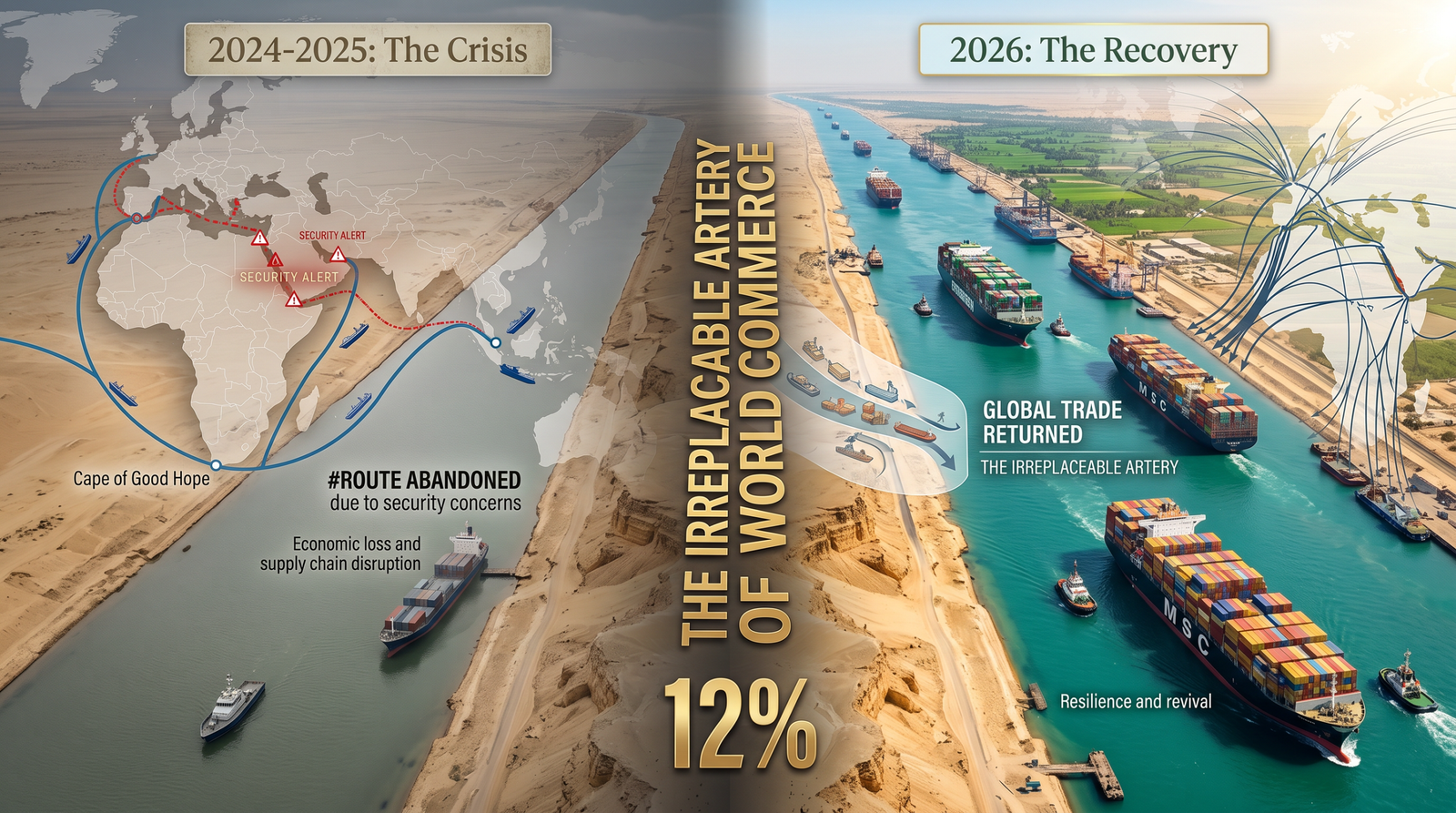
The Suez Canal is one of humanity’s greatest engineering achievements — a 120-mile corridor connecting the Red Sea and the Mediterranean that moves roughly 12% of all global trade. Yet for much of 2024 and 2025, this irreplaceable artery was almost entirely abandoned, as Houthi attacks in the Red Sea sent shipping giants racing toward a far longer, far costlier alternative. Now, in 2026, the canal is fighting to reclaim its place at the center of world commerce — and the stakes could not be higher.
Understanding the Suez Canal means understanding how the modern world moves.
What Is the Suez Canal — and Why Was It Built?

The Suez Canal is a man-made waterway in northeastern Egypt, stretching approximately 193 kilometers (120 miles) from Port Said on the Mediterranean Sea to the port city of Suez on the Red Sea. It passes through the Isthmus of Suez, the narrow strip of land separating Africa from the Sinai Peninsula.
Before it existed, ships traveling between Europe and Asia had no choice but to sail around the entire African continent — a journey that added weeks to transit times and enormous cost to trade. The idea of a shortcut through Egypt was ancient; pharaonic engineers explored it as early as 600 BCE. But it took 19th-century ambition to make it real.
Construction began in 1859 under the direction of French diplomat Ferdinand de Lesseps and the Egyptian government. The work took ten years, relied on a labor force that peaked at 30,000 workers, and was completed in 1869. When it opened, it fundamentally reorganized global shipping, slashing the Europe-to-Asia sea route by roughly 7,000 kilometers.
How the Canal Changed Borders Between Continents

Geographically, the Suez Canal serves as the accepted boundary between the African continent and Asia. On one side lies Egypt’s mainland Africa; on the other, the Sinai Peninsula, classified as part of Asia. The canal’s southern entrance opens into the Red Sea — the narrow waterway bordered by Africa to the west and the Arabian Peninsula (including Saudi Arabia and Yemen) to the east. Its northern terminus flows into the Mediterranean, where ships enter waters bordered by Turkey, Greece, Italy, and North Africa.
This positioning makes the Suez Canal the single most efficient maritime bridge between East and West on the planet.
The Canal’s Extraordinary Economic Importance

Few infrastructure projects in history rival the Suez Canal’s economic weight. At its peak, the waterway handled approximately 19,000 vessel transits per year — about 52 ships per day. According to the Suez Canal Authority (SCA), the canal generated a record $9.4 billion in revenue for Egypt in the 2022–23 fiscal year.
For the global economy, those numbers translate into something far larger. Roughly 12 to 15 percent of all world trade passes through the canal, including 30% of global container traffic. Oil tankers, liquefied natural gas (LNG) carriers, bulk cargo ships, and consumer goods vessels all use it as their primary East–West highway. Delay or disruption in the Suez Canal ripples through supply chains across every continent.
What the Canal Means for Egypt’s Economy

For Egypt, the Suez Canal is a sovereign economic lifeline. Canal tolls represent one of the country’s top three sources of foreign currency revenue, alongside tourism and remittances from Egyptians working abroad. When transit volumes drop, Egypt’s fiscal situation tightens quickly — a fact that has made the Houthi crisis of 2024–2025 especially painful for Cairo.
Suez Canal Authority Chairperson Osama Rabie has stated he hopes traffic will normalize by the second half of 2026, signaling the urgency of recovery for Egypt’s economy.
The Red Sea Crisis — How Houthi Attacks Shut Down the Canal
The Suez Canal’s relevance crashed into global headlines in late 2023, when Houthi militants based in Yemen began launching drone and missile attacks on commercial shipping in the Red Sea, targeting vessels with any perceived link to Israel amid the Israel-Hamas conflict.
Throughout 2024, the Red Sea emerged as a high-risk zone for global shipping due to intensified Houthi attacks. These incidents forced major shipping lines to reroute their operations, leading to significant adjustments across the logistics industry.

The impact was swift and severe. Container lines rerouted around South Africa primarily due to safety concerns and sharply increased insurance premiums. The alternative route added 10–15 days to transit times, and to keep weekly sailings intact, carriers had to deploy two additional vessels per service, significantly increasing operating costs and tightening global vessel capacity. Bertling Container shipping was hit hardest: fourth-quarter 2025 transits were down 86% compared with 2023. Nearly all containerships avoided the canal since the crisis began.
The economic consequences were immediate and global. Freight rates on key Asia–Europe lanes surged. European manufacturers faced component shortages. Consumers paid more for electronics, clothing, and food. The 120-mile shortcut that the world had taken for granted became a ghost route almost overnight.
The Cape of Good Hope Detour — and Its Hidden Costs

With the Suez Canal effectively off-limits to container shipping, the Cape of Good Hope route became the new normal for major carriers. The detour adds roughly 3,500 nautical miles and burns significantly more fuel per voyage. One estimate put the additional fuel cost per trip at $1 million or more for large container vessels.
Beyond fuel, the longer routes consumed vessel capacity. Ships that would have completed three round-trips in a year could now only complete two. That vessel shortage pushed up freight prices globally, contributing to a secondary wave of inflation in 2024 that caught central banks off guard.
The 2025–2026 Comeback — Major Carriers Begin Returning

Containership traffic through the Suez Canal is finally inching higher. In the week ending January 11, 2026, 26 containerships transited the canal — the highest weekly total in more than a month, according to Drewry’s Red Sea Diversion Tracker.
The cautious return is being led by shipping giants. CMA CGM’s transit of the LNG-powered vessel Jacques Saade — 400 meters long with a 23,000 TEU capacity — was described by the Suez Canal Authority as signaling the “full return” of the French shipping group’s vessels to the canal. Maersk’s vessel Sebarok also transited through the southern convoy.
Japan has also committed to the canal’s safety and future, securing a $22 million grant through the Japan International Cooperation Agency (JICA) to finance the construction of a dual-fuel diving support vessel for the Suez Canal Authority fleet — enhancing navigational safety as more shipping lines return.
Can the Canal Fully Recover by 2026?

The recovery is real — but fragile. Despite the return of some carriers, traffic through the Suez Canal in the first week of 2026 remained 60% below the corresponding week in 2023.
Security concerns haven’t fully evaporated. Shipping firms are proceeding ship by ship, convoy by convoy, assessing each transit as a live security test. While geopolitical conditions are shifting and carriers are reassessing risk, a gradual return to Suez is increasingly likely in 2026 — but more traffic through Suez doesn’t automatically mean smoother logistics. It may create new challenges, especially at ports.
If traffic normalizes, the effects will be broadly deflationary — lower freight costs, faster delivery times, and relief for manufacturers and consumers alike.
The Suez Canal’s Place in History — From Crisis to Crisis

The 2023–2025 disruption was not the first time the Suez Canal faced existential threat. In 1956, Egyptian President Gamal Abdel Nasser nationalized the canal, triggering the Suez Crisis — a military intervention by Britain, France, and Israel that ultimately ended under U.S. and Soviet pressure, marking the effective end of British imperial power. The canal was fully closed between 1967 and 1975 following the Six-Day War, during which the Egyptian navy deliberately sank vessels to block it.
Each crisis has underlined the same truth: whoever controls the Suez Canal controls a lever of the global economy.
The 2021 Ever Given Incident — A Reminder of Fragility
Even without geopolitical conflict, the canal’s vulnerability was spectacularly demonstrated in March 2021, when the container ship Ever Given ran aground in the canal and blocked all traffic for six days. The blockage held up an estimated $9.6 billion worth of goods per day, stranding 369 ships and sending global supply chain managers into crisis mode. It was a visual lesson, broadcast worldwide, of just how much the world depends on those 120 miles.
The Future of the Suez Canal in a Shifting World

As the canal rebuilds traffic in 2026, it faces longer-term strategic questions. Egypt has invested heavily in expanding the canal’s capacity — a $8.5 billion expansion project completed in 2015 widened a section of the canal to allow two-way traffic and cut average transit times significantly.
Climate change also poses questions. While Arctic shipping routes are opening as polar ice recedes — potentially offering a Europe–Asia alternative — they remain far more dangerous and limited in seasonal availability. The Suez Canal retains decisive advantages in reliability, infrastructure, and sheer scale.
The canal’s fundamental logic — shorter equals cheaper — has not changed since 1869. As long as Asia manufactures goods that Europe and America consume, there will be overwhelming economic gravity pulling ships through those 120 miles.
The world cannot afford to lose the Suez Canal. History has proven that whenever it goes dark, the entire global economy feels the chill. Its comeback in 2026 matters not just to Egypt, but to every person who buys, ships, or builds anything.
FAQ Block (ready for FAQ schema):
Q: How long is the Suez Canal? A: The Suez Canal is approximately 193 kilometers (120 miles) long, running from Port Said on the Mediterranean Sea to Suez on the Red Sea.
Q: Why is the Suez Canal important to the world economy? A: It handles roughly 12–15% of all global trade and 30% of container ship traffic, making it the most critical maritime shortcut between Europe and Asia.
Q: What caused the Suez Canal crisis in 2024–2025? A: Houthi militant attacks on commercial vessels in the Red Sea forced major shipping lines to reroute around the Cape of Good Hope, causing an 86% drop in container transits through the canal.
Q: When did the Suez Canal open? A: The Suez Canal opened on November 17, 1869, after ten years of construction led by Ferdinand de Lesseps and the Egyptian government.
Q: Is the Suez Canal open in 2026? A: Yes. Major carriers including Maersk and CMA CGM began cautiously returning in late 2025, though traffic in early 2026 remained around 60% below pre-crisis 2023 levels.
Reference –
- Suez Canal Authority official data: https://www.suezcanal.gov.eg
- BIMCO shipping statistics: https://www.bimco.org
- Drewry Red Sea Diversion Tracker: https://www.drewry.co.uk
- gCaptain maritime news: https://gcaptain.com
- Röhlig Logistics Red Sea update: https://www.rohlig.com/company/news-press/latest-updates-on-red-sea-and-suez-canal-shipping-disruptions-march-2025-insights-from-roehlig-logistics
AI Image Generated by ChatGPT and lovart.ai
Click this link to read our important and interesting articles as soon as they are published!