As the world desperately pivots toward green energy, a monumental challenge has emerged: where will we find the raw materials to build the future? The solar panels, wind turbines, and massive lithium-ion batteries powering the electric vehicle revolution require staggering amounts of cobalt, nickel, copper, and manganese. With terrestrial mines facing declining ore grades and severe geopolitical constraints, scientists and industrialists have turned their gaze to the largest untouched frontier on the planet: the bottom of the ocean.
However, venturing into the abyssal plains is not merely a matter of sinking a shovel. It requires unprecedented technological innovation. Today, the field of Deep-Sea Mining Engineering is advancing at a breakneck pace, pushing the limits of what human machinery can achieve under crushing atmospheric pressures. Yet, as we prepare to harvest the ocean’s bounty, a fierce global debate has ignited. How do we extract these vital resources without irreversibly devastating some of the most fragile and least understood ecosystems on Earth?
In this comprehensive exploration, we will dive into the mechanics, the data, and the crucial ecological safeguards that must dictate the future of the deep blue.
The Mechanics of the Deep
Understanding Deep-Sea Mining Engineering requires grasping the sheer extremity of the environment. The abyssal plains—such as the Clarion-Clipperton Zone (CCZ) in the Pacific Ocean, a prime target for extraction—lie between 3,000 and 6,000 meters below the surface. Down here, temperatures hover near freezing, there is absolute darkness, and the pressure is roughly 500 times greater than at sea level.
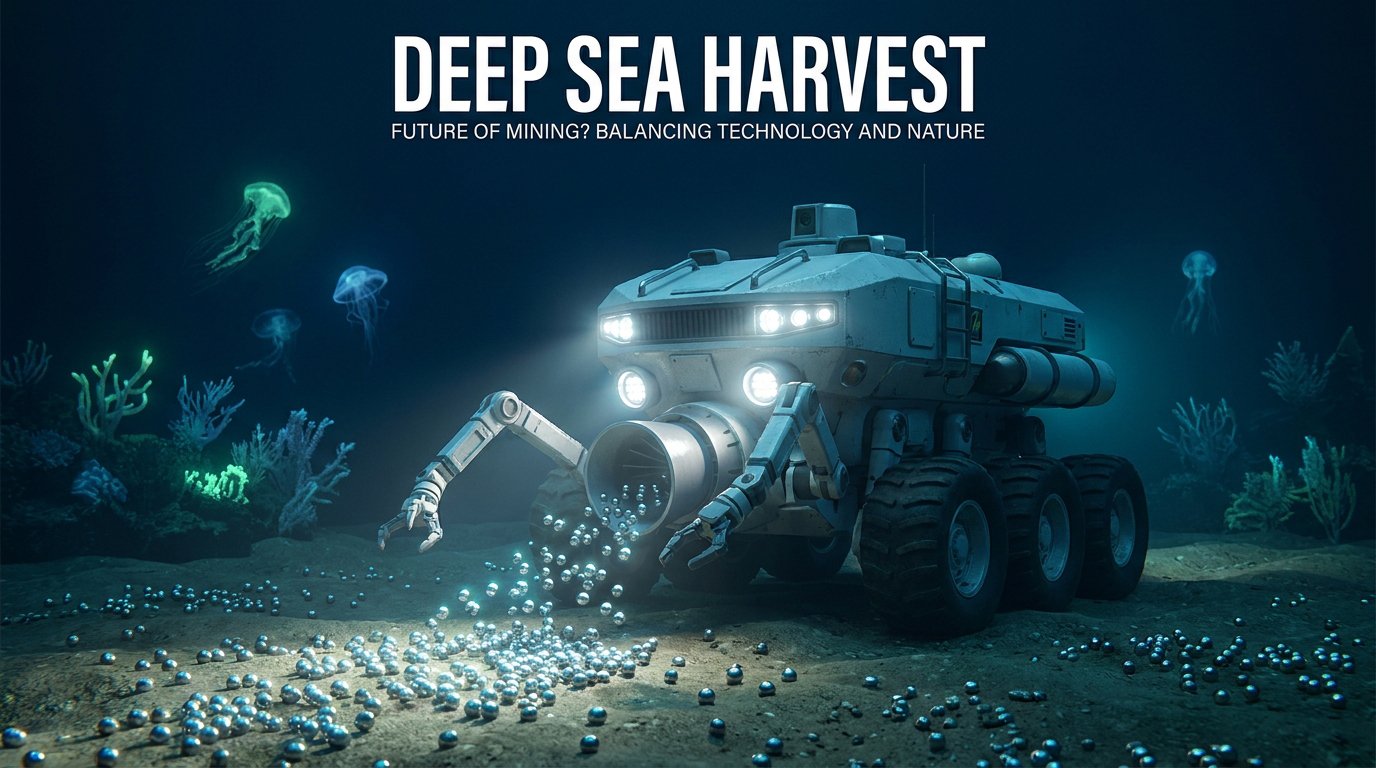
To operate in these conditions, the core of Deep-Sea Mining Engineering relies on highly specialized remotely operated vehicles (ROVs). These machines, often the size of a two-story house, are designed to move along the seafloor on massive caterpillar tracks.

Currently, the primary focus of Deep-Sea Mining Engineering involves the collection of polymetallic nodules. These potato-sized rocks, scattered across the seafloor like cobblestones, have taken millions of years to form. They are rich in the exact cocktail of rare earth elements needed for modern tech. The extraction process involves the ROV vacuuming up a layer of sediment and nodules, separating the rocks from the mud inside the machine, and pumping the valuable nodules up a massive vertical riser pipe to a surface support vessel.
The Ecological Stakes: Evidence of Vulnerability
While advancements in Deep-Sea Mining Engineering have allowed us to reach these depths, marine biologists warn that we are stepping into an ecological minefield. The deep sea is not a barren wasteland; it is a highly specialized biome teeming with unique, slow-growing organisms. From ghost octopuses to ancient deep-water corals and newly discovered species of crustacean, life in the abyss operates on a geological timescale.
Critics of Deep-Sea Mining Engineering point out three primary ecological threats, backed by significant scientific evidence:
- Direct Habitat Destruction: The caterpillar tracks of the mining vehicles crush everything in their path. Because abyssal sediment accumulates at a rate of only a few millimeters per millennium, vehicle tracks made by test mining in the 1980s are still perfectly visible today.
- Sediment Plumes: When the ROVs vacuum the sea floor and return the unwanted mud to the water column, it creates massive sediment plumes. Studies show these cloudy underwater dust storms can travel for hundreds of miles on deep ocean currents, potentially smothering filter-feeding organisms and clogging the respiratory systems of marine life.
- Noise and Light Pollution: The deep ocean is naturally pitch-black and silent. The introduction of industrial lighting, sonar, and grinding machinery could severely disrupt the mating, feeding, and navigational behaviors of deep-sea species, including whales and dolphins in the upper water column.

Forging Ecological Safeguards
Because the oceans belong to humanity as a whole, regulating Deep-Sea Mining Engineering in international waters falls to the International Seabed Authority (ISA), a UN-mandated body. The ISA is currently in the grueling process of drafting a Mining Code—a set of regulations that will determine if, when, and how commercial mining can proceed.
Integrating ecological safeguards into Deep-Sea Mining Engineering is not optional; it is a global mandate. Current proposed safeguards include:
- Preservation Reference Zones (PRZs): Setting aside massive, untouched areas of the seafloor adjacent to mining sites. These areas will serve as ecological baselines to monitor the cascading impacts of nearby mining.
- Plume Mitigation Technology: Engineering solutions that mandate sediment wastewater be injected back into the ocean at the very bottom, rather than mid-water, to prevent the plumes from spreading widely.
- Adaptive Management: A legal framework requiring mining operations to instantly halt if environmental monitoring sensors detect ecological damage exceeding a pre-determined threshold.
For context on how global policies impact environmental technologies, read our analysis on global sustainability frameworks.

Future Research and Development: The Path Forward
The future of Deep-Sea Mining Engineering relies heavily on intense Research and Development (R&D) over the next decade. If the industry is to survive the fierce pushback from environmental groups—many of whom are calling for a total global moratorium—it must invent its way out of the ecological damage it inherently causes.
Future breakthroughs in Deep-Sea Mining Engineering aim to transition from “brute force” extraction to “precision harvesting.”
One major area of R&D is the development of hover-capable collection drones. Instead of utilizing heavy treads that compact the sea floor, engineers are experimenting with autonomous, AI-driven underwater drones that hover a few inches above the seabed, using targeted acoustic frequencies or highly focused water jets to dislodge specific nodules without disturbing the underlying sediment.

Furthermore, future R&D is focusing on closed-loop riser systems. Currently, pumping nodules 4,000 meters to the surface requires massive energy and creates turbulent water mixing. Next-generation Deep-Sea Mining Engineering is looking at hyper-efficient, magnetically propelled elevator systems that isolate the extracted materials from the surrounding water column entirely, ensuring zero leakage of toxic metals or sediments.
Finally, the development of real-time environmental DNA (eDNA) sequencing is revolutionizing how we monitor these environments. By simply taking a water sample, scientists can sequence the eDNA to know exactly what species are present in a mining zone at any given second. If a mining company detects the genetic signature of an endangered or unknown species, autonomous systems could instantly redirect the mining path to preserve the habitat.
Conclusion: A Delicate Balance
Ultimately, sustainable Deep-Sea Mining Engineering is not just an industrial challenge; it is a profound moral test for humanity. We are caught in a paradox: to save our terrestrial environment from the ravages of fossil fuels, we are tempted to exploit an untouched aquatic world.
The evolution of Deep-Sea Mining Engineering will determine the health of our oceans for millennia to come. We possess the ingenuity to build the machines, but we must also possess the wisdom to enforce strict, uncompromising ecological safeguards. The abyss is waiting, filled with both treasure and fragile life. How we choose to navigate the dark will be one of the defining legacies of the 21st century.

Frequently Asked Questions (FAQ)
1. What exactly is Deep-Sea Mining? Deep-sea mining is the process of retrieving mineral deposits from the deep ocean floor. This is primarily focused on areas thousands of meters deep where polymetallic nodules—rocks rich in nickel, cobalt, manganese, and copper—are naturally found.
2. Why do we need these metals from the ocean? These specific metals are critical components for modern technology, particularly in the manufacturing of lithium-ion batteries used in electric vehicles, smartphones, and renewable energy storage systems. As demand skyrockets, terrestrial mines are struggling to keep up.
3. What are the main environmental risks? The main risks include the direct physical destruction of slow-growing benthic (seafloor) habitats, the creation of massive underwater dust storms (sediment plumes) that can choke marine life, and light/noise pollution that disrupts the behavior of deep-sea creatures.
4. How is Deep-Sea Mining Engineering trying to solve these problems? Innovations in Deep-Sea Mining Engineering include developing hovering drones that don’t crush the seabed, advanced closed-loop pipe systems to prevent sediment leakage, and the use of AI and eDNA to detect and avoid sensitive ecological hotspots in real-time.
5. Is commercial deep-sea mining happening right now? As of now, large-scale commercial mining has not officially begun in international waters. The International Seabed Authority (ISA) is currently drafting the regulations and “Mining Code” that will govern if and how commercial extraction can legally and safely occur.