Why Sky Is Dark at Night?
Step outside on a moonless night, far from the glow of a city, and look up. Thousands of stars spill across the blackness, and the longer you stare, the more you notice. You might wonder why the gaps between them are so empty. If the universe is full of stars, why isn’t the whole sky blazing like the surface of the sun?
That question is older than modern astronomy, and it stumped some of the sharpest minds in Europe for centuries. Astronomers call it Olbers’ paradox, after the German physician and amateur astronomer Heinrich Wilhelm Olbers, who popularized it in the early 1800s. The puzzle looks simple. The answer took much longer to find, and it changed how we understand the entire universe.
It matters because the dark sky is more than a pretty backdrop. It’s a clue. It tells us the universe had a beginning, that it is expanding, and that light has been traveling toward us for a very long time. A few words from a sky that looks ordinary can carry a lot of history.
So let’s follow the trail of this question, from the early astronomers who got stuck on it to the modern answer that still surprises people.
A Puzzle Under the Stars

Imagine you’re standing in a dense forest. Trees surround you in every direction, and you can’t see a clear gap anywhere. If the forest went on forever, with trees at the same density in every direction, you’d expect your view to end in a wall of trunks and leaves. The light from those trees would reach you no matter how far away they were.
Now apply that picture to the sky. Stars are scattered through space, and light from each one travels toward Earth. In a simple model of an endless, unchanging universe filled evenly with stars, every line of sight should eventually end on a star. The night sky should be bright all over.
That’s the paradox in plain language. Our night sky is dark, which means the simple model must be missing something important. Early astronomers didn’t have the tools to say what, but they recognized that the question was real and that the answer mattered.
I find this part delightful. Most of us stop noticing the dark between the stars by the time we’re adults. Yet the empty space in the sky is one of the strongest pieces of evidence we have about the universe’s shape and age.
Why Sky Is Dark at Night : Two Centuries of Getting Stuck

The puzzle didn’t start with Olbers. Astronomers and thinkers had been circling it for a long time. In the 1600s, Johannes Kepler suggested that the universe might be finite in size, which would limit how many stars could fill the sky. Edmond Halley, of comet fame, also wrestled with the idea that a stable universe filled with stars should be bright.
When Olbers pushed the question into print in the early nineteenth century, he proposed several possible answers. One was that interstellar dust might absorb starlight, dimming distant stars. That idea had some merit, and it’s partly correct. Dust does block light in parts of the galaxy. But dust that absorbs light would eventually heat up and glow, which would still brighten the sky. So the dust explanation, on its own, doesn’t finish the job.
Think of it like a crowded party seen from across a large room. If the guests are spread out and some are behind curtains, you might see fewer faces. But the room would still be glowing from the lights, and the curtains would warm up under them. Each partial answer solved one part of the mystery and created another.
The real breakthrough came when astronomers stopped assuming the universe was static and eternal.
Why Sky Is Dark at Night : The Universe Has a Beginning

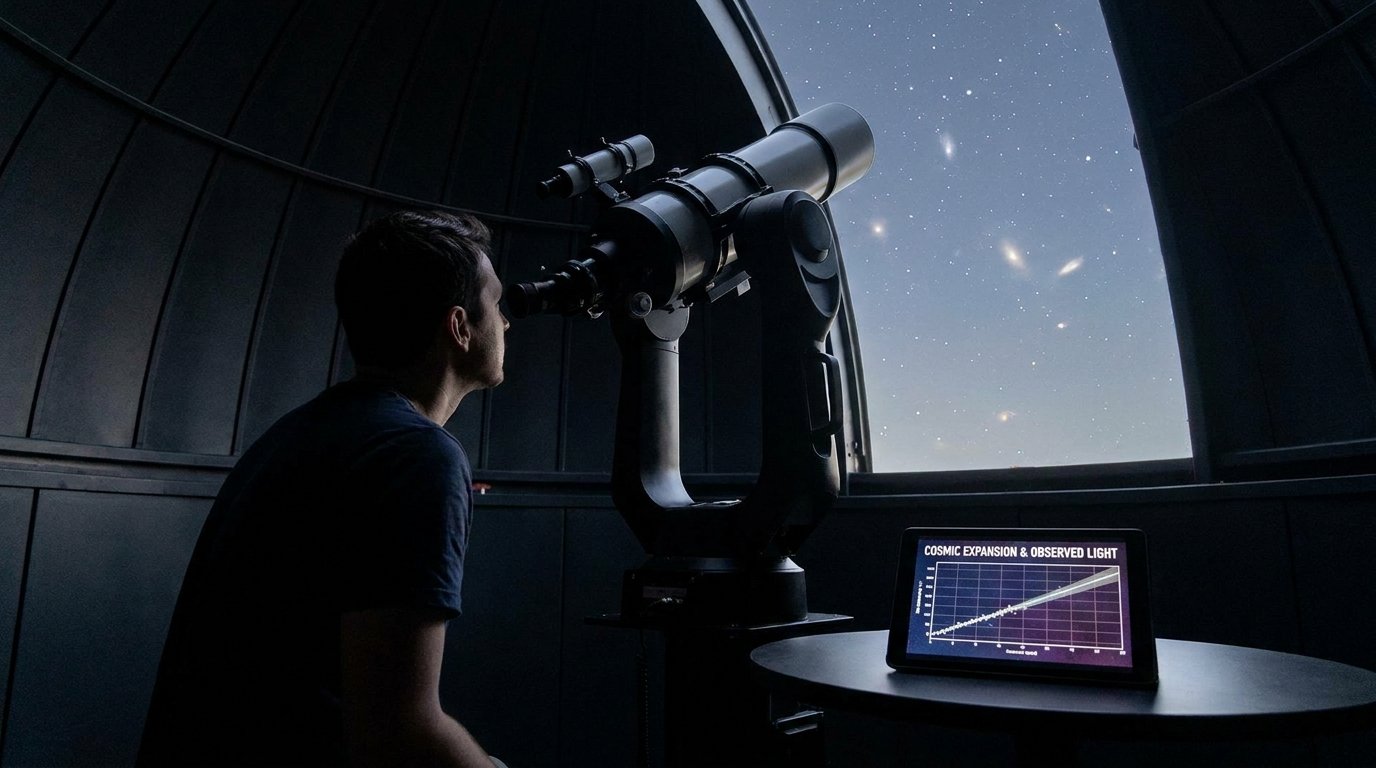
The key ideas arrived in the twentieth century. In the 1920s, Edwin Hubble and others showed that galaxies are moving away from one another, a pattern now known as the expansion of the universe. Georges Lemaître had proposed a version of this idea earlier, suggesting that the universe had originated from a very dense, hot state.
Two features of an expanding universe help explain the dark sky. First, the universe has a finite age. Light from distant stars has had only so long to reach us. Even if stars filled space forever, most of their light would still be on its way. The sky isn’t bright in every direction because the light simply hasn’t arrived yet from the most distant parts of the cosmos.
Second, expansion stretches light. As space grows, the wavelengths of light traveling through it stretch too, a process called redshift. Light from very distant sources is shifted toward longer, less energetic wavelengths. Some of it moves out of the visible range entirely. That’s part of why the most distant light we receive is dimmer and harder to see.
Here’s a simple way to picture it. Imagine a long line of runners who start at different times and cover the course at different speeds. If you stand at the finish line and only a few have crossed so far, the race looks empty even though everyone is still running. The universe’s light works in a similar way. The finish line keeps moving, and much of the light is still in transit.
Why Sky Is Dark at Night : Why This Matters for Your Own Work and Life

It might seem odd that a question about the night sky has anything to do with a freelance designer or a small business owner. But the lesson is surprisingly practical. The sky looks empty because we’re seeing only part of the picture, and our instincts often assume the view in front of us is the whole story.
Consider a freelance analyst in Toronto who builds reports from a single data source. Her monthly dashboards look clean and steady, and she assumes the numbers reflect the market. Then a new competitor appears, and her clients start asking about trends she never tracked. Her data wasn’t wrong. It was simply limited, like a telescope pointed at one patch of sky.
A few habits can help you avoid mistaking your limited view for the whole universe:
- Check what your data can’t see. List the sources you don’t have, such as customer feedback, competitor pricing, or regional trends.
- Ask whether the signal is delayed. Some information reaches you late, like starlight from far away. Reports, surveys, and sales figures often lag behind what’s happening now.
- Compare across more than one window. A second source, even a small one, can reveal what a single view hides.
- Keep a running list of open questions. Astronomers didn’t solve Olbers’ paradox overnight. Writing down what you still don’t know keeps you from closing the case too early.
None of these steps will reveal everything, but they make your conclusions more trustworthy. That’s the same spirit that drove astronomers from one partial answer to the next.
Why Sky Is Dark at Night : The Myth That the Sky Is Dark Because Space Is Empty

A common explanation goes like this: space is mostly empty, so there aren’t enough stars to light up the sky. It sounds reasonable, and it’s a tempting shortcut. But it isn’t the full story, and it’s worth gently correcting.
Space is indeed mostly empty in the sense that stars are far apart. But the paradox isn’t about how crowded space feels. It’s about the total amount of light that could reach us if the universe were infinitely old and filled with stars at a steady density. Even sparse stars, given enough distance and time, add up to a lot of light. Emptiness alone doesn’t explain the dark sky.
The better answer combines several facts that work together. The universe is finite in age, so light from the most distant stars hasn’t reached us yet. Expansion stretches light, which reduces the brightness of the most distant sources. Dust and the finite number of luminous objects also play a role. Each piece is small on its own, but together they explain why the sky is dark.
I’ll admit I used to give the “empty space” answer too. It’s quick and it sounds satisfying. But once you see how much the expanding universe matters, the simple answer feels like stopping halfway up a staircase.
Frequently Asked Questions
What is Olbers’ paradox?
It’s the puzzle of why the night sky is dark if the universe contains an endless number of stars. Heinrich Wilhelm Olbers popularized the question in the early 1800s, though astronomers had raised similar ideas earlier.
Is the sky dark because space is empty?
Not entirely. Space is sparse, but even sparse stars would add up to a bright sky if the universe were infinitely old and unchanging. The real answer involves the universe’s finite age and expansion.
How does the expansion of the universe make the sky darker?
Expansion stretches light into longer wavelengths, which dims distant sources and can move some of their light outside the visible range. It also means the most distant light hasn’t had time to reach us yet.
Where can I learn more about this topic?
NASA’s science website at https://science.nasa.gov offers accessible explanations of the expanding universe, cosmic background light, and related research. Check the site for current missions and updates, since new findings continue to refine our understanding.
Final Thoughts
Why Sky Is Dark at Night:
The dark sky is one of the most ordinary things we see, and one of the most quietly remarkable. The gaps between the stars tell us that the universe has a history, that its light has been traveling for a long time, and that it is still changing. Olbers’ question turned a simple night-time observation into a window on cosmic time.

That lesson travels well beyond astronomy. The spaces in what we see, whether in our data, our markets, or our plans, often point to things we haven’t measured yet. Treat those gaps as clues rather than as proof that nothing is there.
So the next time you step outside on a clear night, take a minute to look at the dark between the stars and ask what the light hasn’t reached yet. Then share this article with someone who loves a good night sky, or explore more curious questions on wikimess.com, where the familiar puzzles get a fresh look.