The single-fire story is one of history’s most seductive lies. The truth is messier, sadder, and far more relevant to how knowledge dies today.
When people picture the Library of Alexandria’s end, they usually see the same cinematic image: towering flames, panicked scholars clutching scrolls, centuries of human knowledge reduced to ash in a single night. It’s a powerful image. It’s also wrong.
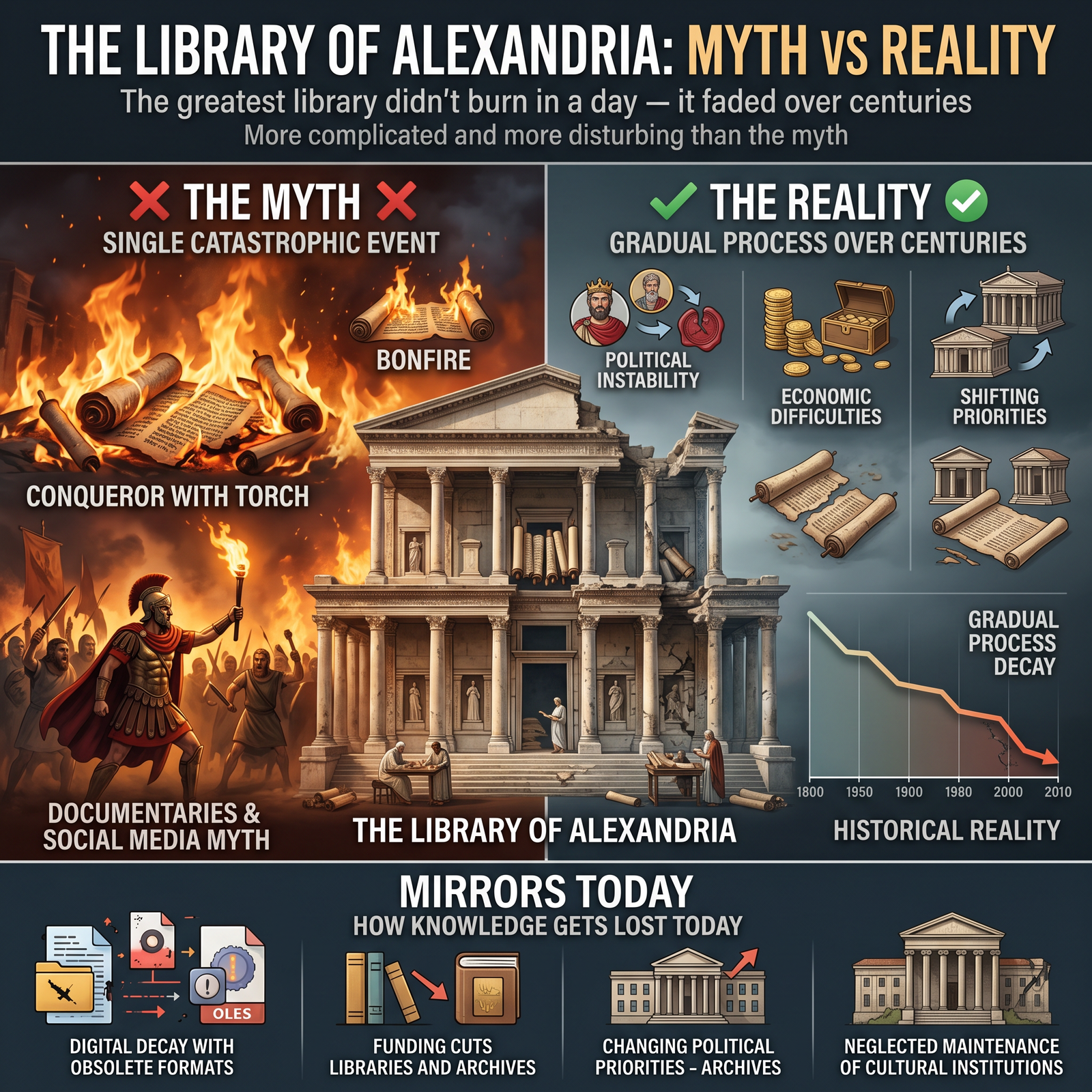
The Library of Alexandria was not destroyed in one catastrophic event. Its decline was far more likely a gradual process shaped by political instability, economic difficulties, and the shifting priorities of successive rulers — not a bonfire, not a mob, not a conqueror with a torch. The dramatic single-event story, endlessly repeated in documentaries and social media threads, is largely a myth constructed centuries after the fact. The Archaeologist
What really happened to the greatest library the ancient world ever produced? The answer is simultaneously more complicated and more disturbing — because it mirrors exactly how knowledge gets lost today.
The Library That Defined the Ancient World

Founded around 300 BCE under Ptolemy I Soter, the Library of Alexandria was never just a building. It was the intellectual engine of an empire. As many as 700,000 scrolls filled its shelves, and the greatest thinkers of the age — scientists, mathematicians, poets from every known civilization — came to study and exchange ideas. goodreads
Attached to the Musaeum (a kind of ancient university), the Library held original works by Aristotle, Euclid’s foundational geometry texts, Eratosthenes’ calculation of the Earth’s circumference, and medical treatises that wouldn’t be equalled for another millennium. It was, in every measurable sense, the internet of the ancient world — a centralized hub for humanity’s accumulated knowledge.
The institution functioned under royal patronage, funded directly by the Ptolemaic rulers of Egypt. That dependency on political goodwill would later prove fatal.
The Caesar Fire — The Most Misunderstood Moment

The most famous “destruction” event involves Julius Caesar, and it’s where the myth gains its most credible footing — but even here, the evidence is thin.
During the siege of 48 BCE, Julius Caesar ordered ships burned to prevent their capture. The flames spread along the waterfront where papyrus stockpiles and storehouses sat close to the waterline. The Odd Signal.
What the Historical Record Actually Says

The fire probably did destroy a significant number of books, but it is unlikely the entire library disappeared. There is evidence for ongoing library activity in Roman Alexandria after the event, and some scholars have suggested the fire destroyed only papyri in warehouses that had not yet been transported to the main library, or which were due to be exported. Open Learning
In other words: a dockside warehouse fire, not the obliteration of the institution itself. Plutarch mentions the fire; Strabo, writing just decades later, appears to reference an active scholarly complex in Alexandria. Records indicate subsequent volumes from Pergamon — a vast transfer attributed to Mark Antony — helped replenish holdings, evidence of interruption followed by reconstitution rather than annihilation. The Odd Signal
Caesar’s fire damaged part of the collection. It did not end the Library. That is a critical distinction the popular narrative erases entirely.
The Christian Mob Theory — Popular, Poorly Supported

The second great villain in the Library’s story is the Christian church. The narrative runs roughly like this: in 391 CE, fanatical Christian mobs, empowered by Emperor Theodosius’s decree outlawing pagan practices, stormed and burned the great library, plunging the world into the Dark Ages.
This is a catchy story — it has all the drama one might want: religious zealots versus enlightened men, books going up in flames, civilization collapsing overnight. It’s also mostly invented. GreekReporter.com
The Serapeum Is Not the Library

What did happen in 391 CE was the destruction of the Serapeum — the Temple of Serapis. However, this was not the Library of Alexandria, or for that matter, a library of any sort. No ancient sources mention the destruction of any library at this time. goodreads
Five contemporary reports of the Serapeum’s destruction don’t mention a library being burned at all. The “great burning by Christians” narrative, as historians have traced it, largely originates not with ancient sources but with 18th-century Enlightenment writers like Edward Gibbon, who had ideological reasons to paint religion — especially Christianity — as anti-intellectual. The Geographical Cure42ZERO
The Irony of Monastic Preservation
The historical irony is considerable. Medieval monks dedicated centuries to copying everything they could access, particularly works by ancient Greek writers. They preserved pagan philosophy, romantic poetry, medical treatises, and astronomical observations — often without fully understanding the content, simply because they believed it might be important for future study. Christians destroyed texts, yes. They also saved far more than they burned. The simple villain narrative collapses under scrutiny. GreekReporter.com
The Muslim Conqueror Myth — Fiction Dressed as History

The third candidate for the Library’s destruction is the Arab general Amr ibn al-As, who conquered Alexandria in 641 CE. According to a story repeated by some medieval writers, Caliph Omar ordered the Library’s scrolls burned to heat the city’s bathhouses, saying: if the books agree with the Quran, they are superfluous; if they disagree, they are dangerous.
It’s a memorable quote. It’s almost certainly fabricated.
Stories that Muslim conquerors destroyed the library or burned scrolls to heat bathhouses are almost certainly later inventions with no credible historical support. The story appears centuries after the fact and reads more like legend than history. Early Muslim scholars preserved and translated large swaths of Greek learning — if anything, they helped ensure that classical texts survived. 42ZEROThe Geographical Cure
The Islamic Golden Age, which preserved Aristotle, Galen, Ptolemy, and Euclid for European rediscovery, is simply incompatible with a narrative of Arabic contempt for ancient knowledge. Bernard Lewis has shown how the Islamic destruction story has a number of parallels in contemporary myth and folklore. It was invented to demonise a rival civilisation, not to record history. Open Learning
The Real Cause — Neglect, Funding Cuts, and Fragile Materials

If no single event destroyed the Library of Alexandria, what actually happened? The mundane truth is that it slowly, quietly fell apart — and nobody cared enough to stop it.
What emerges from the evidence is a steady institutional decline, not a single event of dramatic destruction. The library system could not adapt to Roman rule, Christian culture, and changing educational priorities, all of which contributed to the swift change in the priorities of Alexandrian society. GreekReporter.com
The Budget Problem Nobody Talks About
Royal patronage funded the Library. When Rome absorbed Egypt in 30 BCE, that funding structure collapsed. It has been suggested that Strabo’s later silence on the Library, writing just decades after Caesar’s fire, may indicate that the Library was no longer the centre of scholarship it once was, with ‘budget cuts’ seeming increasingly probable. goodreads
Without consistent funding, scrolls weren’t recopied. Papyrus is brutally fragile — it decays, tears, and crumbles without constant maintenance. Texts only survived if they were copied again and again onto fresh material. As resources dried up, the Library didn’t burn — it slowly rotted. The Geographical Cure
Knowledge Doesn’t Disappear in Fires. It Disappears in Indifference.

This is the genuinely disturbing lesson embedded in the Library’s fate. A single dramatic destruction event would at least imply someone thought the knowledge worth fighting over. The decline was gradual, complex, and messy — not a single fiery catastrophe. There were many libraries in the ancient world, in Pergamon, Rome, and elsewhere, and scholarship continued. The Alexandria Library’s holdings weren’t unique to the building; they became unique as copying ceased and alternatives declined. 42ZERO
The real death of the Library was administrative, financial, and cultural — a civilisational shift in priorities that no army needed to enforce.
What Was Actually Lost — And What Survived

The honest answer is that we don’t fully know what the Library held, because the catalogue itself is lost. We know of works by Aristotle that are referenced but never recovered. We know Eratosthenes calculated the Earth’s circumference with stunning precision, but only fragments of his methodology survive.
What we know survived does so largely because of the very groups blamed for the Library’s destruction. Byzantine scholars preserved Greek philosophy. Arab translators saved medical and astronomical texts. European monks copied and recopied pagan literature they didn’t fully understand.
The tragedy of Alexandria is real. The idea that a single act of violence erased the ancient world’s knowledge is not.
Why the Myth Endures — And Why It Matters

The burning Library makes a better story than the defunded Library. It gives us a villain: Caesar, the Christians, the Arabs. It lets us imagine that knowledge was stolen from us in one dramatic moment, rather than lost through accumulated indifference.
The “great burning” narrative isn’t rooted in ancient historians — it mostly comes from 18th-century Enlightenment writers with ideological reasons to paint religion as anti-intellectual. It was a polemic dressed as history, and it worked. We are still repeating it. 42ZERO
Understanding what actually happened to the Library of Alexandria matters because the real mechanisms of knowledge loss — underfunding, institutional neglect, shifting political priorities, failure to digitise and preserve — are precisely the mechanisms threatening archives, libraries, and open access knowledge repositories today.
The Library of Alexandria didn’t die in a fire. It died because nobody kept paying for it. That should terrify us considerably more than any torch.
FAQ Block (ready for schema markup):
Q: Was the Library of Alexandria destroyed by Julius Caesar?
A: Caesar’s 48 BCE harbor fire likely damaged warehouses containing scrolls near the docks, but historical evidence shows the library continued operating afterward. It was not destroyed.
Q: Did Christians burn the Library of Alexandria?
A: No credible ancient source supports this. The 391 CE destruction of the Serapeum was a pagan temple, not the Library. The “Christian burning” story largely originates with 18th-century Enlightenment writers, not ancient historians.
Q: Did Muslim conquerors destroy the Library of Alexandria?
A: Historians widely regard this as fiction. The story appears centuries after the supposed event and contradicts the well-documented role of Islamic scholars in preserving and translating Greek texts.
Q: What really caused the Library of Alexandria to disappear?
A: A gradual decline over centuries — including loss of royal funding under Roman rule, failure to recopy fragile papyrus scrolls, political instability, and shifting cultural priorities.
Q: How many scrolls did the Library of Alexandria contain?
A: Ancient sources estimate up to 700,000 scrolls, though the actual catalogue is lost to history.
Reference –
- https://www.open.edu/openlearn/history-the-arts/library-alexandria/content-section-3
- https://www.thearchaeologist.org/blog/the-great-library-of-alexandria-fact-myth-and-legacy
- https://greekreporter.com/2025/07/22/fire-alexandria-library-christians-destroy-ancient-knowledge/
- https://42zero.org/library-myths-the-destruction-of-alexandria-explained/
- https://www.thegeographicalcure.com/post/library-of-alexandria-what-happened
AI Image Generated by ChatGPT and lovart.ai
Click this link to read our important and interesting articles as soon as they are published!