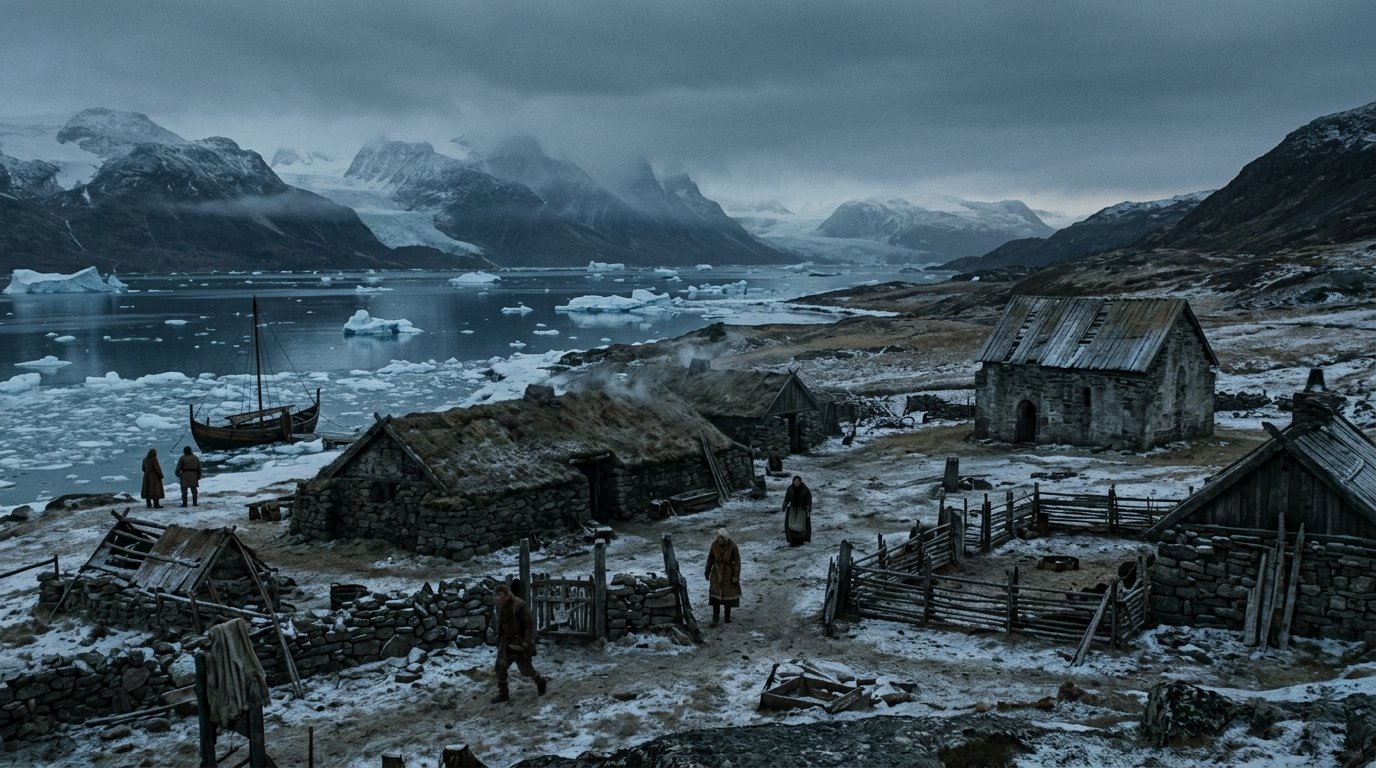
Imagine standing on a green slope in southern Greenland, wind coming off the fjord, and finding a stone church with no roof, its walls still standing after six centuries. That’s what visitors to the ruins of Hvalsey can do today. The last written record of Norse life there dates to 1408, when a wedding was held in the church. After that, the paper trail goes quiet.
That silence is the reason the Greenland Vikings still fascinate people. A community that stretched across hundreds of farms, traded with Europe, and kept its own churches simply stops appearing in the record. For a long time, the popular story was that they all vanished in one dramatic catastrophe. The real story is more uncomfortable and more useful, because it’s about slow pressure, hard choices, and a world that didn’t offer a clean exit.
It matters to us because the story has a familiar shape. Communities that depend on one set of conditions, one trade route, or one market can look rock solid right up until the conditions change. Whether you run a small business in Auckland or manage a team in Manchester, you’ll recognize the pattern.
A Farm at the Edge of the World

The Norse arrived in Greenland around 985 CE, led by Erik the Red, who had been exiled from Iceland. According to the Icelandic sagas, he named the island “Greenland” to attract settlers, which is a bit like naming a new café “Sunshine Coffee” in the middle of winter. The saga account is a literary source, so historians treat it as a guide rather than a precise record. Archaeology and environmental evidence fill in much of the rest.
The Norse built two main settlements. The Eastern Settlement sat near the southern tip of the island, and the Western Settlement lay farther north on the western coast, near what is now Nuuk. Between them, they supported dozens of farms, a bishopric, churches, and a steady connection to Norway and Iceland. Estimates of the total population at the peak vary widely, but a common range is roughly 2,000 to 5,000 people. Treat those numbers as informed guesses, not counts.
Life was hard but workable. The Norse raised cattle, sheep, and goats, grew hay for winter feed, and hunted seals and caribou. They also traded walrus ivory, narwhal tusk, and polar bear and falcon products, which European buyers valued highly. Imagine a farm where the main export is something you have to hunt in icy water, and you can see both the opportunity and the risk.
Two Settlements, One Fragile Bargain

Here’s the part that often gets lost. The Greenland colony wasn’t self-sufficient in the way a farm in Norway might be. It was a link in a long chain of trade, and that chain depended on ships arriving, prices holding, and the church and crown maintaining an interest in a far-off outpost.
Think of it like a small business that sells almost everything to one distributor. As long as the distributor keeps ordering, the business runs smoothly. When orders slow down, the business has little room to pivot, because its tools, skills, and supply lines were built for that one buyer. The Norse had a similar setup. Their economy was tuned to European demand, and their survival depended on keeping that connection alive.

Meanwhile, the land and climate were shifting. Around the 1300s, the North Atlantic entered a colder period often called the Little Ice Age. Sea ice spread, pastures suffered, and the growing season got shorter. Ships found the coast harder to reach. Historians debate the exact timing and severity, and local conditions varied, so the picture is patchy rather than uniform.
Cold Winters, Empty Ships, and an Unanswered Question
The deeper question is why the Norse didn’t simply adapt. Some researchers point to the way they kept old habits. They continued to farm cattle in a landscape where those animals struggled, and some evidence suggests they relied less on seal hunting than the Inuit who later moved into the region. Others argue that the Norse did adapt, but not fast enough to offset falling trade and a harsher climate.

The Inuit, whose ancestors arrived in the region from the north and west, were already well suited to the Arctic. Their hunting methods, boats, and clothing reflected centuries of experience with sea ice. Archaeologists have found Inuit sites near Norse ruins, and some of the interactions between the two groups are debated. Written sources from the Norse side are thin, which means the story has to be pieced together from bones, middens, pollen, and ice cores.
Jared Diamond’s book Collapse, published in 2005, popularized the idea that the Norse failed partly because of cultural stubbornness. The argument struck a chord, but many historians have pushed back. They point out that Norse decisions made sense within their own world and that the forces working against them were largely beyond their control. The debate is still active, and new research keeps refining it.
Here’s my take: the stubbornness story is tempting because it gives us a villain we can learn from. The more accurate version is less comfortable. Good decisions in a stable world can become traps when the world changes, and people rarely notice the change until the margin is gone.
What a Lost Colony Teaches Anyone Who Works Alone
You don’t need to live on a Greenland fjord to recognize this pattern. Take a freelance illustrator in Singapore who built her income around one large client. For two years, the arrangement was perfect. She knew the brief, the client paid on time, and she turned down other work to stay available. Then the client shifted to in-house design, and her income dropped by more than half within a few months.
She wasn’t careless. Her setup simply mirrored the Norse economy. It was efficient, familiar, and dependent on a single distant buyer. When she looked back, the warning signs had been there, but they didn’t feel urgent while the orders kept coming.
A few practical habits can reduce that kind of exposure:
- Track your income sources. If one client or platform covers more than a third of your earnings, treat that as a warning sign rather than a comfort.
- Keep your skills broad enough to pivot. Learn one adjacent skill each year so your work doesn’t depend on a single style, tool, or buyer.
- Build relationships outside your main channel. Local networks, peer groups, and past clients are your early-warning system when conditions change.
- Review your setup on a schedule. A quarterly check-in, even a short one, catches shifts before they become emergencies.
The Norse didn’t have a dashboard showing them their trade numbers dropping. You do. That’s an advantage worth using.
The Myth of the Mass Disappearance

The most persistent myth is that the Greenland Vikings vanished in one sudden event, leaving the farms empty overnight. It’s a dramatic image, and it has appeared in books, documentaries, and tourist talks for generations.
The evidence doesn’t support a single moment of disappearance. The Western Settlement appears to have been abandoned earlier, with its last written mention dating to the mid-1300s. The Eastern Settlement continued for a while longer, and the 1408 wedding at Hvalsey suggests some communities were still active decades later. Some scholars think the Eastern Settlement may have declined over several generations rather than ending in a clean break, though the exact timeline remains debated.
Nor is there clear evidence of a mass killing or an organized exodus that accounts for everyone. Some Norse people may have died from famine or disease, some may have left on ships, and some may have been absorbed into other communities, though the evidence for that last possibility is limited. A “lost colony” sounds neat, but the reality is a slow thinning, where each generation had fewer ships, fewer options, and less room for error.
I’ll admit that the mass-disappearance version used to appeal to me too. It’s cleaner, and it lets us feel like the story has an ending. The slower version is harder to hold in your head, but it’s the one the evidence actually supports.
Frequently Asked Questions
Did 5,000 Greenland Vikings really vanish?
Estimates of the total Norse population at its peak range roughly from 2,000 to 5,000, but no one has a precise count. Historians believe the settlements declined over generations rather than vanishing all at once, so “vanished” is a simplification.
When did the Greenland Norse settlements end?
The Western Settlement’s last written mention dates to the mid-1300s. The Eastern Settlement’s final documented event is a wedding at Hvalsey Church in 1408, but the exact end of Norse presence there is still debated.
Did the Inuit kill the Norse?
There’s no strong evidence for a mass conflict that explains the decline. Researchers generally treat climate change, shrinking trade, and difficulty adapting as more important factors, though interactions between the groups are still being studied.
Can I see the Norse ruins in Greenland today?
Yes. The ruins at Hvalsey and other sites are open to visitors, and the Greenland National Museum & Archives in Nuuk offers excellent context on the Norse and Inuit history of the island. Check local visitor information before traveling, since access and seasonal hours can change.
Final Thoughts
The Greenland Vikings didn’t disappear in a single dramatic night. They thinned out over generations, as cold winters, falling trade, and rigid habits narrowed their options. What looks like a sudden mystery is actually a long lesson in dependence, adaptation, and the cost of waiting too long to change course.

That lesson is worth carrying into your own work. Pay attention to the quiet signals: a shrinking client list, a shifting market, a tool you’ve stopped updating. The Norse weren’t foolish, and neither are most people who get caught off guard. They simply trusted a world that was already changing.
So if this story made you think differently about your own setup, take ten minutes this week to map where your income, skills, and relationships really come from. Then share this article with a friend who loves history, or explore more stories on wikimess.com, where the familiar myths often get a second look.