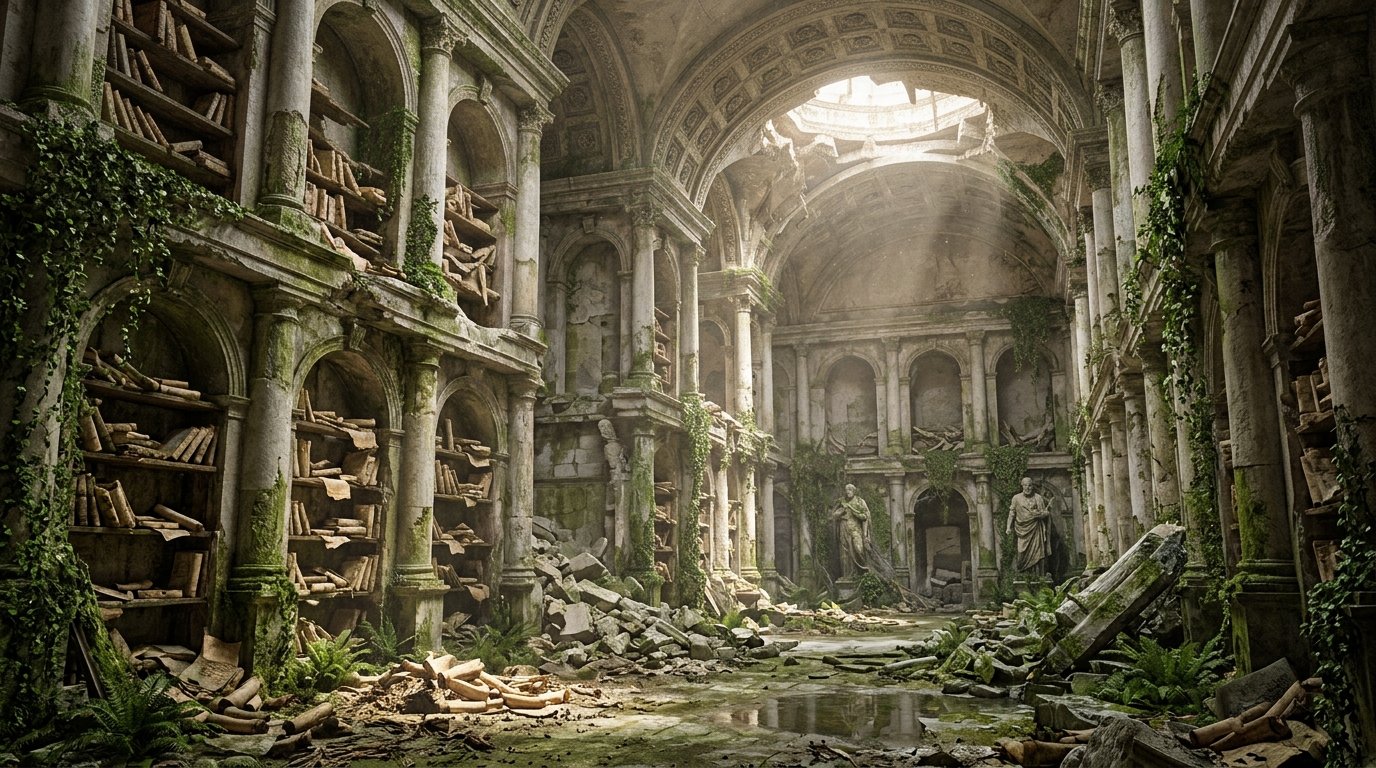
Picture a warehouse full of papyrus scrolls, stacked floor to ceiling, quietly going brittle in the harbor air. Nobody lights a match. Nobody storms in with torches. Instead, a grant runs out, a scholar leaves town, a roof leaks, and a copyist decides not to bother copying that old play anymore. Over two or three centuries, the greatest library of the ancient world empties one shelf at a time.

That’s the real story of the Library of Alexandria, and it matters more than the myth. The version most of us learned says a single dramatic blaze wiped out humanity’s memory in one night. It’s a satisfying story, and it’s almost certainly wrong. The truth is messier, and more useful, because a slow death is the kind of thing that can happen to a project, a skill, or a body of knowledge you care about without anyone noticing until it’s gone.

So let’s walk through what really happened, and why it still speaks to people reading this from Auckland to Seoul to Manchester.
The Fire Everyone Blames
The most famous fire story begins in 48 BCE, when Julius Caesar found himself trapped in Alexandria during a conflict with Ptolemaic forces. According to ancient accounts, fighting spread along the harbor, and books were lost. The Roman writer Seneca later claimed that 40,000 scrolls burned. That number is worth pausing on, because it comes from a writer working generations after the event, and it’s the kind of figure ancient authors liked to use for dramatic effect.

Modern historians tend to read the evidence more carefully. The fire likely damaged warehouses near the docks, where scrolls were stored or in transit, rather than the main research complex. That’s a real loss, but it’s not the same as the library being erased. Think of it like a flood that ruins the basement of a house. The basement is gone, but the house is still standing.
I find that distinction fascinating because it’s so easy to lose in the retelling. When a story needs a villain and a single moment, we reach for the fire, even when the record points to something quieter.
A Library Dies the Way a Garden Does
If the library wasn’t destroyed by one blaze, what killed it? The better comparison is a garden left unwatered. No single day kills the plants. Each week, a little less moisture reaches the roots, until one summer you notice the whole bed is brown.
Alexandria’s library depended on money, patronage, and political goodwill. The Ptolemies funded scholars, bought manuscripts, and treated knowledge as a source of prestige. When the dynasty’s fortunes weakened and the city went through turmoil, that support didn’t vanish overnight. It thinned out. Funding became irregular. Scholars drifted to other cities. Copying slowed, and older texts were no longer recopied as they decayed.

Ancient manuscripts were fragile. Papyrus rots, mildews, and cracks, and it survives only when someone keeps copying it onto fresh material. A text nobody recopies is a text on borrowed time. So the loss wasn’t always dramatic. It was the quiet absence of maintenance.
Here’s what that looks like in everyday life. Imagine a freelancer who stops updating her portfolio, stops reaching out to old clients, and stops learning new software. Nothing collapses in a single week. But two years later, the work that once paid the bills has quietly evaporated. Libraries, careers, and communities often die this way: not in a bang, but in neglected maintenance.
Who Really Emptied the Shelves
Several events in the Library’s long history are often mentioned together, and they’re worth separating.
In the late third century CE, the Roman emperor Aurelian’s campaign in Egypt caused heavy damage to the Brucheion, the royal quarter where parts of the Library were located. The ancient historian Ammianus Marcellinus describes the district being ruined, though he doesn’t frame it as the end of scholarship in the city. Later, in the late fourth century, the Serapeum, a temple that housed a daughter library, was destroyed during a campaign against pagan sites led by the Christian patriarch Theophilus. That was a significant blow to what remained of the city’s book culture.

These events happened over roughly 400 years. Each was a setback. None, on its own, ended the story. What ended it was the cumulative effect: a city that stopped valuing its scholars enough to keep them, and a collection that stopped being copied, cared for, and passed on.
That’s the detail nobody talks about. The Library didn’t lose a war with fire. It lost a series of small contests with time, money, and neglect, and it lost them one at a time.
What a Shrinking Library Teaches Anyone Who Works Alone
Let’s bring this closer to home. Whether you’re a freelance designer in Singapore, a remote data analyst in Sydney, or a small bakery owner in Lyon, you’re running your own mini library. Your skills, client files, recipes, and reputation are a collection that needs regular copying, updating, and protection.
Here are a few ways to keep your own collection from going quiet:
- Schedule maintenance the way you’d schedule a client call. A monthly hour to update your portfolio or tidy your files beats a frantic weekend before a deadline.
- Keep at least two copies of anything important. A single hard drive is the modern equivalent of a single scroll in a single warehouse.
- Recopy your knowledge. Write up what you learned from a project. The act of rewriting it keeps it alive in your mind and in your archive.
- Stay in touch with your network. Libraries survive through readers. Clients and collaborators are your readers.
I’ll admit that I used to assume my work was safe as long as I kept producing it. Then I looked back at a folder of client notes from three years earlier and couldn’t read half the file formats. Nothing had been “lost” in a dramatic sense. It had simply become unreadable through neglect.
The Myth of the Single Villain

No discussion of Alexandria is complete without the most famous legend of all: the claim that the Muslim caliph Omar ordered the books burned after the city fell in 642 CE, with the line that if the books agreed with the Quran they were redundant, and if they disagreed they were harmful.
It’s a vivid story, and it has been repeated for centuries. But historians have good reasons to doubt it. The account appears in sources written many centuries after the conquest, and no contemporary evidence from the 640s supports it. Some historians also note that by then the great scholarly institutions of the city were already much diminished, so a dramatic burning isn’t needed to explain their decline.
Why does the myth persist? Because a single villain is easier to remember than a slow process. It’s also easier to use as a political or cultural weapon. The more interesting truth is that the story of the Library is a story about ordinary choices, repeated over centuries, by people who didn’t realize what they were letting go.
Frequently Asked Questions
Did the Library of Alexandria ever burn down completely?
There’s no good evidence for a single, total destruction. Historians describe a series of losses and gradual decline over several centuries, including damage during Caesar’s conflict in 48 BCE and later destruction in the Brucheion and the Serapeum.
How many scrolls did the Library hold?
Ancient sources give figures such as several hundred thousand scrolls, but these numbers are estimates and are sometimes disputed. Treat any exact count with caution.
Was the Library of Alexandria ever rebuilt?
A modern institution, the Bibliotheca Alexandrina, opened in 2002 as a new cultural and research center in the city. It’s inspired by the ancient library’s legacy but isn’t a direct continuation of it.
Why does the “slow death” matter today?
Many of the things we value, including knowledge, skills, and digital files, need active maintenance. Neglect can erase them just as effectively as a dramatic disaster, and often more quietly.
Final Thoughts
The Library of Alexandria didn’t go out in a blaze of glory. It faded, the way most important things do: a little less funding here, a little less copying there, until one day the shelves were nearly bare and nobody could say exactly when it happened. That’s the lesson worth carrying with you. The biggest threats to what we value are often not the fires we fear but the small, unnoticed neglects we tolerate.
So today, pick one thing in your own life that needs recopying. Back up that folder, update that portfolio, or write down what you learned last month before it fades. If this story made you think differently about how knowledge survives, share it with someone who’d enjoy the detective work. And if you’d like more stories where history turns out to be stranger than the myths, explore the rest of the site.
Explore more in our History section: https://wikimess.com/history/