In the spring of 1900, a group of Greek sponge divers sheltering from a storm dropped anchor near a tiny, barren island called Antikythera, halfway between Crete and mainland Greece. When the weather cleared, they dove — and instead of sponges, they found a 2,000-year-old shipwreck packed with bronze statues, marble figures, jewelry, and glassware, scattered across the seafloor 45 meters down.
It triggered the first major underwater archaeology operation in history. But the single most important object they hauled up went completely unnoticed. It looked like a shapeless, corroded lump of bronze and rotted wood — easy to overlook beside life-sized statues. It sat in a museum drawer in Athens for over a year before anyone realized what it was. When they finally did, it rewrote what we thought the ancient world was capable of building.
A Lump of Bronze That Made No Sense

In 1902, the Greek archaeologist Valerios Stais was examining items recovered from the wreck when he noticed something embedded in one corroded fragment: a gear wheel. A precisely cut, toothed bronze gear — in an object dated to roughly the 2nd or 1st century BCE.
That was a problem. Gearing of that sophistication wasn’t supposed to exist in the ancient Greek world. Nothing else survives from antiquity, and nothing approaching its complexity would appear again for well over a thousand years — not until the geared astronomical clocks of medieval Europe. By every reasonable expectation of the historical record, this device shouldn’t exist at all. And yet there it was, sitting in a drawer in Athens.
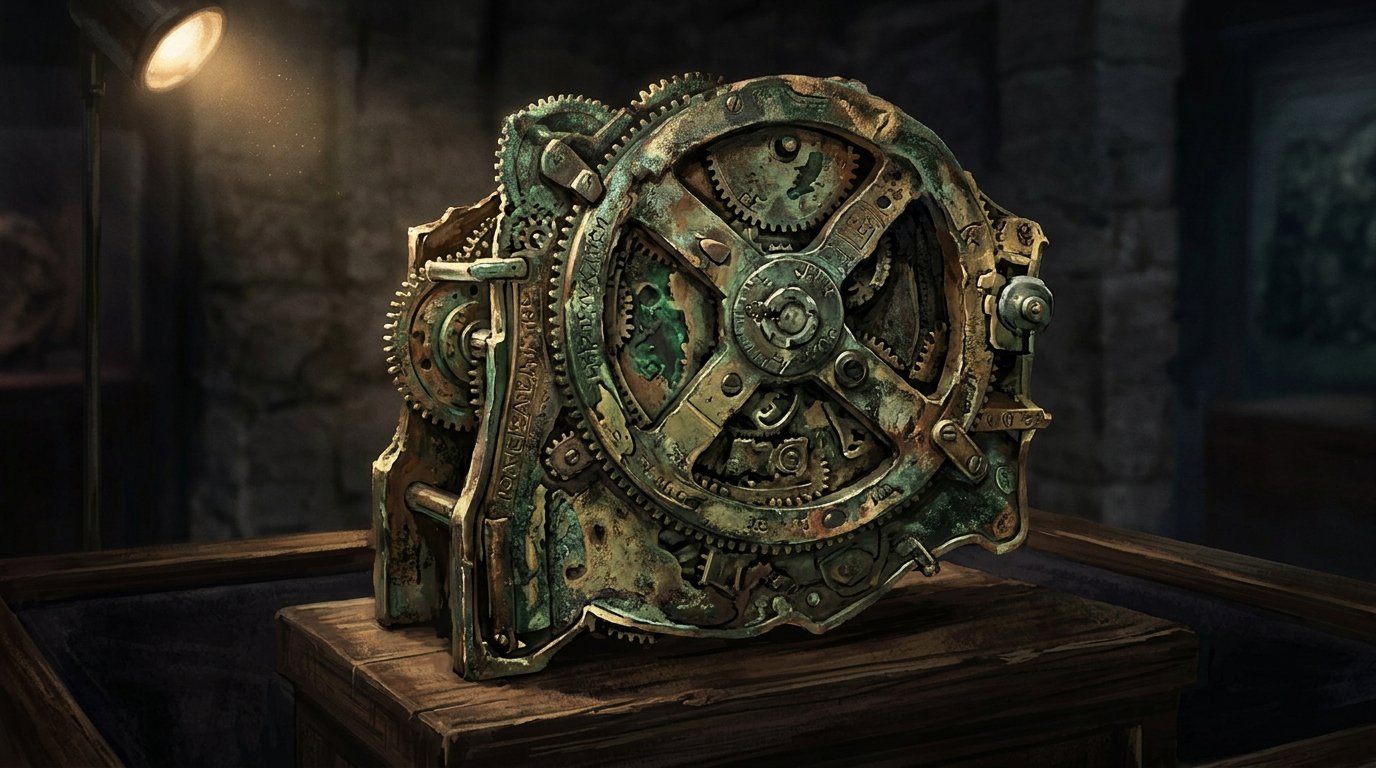
For decades, the corroded object resisted understanding. It was clearly mechanical, clearly complex, but its purpose stayed locked inside layers of corrosion and broken fragments. Today, the surviving pieces amount to 82 fragments containing around 30 corroded bronze gearwheels — only about a third of the original device, which once stood about a foot tall and was housed in a wooden case.
Antikythera Mechanism: So What Did It Actually Do?
Here’s the part that earns the “computer” label. The device wasn’t a calculator in the modern sense — it had no electronics, obviously — but it was an analog computer: a machine that takes an input and mechanically computes a complex output. Many researchers consider it the world’s first known analog computer.
The input was simple: you turned a hand crank on the side to set a date. From there, the internal gear train did the heavy lifting, and the dials on the front and back displayed a startling range of astronomical information:
- The position of the Sun and Moon against the zodiac
- The phase of the Moon on any given date
- The positions of the five planets known in antiquity — Mercury, Venus, Mars, Jupiter, and Saturn
- Predictions of solar and lunar eclipses, years in advance
- The dates of the Panhellenic games, including the Olympics
That last one is a beautiful detail. This device, built to track the heavens, also told its owner when the next Olympics would be held. It wasn’t only a scientific instrument — it had a civic and cultural dimension, naming games and cities across the Greek world. Some researchers think it served as teaching material; others believe it was a prized possession commissioned by someone wealthy, or even a high-status gift.
And it was accurate. Modern reconstructions suggest its predictions for the Sun and Moon stayed correct to within about a degree over long stretches. The inscriptions covering it, written in Koine Greek, functioned partly as a built-in user manual.
Antikythera Mechanism: How a Crank and Some Gears Predicted the Heavens

The genius of the device is in how it modeled the irregular motion of celestial bodies using nothing but bronze gears of carefully chosen tooth counts.
The Moon, for example, doesn’t move across the sky at a constant speed — it speeds up and slows down depending on where it is in its elliptical orbit. The builders captured this with an ingenious pin-and-slot arrangement: two gears mounted slightly off-center, one driving the other through a pin riding in a slot, producing a varying speed that mimicked the Moon’s real motion. That’s not a crude approximation. That’s a mechanical model of orbital mechanics, centuries before anyone wrote down the underlying physics.
To handle the planets and their complicated apparent motions, the builders relied on gear ratios that approximated long astronomical cycles. Modern researchers found that the makers used clever shared gears and mathematical shortcuts — picking cycle numbers with small prime factors so the same gearwork could serve multiple planets. This is the kind of optimization a careful engineer would be proud of today.
The 2021 Breakthrough That Cracked the Front

For over a century, researchers chipped away at the puzzle, limited by the technology of their era. A major leap came in 2005, when microfocus X-ray CT scanning let researchers peer inside the fused fragments and read inscriptions hidden for two millennia. That work decoded much of the rear of the device — the eclipse predictor and the lunar motion.
But the front — the part that displayed the planets as an ancient Greek “Cosmos” — stayed unresolved. The surviving gears for the front simply didn’t add up to a working model anyone could reconstruct.
Then, in March 2021, a research team at University College London led by Professor Tony Freeth published a new proposed reconstruction in Scientific Reports. Using the inscriptions’ own descriptions of planetary cycles, they produced the first model that, in their words, conforms to all the physical evidence and matches the device’s own engraved descriptions. It was a genuine milestone — though Freeth’s team is careful to note that, lacking some original parts, their reconstruction may still be incomplete. More than 120 years after divers pulled it from the sea, the device still hasn’t fully given up its secrets.
Antikythera Mechanism: Who Built It — and Why Does Nothing Else Like It Survive?
This is where the headline’s “shouldn’t exist” really bites. The builder is unknown. Researchers have floated names from the era’s scientific elite — Archimedes of Syracuse, Hipparchus of Rhodes, the philosopher Posidonius — but the honest answer is that nobody knows who designed it. The island of Rhodes, a center of ancient Greek astronomy, is a leading candidate for where it was made.

The deeper mystery isn’t how it was built, but why it’s alone. A device this sophisticated implies a tradition — workshops, predecessors, apprentices, refinements over generations. You don’t leap straight to a 30-gear astronomical computer with no practice runs. Yet not a single comparable mechanism survives from the ancient world. Whether others existed and were lost, melted down, or simply haven’t been found, we don’t know.
That absence is exactly what fuels the “ancient aliens” theories that cling to this object. But the device doesn’t need them. Everything about it — the Greek inscriptions, the astronomical knowledge it encodes, the manufacturing techniques — is consistent with the documented capabilities of Hellenistic Greek science. The ancient Greeks had mathematics, astronomy, and metalworking. What they apparently lacked was a reason to mass-produce such a thing, or the luck to have more than one survive a shipwreck and 2,000 years on the seafloor.
Antikythera Mechanism: Why It Still Matters
The real lesson of this object isn’t that the ancients had impossible technology. It’s that our picture of the past is built from survivors — the handful of objects that happened to last. For centuries, historians assumed this level of mechanical sophistication simply didn’t exist before the Renaissance, because no evidence of it had survived. One corroded lump, overlooked in a museum drawer, overturned that assumption entirely.
It’s a humbling reminder that “we’ve never found one” is not the same as “it never existed.” Somewhere out there, the workshop that built it, and perhaps the devices that came before it, may still be waiting — just like this one waited, in silence, on the seafloor off a barren Greek island for two thousand years.
Fascinated by ancient ingenuity that defies expectations? Read our breakdowns of [the underground city of Derinkuyu] and [the real reason Rome fell].
FAQ Section (add at the bottom of the post)
What is the Antikythera Mechanism? It is an ancient Greek astronomical calculator, often called the world’s first known analog computer. Dated to roughly the 2nd–1st century BCE, it used bronze gears to predict the positions of the Sun, Moon, and planets, as well as eclipses and the dates of the Olympic Games.
When and where was it discovered? Greek sponge divers found it in a Roman-era shipwreck off the island of Antikythera in 1900–1901. The corroded device went unnoticed until the archaeologist Valerios Stais spotted a gear wheel in it in 1902.
How does the Antikythera Mechanism work? The user turned a hand crank to set a date, and an internal system of around 30 interlocking bronze gears moved dials that displayed astronomical information, including the Moon’s phase and position and predicted eclipses.
Who built it? The builder is unknown. Researchers have suggested figures such as Archimedes, Hipparchus, or Posidonius, and the island of Rhodes is considered a likely place of manufacture, but no definitive answer exists.
Why is it considered impossible for its time? No other device of comparable mechanical complexity survives from the ancient world, and nothing similar reappears for over a thousand years. Its sophistication far exceeds what historians previously believed ancient Greek engineering could achieve.
AI Image Generated by Grok.com and lovart.ai
Click this link to read our important and interesting articles as soon as they are published!