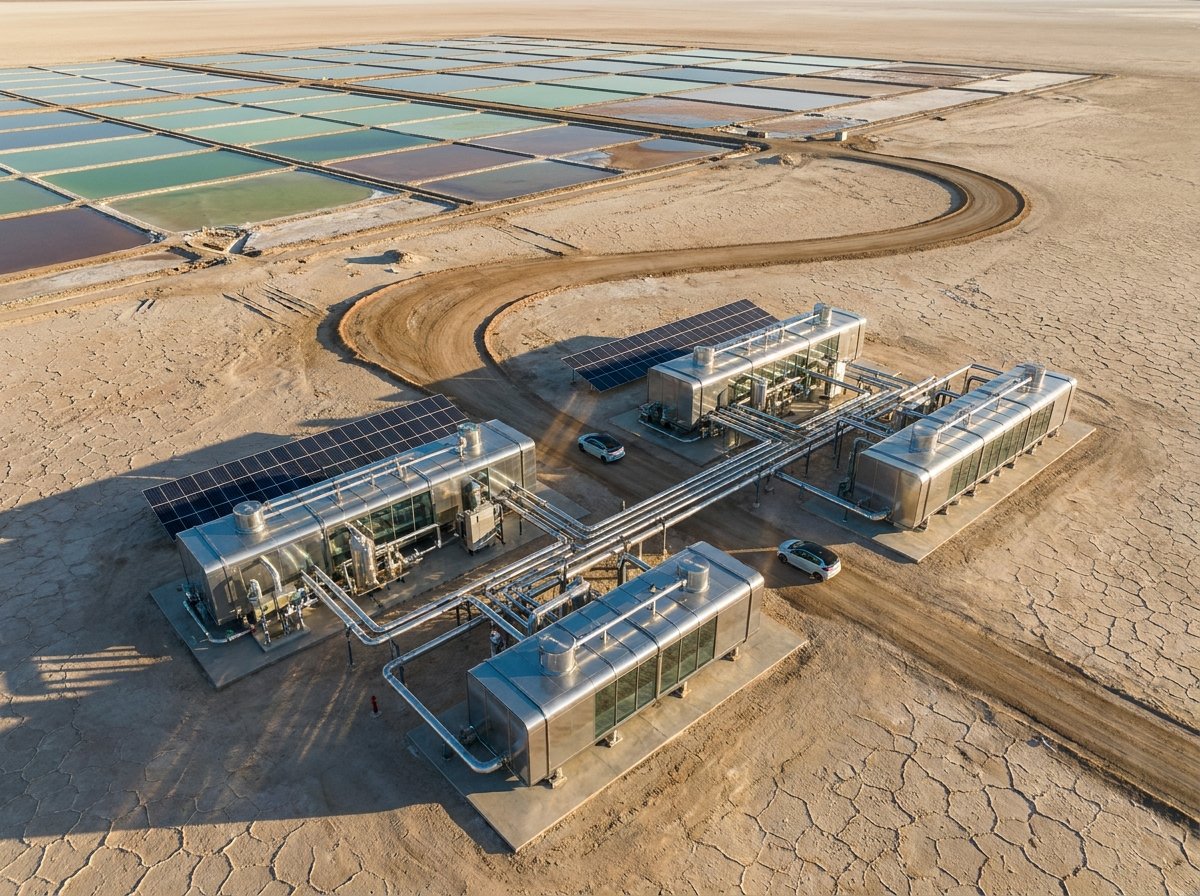
In the salt flats of Argentina’s Salta Province, at nearly 4,000 meters above sea level, brine that once sat quietly for millions of years is now being pumped up, filtered, and turned into battery-grade lithium carbonate in about a week. A few years ago, the same process would have taken a year and a half and covered dozens of hectares in evaporation ponds. The technology responsible for that shift has a plain, almost clinical name — direct lithium extraction — but it may end up being one of the most consequential pieces of chemistry behind the entire electric vehicle revolution.
Every EV battery on the road today needs lithium, and for decades there were really only two ways to get it: dig it out of hard rock, or pump lithium-rich brine into giant ponds and wait for the sun to evaporate the water away. Direct lithium extraction is a newer, faster, chemistry-driven alternative, and in 2026 it is finally moving from pilot projects into full industrial operation — right as global EV demand is straining the supply of the metal that makes those batteries work.
What Direct Lithium Extraction Actually Is

At its core, direct lithium extraction (DLE) is a set of chemical and physical processes that selectively pull lithium ions out of brine — salty underground water — without needing to evaporate the water first. Instead of waiting for a year or more in an open-air pond, brine is pumped through specially engineered materials that grab onto lithium ions and let almost everything else pass through.
There are several competing DLE approaches. Some use ion-exchange resins or sorbents that act like a chemical sponge, absorbing lithium and releasing it later using a wash solution. Others use membrane-based electrodialysis, where an electrical current pulls lithium ions across a selective membrane. A newer hybrid approach, called DLE-R (direct lithium extraction and refining), combines extraction and purification into a single continuous process, cutting out several intermediate steps that traditional lithium refining requires.
Whichever method is used, the brine that’s left over is typically reinjected back underground, and the process can be completed in days rather than months. That single difference — speed — is what has industry analysts describing 2026 as the year direct lithium extraction stopped being a laboratory promise and became an industrial reality.
Why the Old Method Can’t Keep Up

To understand why direct lithium extraction matters, it helps to understand what it’s replacing. The traditional method for brine-based lithium production — used for decades in Chile’s Atacama salt flats — relies on pumping brine into a series of shallow, sun-baked evaporation ponds. Water slowly evaporates over 12 to 18 months, gradually concentrating the lithium until it can be chemically processed into carbonate or hydroxide.
That method works, but it has three serious drawbacks that are becoming harder to ignore as global lithium demand grows. First, it’s slow — a year and a half of waiting is a long time when EV manufacturers need supply now. Second, it recovers relatively little of the available lithium, often only 40 to 50 percent, because a meaningful share is lost during evaporation. Third, and increasingly controversial, it consumes enormous volumes of fresh water in some of the driest regions on Earth, competing directly with local communities and ecosystems for a scarce resource.
Direct lithium extraction addresses all three problems at once. Recovery rates with modern DLE systems can reach roughly 90 percent of the lithium contained in the brine — nearly double the traditional evaporation method. Processing time drops from over a year to about a week. And because DLE doesn’t rely on evaporation, it can cut water consumption dramatically; some DLE systems use up to 99 percent less fresh water per ton of lithium produced compared to old evaporation ponds. That combination of speed, yield, and water savings is why mining companies, oil majors, and governments are now racing to deploy direct lithium extraction at scale.
From Pilot Plants to Industrial Reality

The clearest proof that direct lithium extraction has crossed from concept to commercial fact sits in Argentina. French mining group Eramet’s Centenario plant, built on the Centenario-Ratones salar in Salta Province, began commercial-scale operation using an in-house DLE process, becoming one of the first facilities in the world to produce battery-grade lithium carbonate this way at industrial volume. The plant is designed to produce 24,000 metric tons of lithium carbonate a year, drawing from a resource base estimated at more than 15 million tons of lithium carbonate equivalent — enough, in theory, to support decades of expansion. Eramet reports lithium recovery around 90 percent, compared with the 40 to 50 percent typical of conventional evaporation at the same site.
The United States is chasing a very different version of the same technology, and the players are surprising: oil companies. ExxonMobil has been drilling into the Smackover Formation in southern Arkansas — a region long known for oil and gas — targeting lithium-rich brine sitting roughly 10,000 feet underground. Because the geology is already well understood from a century of petroleum drilling, ExxonMobil is applying its existing drilling expertise while licensing direct lithium extraction technology to separate the metal from the brine, aiming to begin production by 2027 and eventually supply enough lithium for a million electric vehicles a year by 2030. Chevron and Standard Lithium have also staked out large positions nearby, turning Arkansas’s Smackover Formation into an unlikely new front line in the EV battery supply chain.
The Global Race and the Latest 2026 Developments
2026 has brought a wave of new direct lithium extraction news. In the United Kingdom and Australia, two clean-tech firms, ElectraLith and Captura, announced a partnership combining ElectraLith’s DLE-R process with Captura’s membrane-based electrodialysis technology, targeting commercial pilot plants on American soil by early 2027 and a broader global rollout by 2028. The companies argue that bolting the two technologies together can deliver battery-grade lithium with fewer processing steps and less chemical use than either method alone — though industry veterans caution that lithium extraction has a long history of methods that impress in the lab and struggle once scaled up.

Market researchers are increasingly bullish on the sector’s trajectory. Industry forecasts now project the global direct lithium extraction technology and services market growing from roughly $1.5 billion in 2026 to more than $5.7 billion by 2036, a compound annual growth rate near 14 percent. Lithium producers and miners are expected to remain the dominant customers, and analysts note a broader industry shift: DLE developers are moving away from small demonstration projects and toward continuous, large-scale commercial plants, while increasingly linking extraction directly to downstream battery-grade conversion.
Governments are also stepping in. In the United States, the Department of Energy announced $69 million in funding to support projects that combine mineral extraction with geothermal power generation — an approach that could let future DLE plants pull both lithium and clean electricity from the same underground brine resource, potentially making the process even more sustainable.
Environmental Trade-Offs Worth Understanding
Direct lithium extraction is often marketed as the “clean” alternative to older mining methods, and in several important respects that’s accurate: less land disturbance, dramatically less water use, and faster turnaround. But it isn’t without environmental cost. DLE facilities still require chemical reagents for extraction and regeneration, generate waste streams that must be managed responsibly, and — like any large brine operation — carry some risk of affecting groundwater systems if not carefully monitored. Reinjecting the depleted brine back underground, as ExxonMobil and Eramet both do, is one way operators are trying to minimize long-term impact, but the technology is still young enough that its full environmental footprint at a truly massive scale remains to be seen.
Future Research and Development

Looking ahead, several research threads are converging to make direct lithium extraction faster, cheaper, and more broadly deployable. Scientists are developing next-generation sorbents and membranes engineered for specific brine chemistries, since lithium concentration and the mix of other minerals present vary enormously from one salar to another. Combining DLE with geothermal energy production, as the Department of Energy is now funding, could turn extraction plants into dual-purpose facilities that produce both critical minerals and clean power. And hybrid processes like DLE-R, which fuse extraction and refining into one continuous line, are being watched closely as a way to shrink the number of separate processing steps — and the cost — between raw brine and battery-ready material.

What began as a niche chemical engineering challenge is now central to the geopolitics of the energy transition. As countries compete to secure lithium supply chains outside traditional mining giants, and as EV demand keeps climbing, direct lithium extraction has moved from an interesting technical footnote to one of the defining industrial technologies of the 2020s — the quiet chemistry making sure the electric vehicle boom doesn’t run out of road.
3. FAQ SECTION
Q1: What is direct lithium extraction (DLE)? Direct lithium extraction is a group of chemical technologies — including ion-exchange, sorbents, and membrane electrodialysis — that pull lithium directly out of brine without needing to evaporate the water first, cutting processing time from over a year to about a week.
Q2: How is direct lithium extraction different from traditional lithium mining? Traditional brine mining relies on evaporation ponds that take 12–18 months and recover only 40–50% of available lithium. Direct lithium extraction can recover up to 90% of the lithium in days, while using far less water.
Q3: Is direct lithium extraction actually being used commercially, or is it still experimental? It’s commercial now. Eramet’s Centenario plant in Argentina produces 24,000 tons of battery-grade lithium carbonate a year using DLE, and ExxonMobil is developing a large DLE project in Arkansas targeting first production by 2027.
Q4: Why are oil companies like ExxonMobil and Chevron getting into lithium extraction? They already have the drilling expertise to access deep underground brine reservoirs; they just need direct lithium extraction technology to separate the lithium once it’s pumped to the surface, letting them apply existing skills to a new resource.
Q5: Does direct lithium extraction use less water than traditional methods? Yes. Some DLE systems use up to 99% less water per ton of lithium produced compared to evaporation ponds, which is especially important in arid regions like Argentina’s Lithium Triangle.
Q6: How big is the direct lithium extraction market expected to become? Forecasts project the global DLE technology and services market growing from around $1.5 billion in 2026 to over $5.7 billion by 2036.
Click this link to read our important and interesting Engineering articles as soon as they are published!