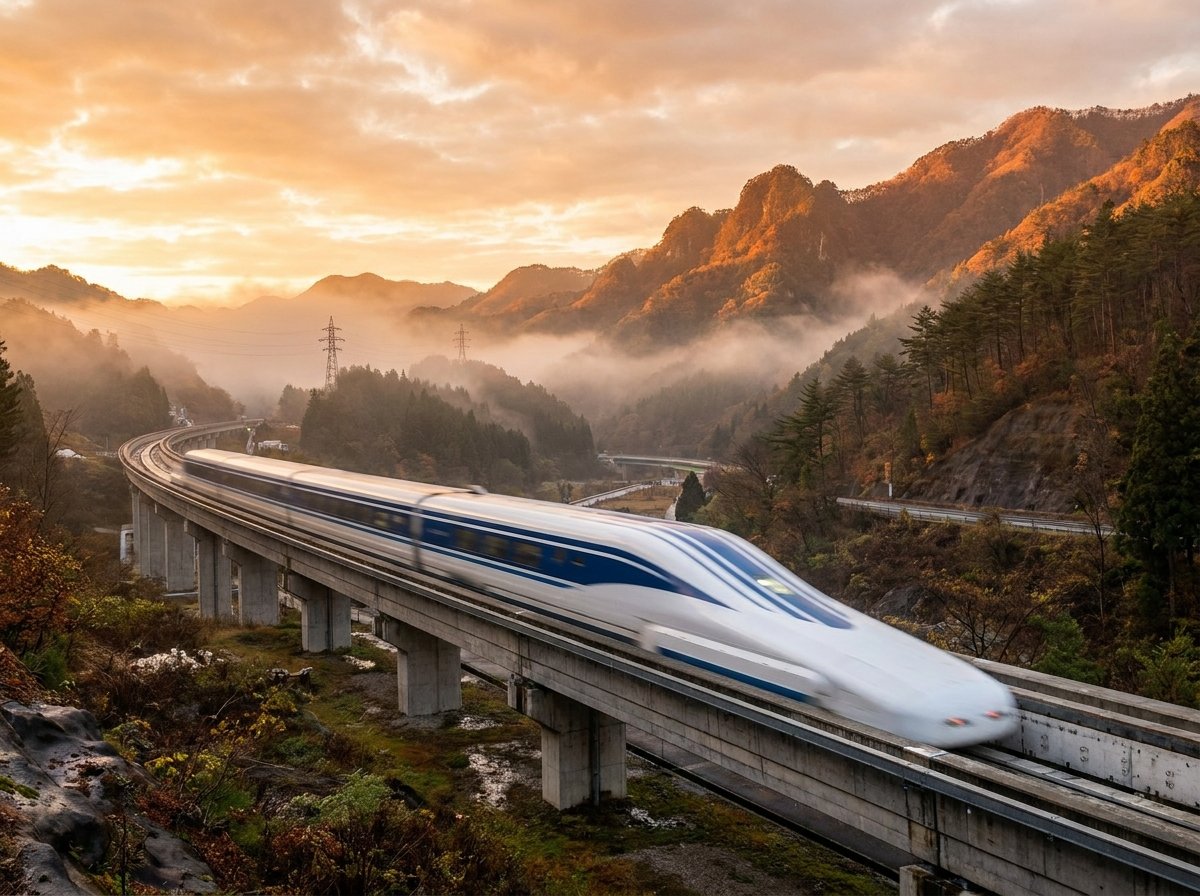
Somewhere in the mountains west of Tokyo, a white train with a shark-like nose sits on a raised concrete guideway, waiting for a green light. When it finally moves, something strange happens: it doesn’t roll. It floats — hovering roughly 10 centimeters above the track on an invisible cushion of magnetic force, then surging forward at speeds that would leave a commercial jet’s takeoff run looking sluggish. This is maglev, short for magnetic levitation, and the guideways, power stations, and tunnels built to support it represent one of the most ambitious categories of maglev train infrastructure ever attempted by modern engineers.
Unlike a conventional train, a maglev vehicle has no wheels touching a rail. There is no steel-on-steel friction, no mechanical wear, and — in theory — far less noise and vibration. But that freedom from friction comes at an enormous structural price. Maglev train infrastructure cannot simply reuse existing railway lines; it needs an entirely new, precisely engineered guideway system built from scratch, which is exactly why, decades after the technology was proven, only a handful of countries have actually built it.
How Magnetic Levitation Actually Works

There are two competing approaches to maglev technology, and understanding them explains almost everything about why maglev train infrastructure is so expensive and so different from ordinary rail.
The first is Electromagnetic Suspension (EMS), used by Germany’s original Transrapid system and by the Shanghai Maglev in China. In EMS, magnets mounted on the underside of the train wrap around a steel guideway and are pulled upward toward it, with onboard sensors constantly adjusting the current to keep a small, stable air gap of about a centimeter. It’s an active, computer-balanced form of levitation — closer to a controlled magnetic hover than a passive float.
The second is Electrodynamic Suspension (EDS), the system Japan uses for its Chuo Shinkansen. EDS relies on superconducting magnets cooled to extremely low temperatures, which induce currents in coils embedded in the guideway walls as the train moves. Those induced currents create a repulsive force that pushes the train upward and sideways, creating a larger, more forgiving levitation gap of around 10 centimeters. EDS needs speed to generate lift, so these trains ride on rubber tires at low speed before “taking off” magnetically once they’re moving fast enough.
Both systems eliminate rolling friction, which is the main reason maglev trains can safely operate at speeds conventional wheeled trains cannot reach without dangerous vibration and track wear.
The Infrastructure Problem: Why Maglev Is So Expensive to Build

This is the part magazine headlines about “floating trains” tend to skip. The vehicle is the easy part. The real challenge of maglev train infrastructure is the guideway — the physical structure the train levitates over.
Because a maglev vehicle can’t turn a normal curve or climb a normal grade at high speed, its guideway must be built with extremely gentle curvature and elevation changes, engineered to tolerances measured in millimeters. In mountainous countries like Japan, that means most of the line has to run through tunnels bored directly through mountains, or on elevated viaducts that carry the train dead straight across valleys. Japan’s Chuo Shinkansen maglev line, connecting Tokyo and Nagoya, will run roughly 86 percent of its route underground for exactly this reason.
Then there’s the guideway itself, which is not passive concrete — it’s an active electrical system. For EDS lines, thousands of propulsion coils have to be embedded along the walls with millimeter-level precision, wired to substations that feed them alternating current in a carefully timed sequence, essentially turning the entire guideway into one long linear motor. Power substations have to be built every few kilometers to energize each section as the train passes through it. None of this can be adapted from existing rail infrastructure; it has to be purpose-built.
The result is a price tag that dwarfs conventional high-speed rail. Japan’s Chuo Shinkansen maglev project is now estimated to cost around ¥11 trillion, or roughly $67.7 billion, for a single 286-kilometer intercity corridor. Every kilometer of maglev train infrastructure built through mountainous or urban terrain adds tunneling costs, land acquisition costs, and specialized electrical engineering costs that a normal railway simply does not face.
Where Maglev Train Infrastructure Exists Today

Despite the cost, maglev technology isn’t theoretical — it’s already carrying passengers. The Shanghai Maglev in China remains the fastest commercially operating train of any kind in the world, reaching 430 km/h on its short airport link using EMS technology derived from Germany’s Transrapid research. South Korea also operates a low-speed EMS maglev line serving Incheon Airport, aimed more at demonstrating the technology than breaking speed records.
Japan’s approach is more ambitious. Its SCMaglev L0 Series, using EDS technology, holds the outright world speed record for any train: 603 km/h, set during a test run on the Yamanashi test track back in 2015. That test line is now being extended into a full commercial corridor, the Chuo Shinkansen, which will eventually connect Tokyo, Nagoya, and Osaka at an operating speed of about 500 km/h — cutting the current two-and-a-half-hour Tokyo–Osaka trip to roughly an hour.

That project has been repeatedly delayed. For nearly nine years, construction of a critical stretch through Shizuoka Prefecture was blocked by the region’s former governor, who cited concerns that tunneling could reduce water flow in the Oi River, an important local water source. In July 2026, new Shizuoka Governor Yasutomo Suzuki finally approved construction of that segment, clearing the last major political obstacle to the project. Even so, JR Central, the railway operator building the line, still faces soaring construction costs and a construction timeline that continues sliding — passenger service isn’t expected to begin before the early 2030s at the earliest.
The United States: A Cautionary Tale
If Japan shows how far maglev train infrastructure can go with sustained political commitment, the United States shows what happens without it. The proposed Baltimore–Washington Superconducting Maglev Project — a 64-kilometer line meant to link Washington, D.C. and Baltimore using licensed Japanese SCMaglev technology at speeds up to 505 km/h — spent years moving through federal environmental review. In 2025, the Federal Railroad Administration formally rescinded its environmental review process for the project, concluding the plan would cause unresolvable impacts to federal property and agency operations, and citing years of delay and cost overruns. The agency noted this doesn’t permanently rule out SCMaglev technology in the U.S., but for now, America’s most advanced maglev train infrastructure proposal exists only on paper.
China’s Next Leap: Vacuum-Tube Maglev

While Japan builds tunnels and America shelves proposals, China is pushing maglev technology in a more radical direction: combining magnetic levitation with a near-vacuum tube to remove air resistance entirely. The project, known as T-Flight and developed by the China Aerospace Science and Industry Corporation, has already completed low-vacuum test runs at 623 km/h on a short test track, with a design target of 1,000 km/h — fast enough to rival a jet airliner over land. In a separate test, Chinese engineers also demonstrated a superconducting maglev vehicle accelerating from a standstill to 700 km/h in just two seconds, showcasing propulsion technology that researchers say could eventually assist rocket launches as well as trains.
This hyperloop-style maglev train infrastructure faces its own brutal engineering demands: the test tube’s inner surface has to be flattened to within a third of a millimeter across its full length to prevent instability at extreme speed, and maintaining a vacuum across dozens or hundreds of kilometers is vastly harder than doing it over a two-kilometer test track. As one Railway News analysis put it, the maglev half of the equation is basically solved — the open question is whether anyone can build and maintain vacuum-tube infrastructure at a truly useful scale.
The Road Ahead: Research and Development

Future maglev train infrastructure research is converging on a few key fronts. Higher-temperature superconducting magnets could cut the enormous cooling costs that make EDS systems expensive to run. Modular, prefabricated guideway segments are being studied as a way to reduce on-site construction time in projects like the Chuo Shinkansen. And the vacuum-tube maglev concept, if it matures, could eventually connect not just cities within a country but entire regions, at speeds no conventional aircraft-free technology has ever achieved.
What’s clear is that maglev train infrastructure sits at an unusual crossroads: the core levitation technology has been proven safe and reliable for decades, yet building the surrounding infrastructure at scale remains one of the most expensive and politically fraught undertakings in modern engineering. Whether the next breakthrough comes from Japan’s patient tunnel-boring, China’s vacuum-tube ambitions, or a revived American project, the story of maglev is really a story about infrastructure — not the trains that float, but everything humans have to build so they can.
3. FAQ SECTION
Q1: What is maglev train infrastructure, exactly? Maglev train infrastructure refers to the specialized guideway, power substations, tunnels, and viaducts built specifically for magnetic levitation trains. Unlike normal railway track, it cannot be shared with conventional trains and must be engineered to extremely tight tolerances.
Q2: How fast can maglev trains go? Japan’s SCMaglev holds the world record at 603 km/h, set in a 2015 test run. The Shanghai Maglev is the fastest train in regular commercial service at 430 km/h. China’s experimental T-Flight vacuum-tube maglev is targeting speeds up to 1,000 km/h.
Q3: Why is maglev train infrastructure so much more expensive than regular high-speed rail? Because it requires an entirely new guideway system with embedded electrical coils, dedicated power substations, and extremely precise tunneling or elevated construction — none of which can reuse existing rail infrastructure.
Q4: Which countries currently operate maglev trains? China (Shanghai Maglev) and South Korea (Incheon Airport Maglev) operate commercial lines today. Japan is building the Chuo Shinkansen, a much longer intercity maglev corridor, with service expected in the early 2030s.
Q5: What happened to the US maglev project between Baltimore and Washington? In 2025, the Federal Railroad Administration rescinded its environmental review of the project, effectively shelving it, though officials noted this doesn’t rule out SCMaglev technology in the US in the future.
Q6: What’s the difference between EMS and EDS maglev systems? EMS (Electromagnetic Suspension) uses attractive magnetic force and works at any speed; EDS (Electrodynamic Suspension) uses repulsive force generated by superconducting magnets and only levitates once the train is already moving.
Click this link to read our important and interesting Engineering articles as soon as they are published!