More than 1,000 years before GPS satellites, a scholar standing on a mountain peak in present-day Pakistan calculated the Earth’s Radius — alone, without telescopes, computers, or space technology. His answer was off by less than 1% from what we know today. His name was Abu Rayhan Al-Biruni, and his method was so elegant it still appears in university physics textbooks. Al-Biruni’s Earth’s Radius Measurement.
This is the story of how one man, a mountain, and pure mathematics rewrote the limits of human knowledge.
Who Was Al-Biruni? The Genius Behind the Calculation
Born in 973 CE in Khwarezm (modern-day Uzbekistan), Abu Rayhan Muhammad ibn Ahmad al-Biruni was among the greatest polymaths the world has ever produced. He wrote over 146 works spanning astronomy, mathematics, geography, pharmacology, history, and linguistics. He learned Sanskrit to study Indian texts in their original language. He debated with Ibn Sina (Avicenna) through letters. He measured, questioned, and documented — decades before the European Renaissance even began.
When Sultan Mahmud of Ghazni’s campaigns brought Al-Biruni to the Indian subcontinent in the early 11th century, he didn’t waste the opportunity. He studied local scholars, mapped the geography, and — famously — climbed a mountain near the Salt Range in Punjab to conduct one of the most brilliant experiments in the history of science.
The Problem: How Do You Measure a Planet?
Before Al-Biruni, Greek scholars had already attempted to measure Earth’s size. Around 240 BCE, Eratosthenes calculated Earth’s circumference using the angle of sunlight between two Egyptian cities — Alexandria and Syene — on the same day. His result was remarkably close to modern measurements.
But Al-Biruni’s challenge was different: he wanted a method that could be performed by a single observer, without needing simultaneous measurements at two distant locations. He wanted a portable, repeatable method.
The answer, he realized, was right in front of him — literally. A mountain.
Al-Biruni’s Mountain Method — Step by Step
Al-Biruni’s Earth’s Radius Measurement

Al-Biruni’s method, now called the “dip angle method,” is a masterpiece of applied trigonometry. Here’s how it worked:
Step 1: Measure the Mountain’s Height
Al-Biruni first calculated the height of the mountain using triangulation — a standard surveying technique where you measure horizontal distances and vertical angles from two known points at the base of the mountain. This gave him the mountain’s height (h).
Step 2: Observe the Dip of the Horizon
Standing at the mountaintop, Al-Biruni used an astrolabe — the high-tech instrument of its era — to measure the “dip angle” (θ). This is the angle between the true horizontal plane and the line of sight to the horizon. When you’re at sea level, the horizon appears perfectly horizontal (0° dip). But when you’re elevated on a mountain, you can literally see the Earth curve away below you, and the horizon dips below the horizontal.
Step 3: Apply the Trigonometry
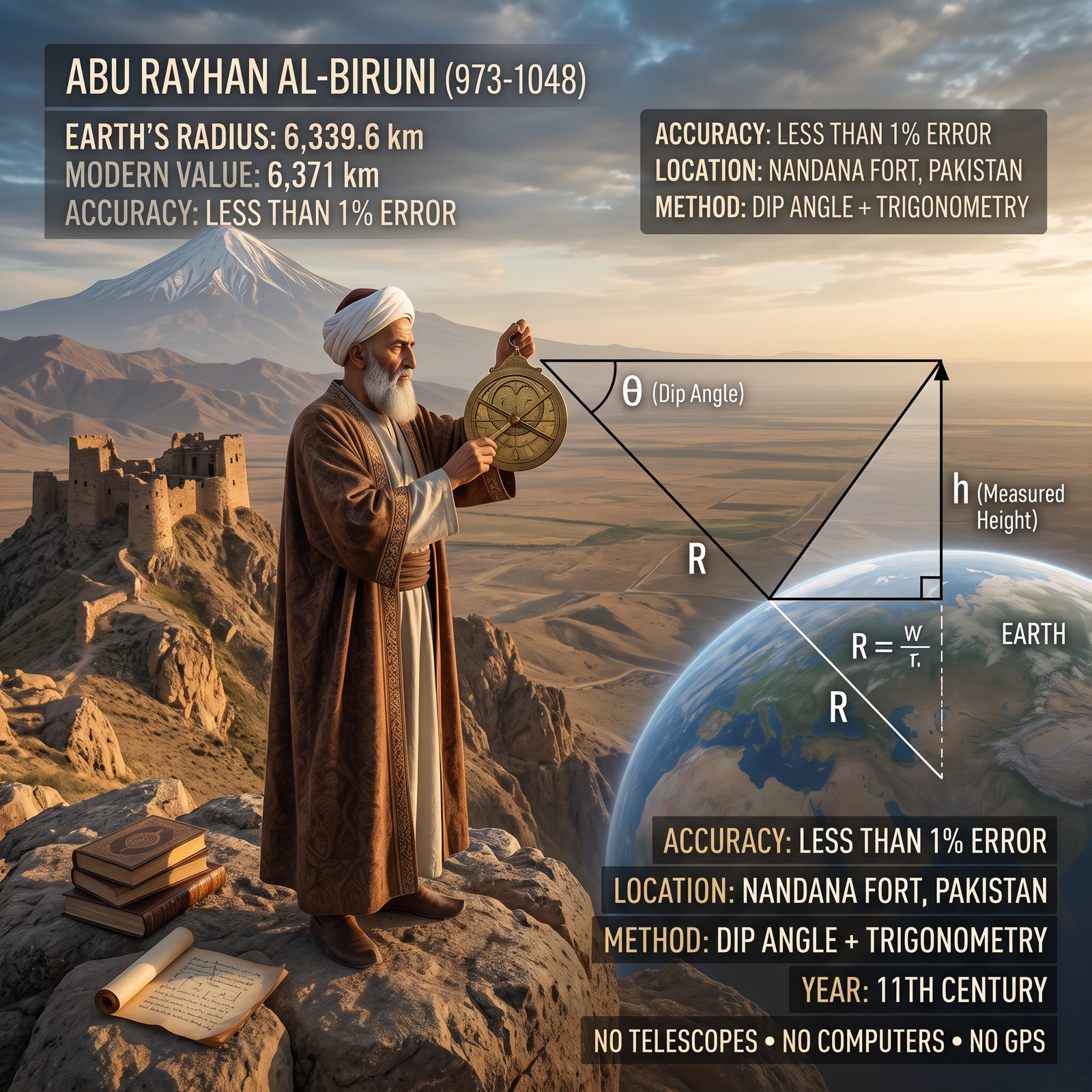
With the mountain height (h) and the dip angle (θ), Al-Biruni used a right-triangle relationship. If R is Earth’s radius:
The line from the mountaintop to the horizon is tangent to Earth’s surface. This creates a right triangle where:
The hypotenuse = R + h (from Earth’s center to the mountaintop)
One side = R (from Earth’s center to the horizon point)
The dip angle θ is at the mountaintop
This gives the relationship: cos(θ) = R / (R + h)
Solving for R: R = h·cos(θ) / (1 − cos(θ))
Step 4: Al-Biruni’s Result
Working in medieval units, Al-Biruni calculated Earth’s radius as approximately 6,339.6 kilometers. The modern accepted value is 6,371 kilometers. That’s an error of roughly 0.5% — extraordinary for the 11th century, and arguably more accurate than Eratosthenes’ earlier estimate.
Why This Was Revolutionary
What made Al-Biruni’s approach so remarkable wasn’t just the accuracy — it was the methodology. He had:
Eliminated the need for simultaneous distant observations. Eratosthenes needed two cities, two observers, and precise timing. Al-Biruni needed only a mountain and one carefully measured angle.
Combined empirical measurement with mathematical rigor. He didn’t guess or philosophize — he measured, calculated, and documented his methodology so others could repeat it.
Accounted for practical limitations. Al-Biruni was aware of atmospheric refraction — the way Earth’s atmosphere bends light — and he discussed its effects on angular measurements, demonstrating a level of scientific self-awareness that was centuries ahead of its time.
The historian of science S. Pines described Al-Biruni’s scientific method as resembling modern empirical science more closely than almost any other medieval scholar. The Encyclopædia Britannica calls him “the first anthropologist” for the cultural rigor he brought to his studies of India — but his Earth measurement alone would cement his legacy forever.
The Tools Al-Biruni Used — Medieval Technology Meets GeniusAl-Biruni’s Earth’s Radius Measurement
Al-Biruni’s primary instrument was the astrolabe, a device used to measure angles between celestial bodies and the horizon. By his era, Islamic craftsmen had refined the astrolabe to extraordinary precision. He also relied on:

Graduated quadrants for angular measurement
Surveying poles for baseline measurements
Trigonometric tables he himself helped compile and refine
He published his methods in his landmark work Kitab Tahdid Nihayat al-Amakin (“The Determination of the Coordinates of Positions for the Correction of Distances between Cities”), written around 1025 CE. This text remains one of the foundational documents of geodesy — the science of measuring Earth’s shape and size.
Al-Biruni’s Legacy in the Age of GPS

Today, Earth’s radius is known with extraordinary precision thanks to satellite geodesy, laser ranging, and the Global Navigation Satellite System (GNSS). The Earth is not a perfect sphere — it’s an oblate spheroid, slightly flattened at the poles and bulging at the equator, with an equatorial radius of 6,378.1 km and a polar radius of 6,356.8 km.
Yet Al-Biruni’s single-mountain measurement — conducted with a brass astrolabe and mathematical ingenuity — landed within half a percent of those modern values. His work reminds us that precision isn’t only a product of technology; it’s a product of careful thought.
Why This Story Matters Today

In an era of information overload, Al-Biruni’s story carries a striking lesson: the tools matter far less than the quality of the questions you ask. He worked during the Islamic Golden Age (8th–14th centuries CE), a period when the Arab world was the global center of mathematics, astronomy, medicine, and philosophy. Scholars like Al-Khwarizmi (who gave us algebra and the word “algorithm”), Ibn al-Haytham (who pioneered optics), and Al-Biruni himself built the foundations that European scientists would later inherit and build upon.
Their contributions were systematically minimized in Western historical narratives for centuries. Today, a new generation of historians and educators is working to correct that record.
Al-Biruni’s Earth’s Radius Measurement : Al-Biruni and the Flat Earth Debate

Al-Biruni lived in an era when the spherical Earth was accepted scientific consensus in the Islamic scholarly tradition — not a controversial claim. His work didn’t try to prove Earth was round; it assumed that and asked: how round, exactly? That’s a distinction worth noting in an age when flat-Earth theories circulate on social media with millions of views.
He gave us the answer a millennium ago, from a mountain peak, with geometry.
The Mountain Still Stands
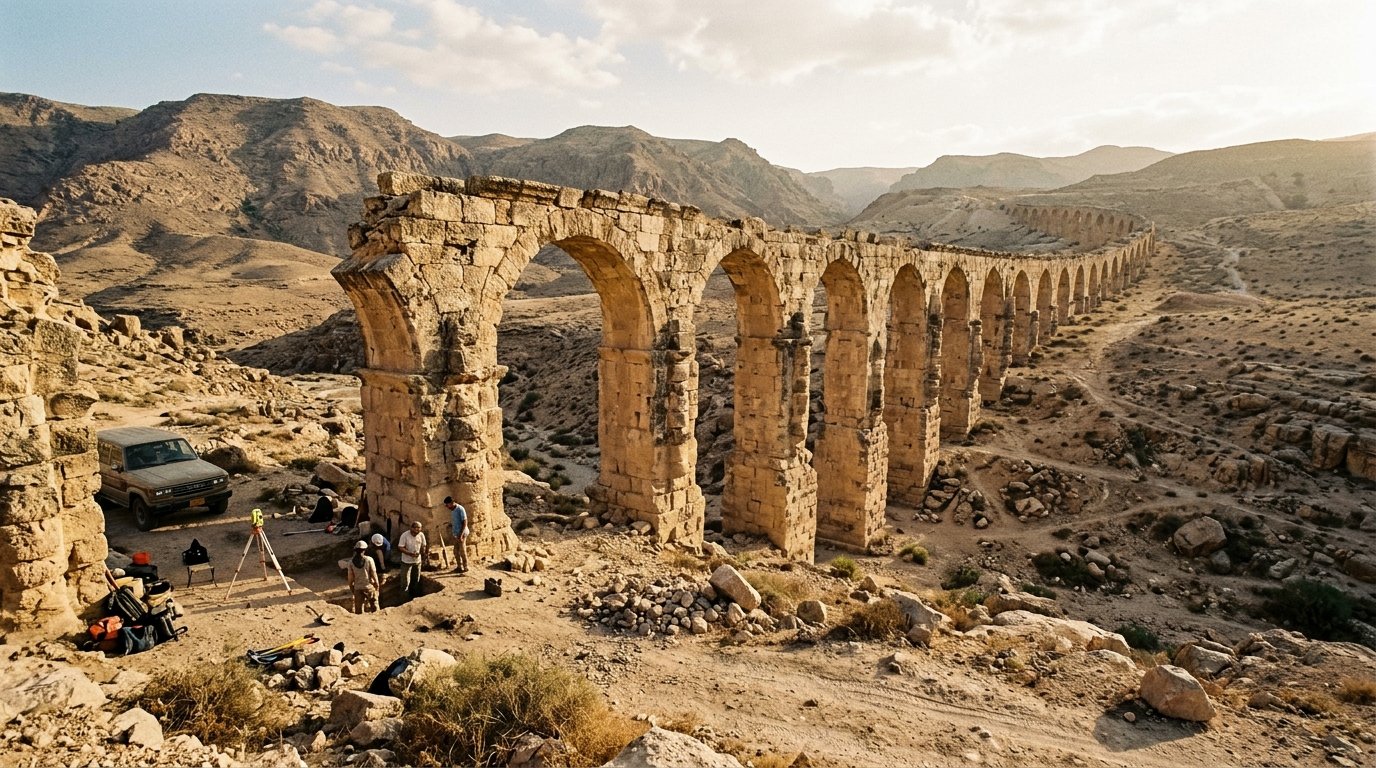
The exact mountain Al-Biruni climbed is debated by historians, but the most likely candidate is a peak in the Nandana region of Pakistan’s Punjab province — near the ruins of the Nandana Fort, where Sultan Mahmud’s army once camped. The landscape is largely unchanged. The geometry certainly is.
If you stood there today, dip angle in hand, and ran Al-Biruni’s calculation, you’d get the same answer he did. That’s what makes great science timeless.
Al-Biruni didn’t just measure the Earth. He showed the world that measurement itself — careful, humble, rigorous — is among the most human things we do.
Explore more history-of-science stories in WikiMess Magazine’s History section.
FAQ
Q: How did Al-Biruni measure the Earth’s radius?
A: Al-Biruni used the “dip angle method” — standing atop a mountain, he measured the angle at which the horizon dipped below the horizontal, then used trigonometry with the mountain’s height to calculate Earth’s radius.
Q: How accurate was Al-Biruni’s calculation?
A: Remarkably accurate — he calculated Earth’s radius at approximately 6,339.6 km, compared to the modern value of 6,371 km. That’s an error of less than 0.5%.
Q: When did Al-Biruni make this calculation?
A: Al-Biruni made this calculation around 1018–1025 CE, during the early 11th century, while accompanying Sultan Mahmud of Ghazni’s campaigns in the Indian subcontinent.
Q: What tools did Al-Biruni use?
A: He used an astrolabe to measure angles, graduated quadrants, and surveying poles — combined with his own extensive trigonometric tables.
Q: Where did Al-Biruni conduct the experiment?
A: Most historians believe he conducted the experiment at or near Nandana, in present-day Punjab, Pakistan.
Reference – plato.stanford.edu
hal.science
www.quora.com
AI Image Generated by ChatGPT and lovart.ai
Click this link to read our important and interesting articles as soon as they are published!