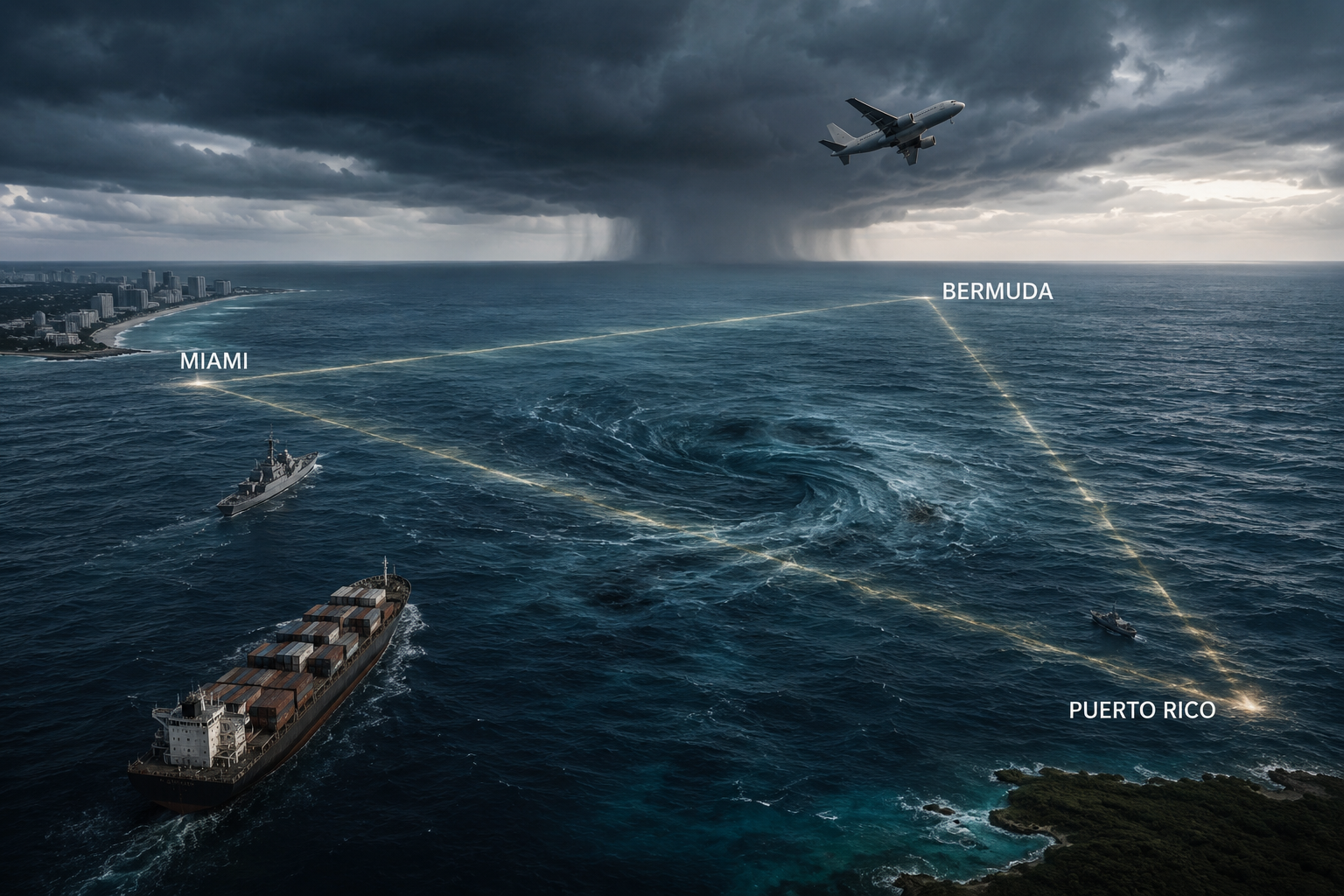
For decades, the Bermuda Triangle has swallowed ships, planes, and rational explanations whole. Stretching across roughly 500,000 square miles of Atlantic Ocean between Miami, Bermuda, and Puerto Rico, this stretch of water has claimed over 1,000 lives in the 20th century alone. But is the Bermuda Triangle mystery real — or the world’s most successful piece of geographic mythology?

The answer, as it turns out, is far more fascinating than either aliens or coincidence.
What Is the Bermuda Triangle?
The Bermuda Triangle — also called the Devil’s Triangle — is a loosely defined region in the North Atlantic Ocean. It first entered public consciousness in 1950, when journalist Edward Jones wrote about the mysterious disappearance of ships and aircraft in the area. Author Charles Berlitz then supercharged the legend with his 1974 bestseller The Bermuda Triangle, which sold over 20 million copies worldwide.\

The region sits at a geographic crossroads: it overlaps some of the world’s busiest shipping and flight lanes, is subject to violent and sudden weather, and sits atop an ocean floor that drops from shallow Caribbean reefs to some of the deepest trenches on Earth.
The Most Famous Bermuda Triangle Disappearances
Not all disappearances are equal. Several cases remain genuinely unexplained — and they deserve a closer look.

Flight 19 — The Lost Squadron (1945)
The most iconic Bermuda Triangle disappearance involved five U.S. Navy TBM Avenger torpedo bombers that vanished on December 5, 1945, during a routine training mission. All 14 airmen were lost. A rescue aircraft sent to find them also disappeared, killing 13 more.
The flight leader, Lt. Charles Taylor, was heard saying: “We can’t find west. Everything is wrong. We can’t be sure of any direction.” A Navy investigation later attributed the loss to pilot disorientation — but the disappearance of the rescue plane was never fully explained.
SS Marine Sulphur Queen (1963)
A 524-foot tanker carrying molten sulphur vanished in the Florida Straits with 39 crew members. Only a life jacket and a few debris pieces were ever recovered. The U.S. Coast Guard noted the ship had a troubled history of structural problems — but its sudden disappearance without a distress call remains chilling.
Ellen Austin Mystery (1881)
A British ship reportedly found an abandoned schooner drifting in the Bermuda Triangle. After placing a prize crew aboard to sail it to port, the schooner allegedly disappeared again — this time with both crews. Historians have since questioned whether the story was embellished, but it remains one of the region’s most retold tales.
Scientific Explanations: What Actually Causes Disappearances?
The Bermuda Triangle mystery looks very different through a scientific lens. Several credible theories have emerged — and some have substantial evidence behind them.

1. Rogue Waves
In 2024, oceanographers at the University of Southampton presented compelling evidence that rogue waves — sudden walls of water reaching 30 metres or more — may explain many historical ship disappearances in the region. These waves form when multiple wave patterns converge, and they can appear without warning in otherwise calm seas.
Using ocean modelling technology, researchers demonstrated that the geographic shape of the Bermuda Triangle creates ideal conditions for rogue wave formation, particularly during Atlantic storm season.
2. Methane Hydrate Eruptions
The ocean floor beneath the Bermuda Triangle contains vast deposits of methane hydrates — frozen methane gas locked in ice-like structures. When these deposits destabilise (due to seismic activity or rising ocean temperatures), they can release massive methane bubbles.
A large enough methane eruption could theoretically reduce water density so dramatically that ships would simply sink without warning. The same gas cloud could also affect aircraft engines and cause instrument failure. Research published in the Proceedings of the Royal Society has lent credibility to this hypothesis.
3. Unusual Compass Variations
The Bermuda Triangle is one of only two places on Earth (the other being near Japan) where true north and magnetic north align. This “agonic line” has shifted over the decades, but historically it created navigation confusion — particularly for pilots and sailors relying on magnetic compasses before GPS.
4. Violent Weather Patterns
The region sits in the path of Atlantic hurricane formation, experiences rapid weather changes, and is subject to waterspouts — tornado-like columns of water that can reach Category 1 hurricane wind speeds. Many incidents attributed to the Bermuda Triangle mystery likely have mundane meteorological explanations.
5. Human Error and the Gulf Stream
The Gulf Stream — one of the world’s most powerful ocean currents — runs directly through the triangle. It moves at up to 5 miles per hour and can rapidly disperse wreckage, making recovery nearly impossible. Combined with pilot error, mechanical failure, or fuel miscalculation, the Gulf Stream explains why so many incidents leave no trace.
Why Does the Bermuda Triangle Myth Persist?

Lloyd’s of London — one of the world’s most respected insurance markets — does not charge higher insurance premiums for ships crossing the Bermuda Triangle. The U.S. Coast Guard has stated repeatedly that the number of disappearances in the region is not statistically higher than any other heavily trafficked ocean area of comparable size.
So why does the myth endure?
Confirmation bias plays a massive role. When a plane disappears over Kansas, it’s a tragedy. When one disappears near the Bermuda Triangle, it’s a mystery. Researcher Lawrence David Kusche demolished much of the Bermuda Triangle mythology in his 1975 book The Bermuda Triangle Mystery — Solved, showing that many “mysterious” disappearances happened in different locations than claimed, during storms that were never mentioned, or simply never happened at all.
The triangle endures because humans are wired for pattern recognition — and because the ocean itself is genuinely dangerous, unpredictable, and vast enough to hide its secrets for decades.
Is the Bermuda Triangle Still Dangerous Today?

Yes — but no more dangerous than any other stretch of open ocean.
Modern GPS, satellite communication, improved weather forecasting, and advances in aviation technology have dramatically reduced disappearances across all ocean regions, including the Bermuda Triangle. The last major commercial aviation incident in the area occurred decades ago.
What makes the region genuinely challenging is its combination of heavy traffic volume, hurricane exposure, and the Gulf Stream’s ability to erase evidence. These are real hazards — just not supernatural ones.
The Verdict: Mystery or Myth?

The Bermuda Triangle is both. The disappearances are real. The geographic hazards are real. The human tendency to seek extraordinary explanations for ordinary tragedy is very real.
But the supernatural dimension — the alien abductions, the time vortexes, the sea monsters — exists entirely in the realm of bestselling paperbacks and late-night documentaries.
The true Bermuda Triangle story is actually more interesting than the myth: a confluence of rogue waves, methane eruptions, compass anomalies, violent weather, and the unforgiving power of the Gulf Stream, filtered through decades of journalistic exaggeration and human pattern-seeking.
The ocean doesn’t need mythology to be terrifying. It manages that perfectly well on its own.
Frequently Asked Questions About the Bermuda Triangle
Q: How many people have disappeared in the Bermuda Triangle? Estimates vary widely, but researchers suggest over 1,000 people have been lost in the region over the past century. However, the U.S. Coast Guard notes this figure is not statistically unusual for such a heavily trafficked ocean zone.
Q: Has the Bermuda Triangle mystery been solved? No single explanation covers all incidents. Scientists point to rogue waves, methane hydrate eruptions, compass anomalies, and severe weather as the most credible factors — but no official body has declared the matter closed.
Q: Why don’t planes fly over the Bermuda Triangle? Commercial aircraft do fly over the Bermuda Triangle regularly. It is not an aviation exclusion zone. The myth that planes avoid it is false.
Q: What is at the bottom of the Bermuda Triangle? The ocean floor beneath the Bermuda Triangle includes the Puerto Rico Trench — the deepest point in the Atlantic Ocean at 8,376 metres. This extreme depth makes wreck recovery nearly impossible, which contributes to the mystery surrounding disappearances.
Q: Is the Bermuda Triangle real or made up? The geographic area exists. The concentration of mysterious disappearances, however, is largely a media construction. Insurance data and Coast Guard records show no statistically abnormal rate of incidents compared to other ocean regions.
External authoritative sources to cite:
- NOAA.gov — ocean weather data
- U.S. Coast Guard official statements
- Lloyd’s of London insurance records
- University of Southampton rogue wave research
AI Image Generated by ChatGPT and lovart.ai
Click this link to read our important and interesting articles as soon as they are published!