Introduction: The First Globalized World
More than three thousand years ago, the Eastern Mediterranean was the center of a thriving, interconnected, and highly sophisticated global economy. The great empires of the era—the Egyptians, the Hittites, the Mycenaeans, the Assyrians, and the Babylonians—did not exist in isolation. They were bound together by a complex web of diplomacy, marriages, and, above all, international commerce. However, around 1200 BCE, this magnificent network rapidly unraveled. Palaces burned, populations vanished, and writing systems were entirely forgotten.
To understand why this happened, we cannot just look at battles or natural disasters; we must look at supply chains. The Trade Logistics of the Bronze Age Collapse offer a terrifying glimpse into how systemic fragility can destroy even the most powerful civilizations. By examining how goods moved, where the bottlenecks were, and what happened when a single node failed, we can uncover a mystery that feels strikingly relevant to our modern, hyper-connected world.

The Tin Bottleneck: The Ancient Microchip
In the modern era, our global economy relies on semiconductors and microchips. In 1200 BCE, the ultimate strategic resource was bronze. Bronze was the undisputed king of materials, used to forge everything from agricultural plows to the swords and armor of elite chariot warriors. However, creating bronze requires an incredibly specific and geographically challenging recipe: 90% copper and 10% tin.
When we analyze the Trade Logistics of the Bronze Age Collapse, the “tin bottleneck” becomes immediately apparent. Copper was relatively abundant, primarily mined in massive quantities on the island of Cyprus. Tin, however, was exceptionally rare. There were virtually no viable tin mines in the Eastern Mediterranean. To get tin, merchants had to facilitate trade caravans stretching thousands of miles to places like ancient Afghanistan (Bactria), or even as far away as Cornwall in Britain.

Understanding the Trade Logistics of the Bronze Age Collapse requires recognizing that if the tin supply route was severed by bandits, drought, or political instability, an empire could no longer produce weapons or tools. The global supply chain was entirely dependent on a delicate, highly synchronized maritime and overland delivery system. It was an ancient “just-in-time” manufacturing model that was highly efficient, but incredibly fragile.
The Domino Effect of Systemic Failure
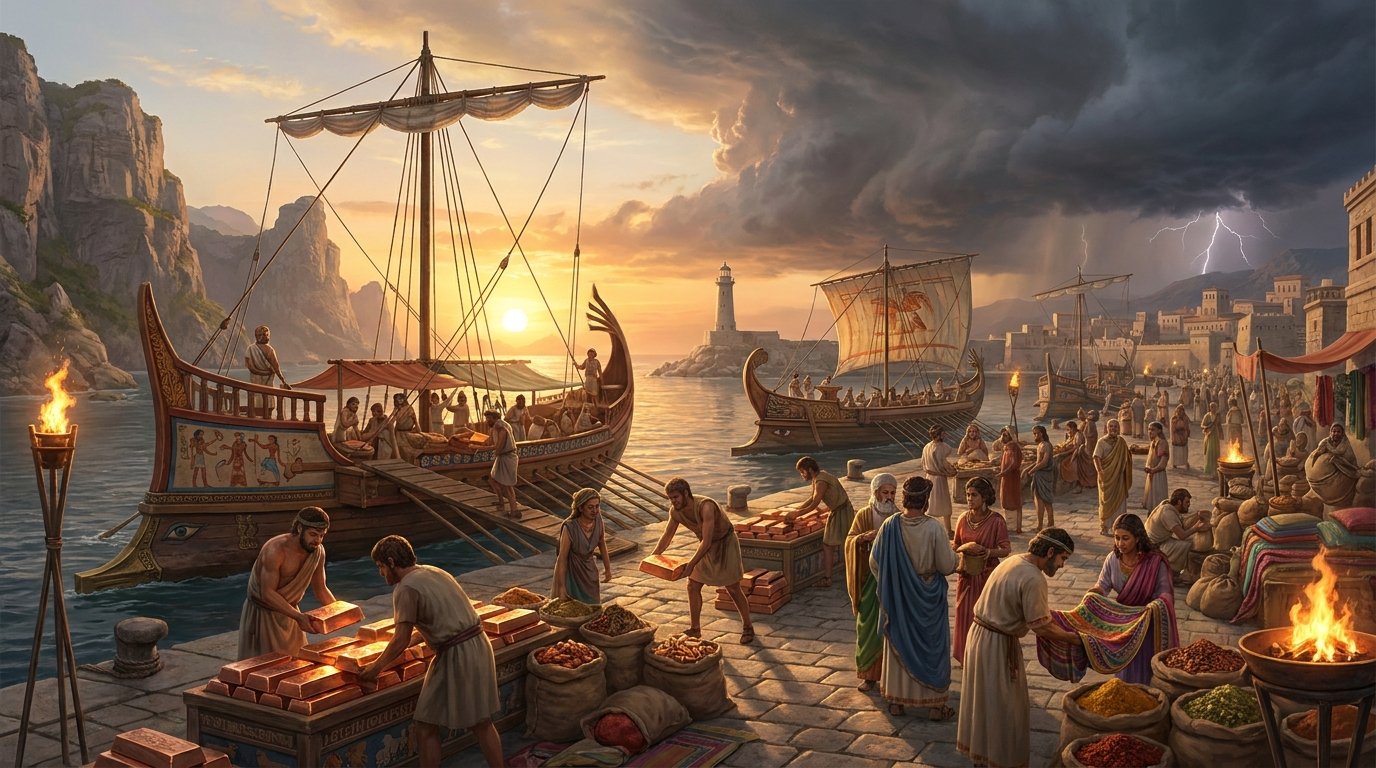
The late Bronze Age economy functioned like an intricate set of dominos. The great kings called each other “brother” and engaged in reciprocal gift-giving, which was essentially a polite cover for massive, state-sponsored import-export businesses. Gold flowed from Nubia (Egypt), timber from Lebanon, grain from the fertile Nile delta, and luxury goods like lapis lazuli from the far East.
The real terror of the Trade Logistics of the Bronze Age Collapse lies in how quickly this interconnectedness became a fatal liability. According to historical data on the Late Bronze Age collapse, historians widely agree that a “perfect storm” of catastrophes struck the region almost simultaneously.
[Placement: Image 3 goes here]

A series of severe, prolonged droughts led to massive crop failures. Earthquakes leveled major commercial centers. Starving populations were forced to migrate. This led to the rise of the mysterious “Sea Peoples”—a loose confederation of displaced marauders and pirates who began raiding coastal cities. In the context of the Trade Logistics of the Bronze Age Collapse, these invaders were the final nail in the coffin. They did not just destroy cities; they destroyed the ports, the shipyards, and the safety of the maritime trade routes. Once the ships stopped sailing, the copper and tin stopped moving. Without bronze, armies could not be equipped to fight off the raiders. The system collapsed inward upon itself.
Evidence from the Ashes: The Amarna Letters and Ugarit
How do we know the exact details of this logistical nightmare? The evidence survives in the baked clay of ancient administrative archives.
The Amarna Letters, discovered in Egypt, showcase the intense diplomatic pressure to keep trade routes open between the pharaohs and the kings of Babylon and Mitanni. However, the most chilling evidence comes from Ugarit, a wealthy port city in modern-day Syria. Texts from Ugarit highlight the Trade Logistics of the Bronze Age Collapse in real-time.

As the Sea Peoples approached, the King of Ugarit wrote a desperate letter to the King of Alashiya (Cyprus), stating: “My father, behold, the enemy’s ships came (here); my cities(?) were burned, and they did evil things in my country. Does not my father know that all my troops and chariots(?) are in the Hittite country, and all my ships are in the land of Lycia?” This tablet was found in a kiln, baked by the fires that ultimately destroyed the city. It proves that military and logistical resources were stretched too thin across the global network to defend the homeland.
The Uluburun Shipwreck: A Logistics Time Capsule
A key piece of evidence for the Trade Logistics of the Bronze Age Collapse is the famous Uluburun Shipwreck, discovered off the coast of southwestern Turkey. Dating back to the late 14th century BCE, this sunken merchant vessel is a literal time capsule of ancient globalism.

When marine archaeologists excavated the wreck, they found exactly what the global supply chain looked like. The cargo included 10 tons of Cypriot copper oxhide ingots, exactly 1 ton of tin (the precise 10-to-1 ratio needed for bronze), Canaanite jars filled with rare terebinth resin, Baltic amber, African ebony, elephant tusks, and even a golden scarab belonging to the Egyptian Queen Nefertiti. The Uluburun shipwreck proves that the Trade Logistics of the Bronze Age Collapse involved ships visiting multiple ports across different empires to assemble raw materials into high-value manufactured goods. When these cargo ships were sunk by the Sea Peoples, the economic losses were staggering.
Future Research and Development: AI and Archaeology
The Trade Logistics of the Bronze Age Collapse mirror our own modern supply chain vulnerabilities, which is why future research into this era is more critical than ever. In 2026, the field of archaeology is undergoing a massive technological renaissance.
As noted in recent reports on wikimess.com archaeological AI tools, researchers are no longer relying solely on physical excavation. Future R&D relies heavily on Artificial Intelligence and Machine Learning.

Today, deep learning algorithms are being used to virtually piece together tens of thousands of fragmented cuneiform tablets that have sat unreadable in museum basements for a century. By using AI to translate these mundane shipping manifests and grain receipts, historians are building a massive, data-driven digital twin of the ancient Mediterranean economy.
Furthermore, Light Detection and Ranging (LiDAR) and remote sensing technologies are discovering previously unknown, sunken coastal ports that were lost to rising sea levels or earthquakes. Exploring the Trade Logistics of the Bronze Age Collapse is entering a new era; by utilizing predictive modeling and GIS (Geographic Information Systems), researchers can simulate exactly how the trade network functioned, calculating the precise point where the failure of one city (like Ugarit) caused an economic contagion that wiped out the Hittite Empire.
Conclusion
Ultimately, the Trade Logistics of the Bronze Age Collapse serve as a profound warning from history. The late Bronze Age civilizations were incredibly wealthy, highly advanced, and deeply interconnected. Yet, their reliance on a complex, international supply chain for critical resources like tin left them highly vulnerable to external shocks.
Analyzing the Trade Logistics of the Bronze Age Collapse with modern technological tools reveals that civilizations do not always fall due to a single catastrophic event. Instead, they fall when their underlying logistical networks are stretched beyond their breaking point. As we navigate the complexities of our own 21st-century global supply chains—balancing microchip shortages, shipping lane disruptions, and climate change—the lessons written in the ashes of the Bronze Age have never been more important to learn.
Frequently Asked Questions (FAQ)
1. What was the Bronze Age Collapse? The Bronze Age Collapse was a sudden, violent, and culturally disruptive transition in the Eastern Mediterranean and Near East around 1200 BCE. Major empires (like the Mycenaeans and Hittites) fell, trade routes collapsed, and writing systems were temporarily lost, ushering in the Greek Dark Ages.
2. Why was tin so important to ancient trade logistics? Bronze is an alloy made of copper and tin. While copper was abundant in areas like Cyprus, tin was incredibly rare and had to be imported from thousands of miles away. If the supply chains delivering tin were disrupted, a civilization could no longer produce bronze weapons, tools, or armor.
3. Who were the Sea Peoples? The “Sea Peoples” were a mysterious, seafaring confederation of groups who attacked ancient Egypt and other Eastern Mediterranean regions prior to and during the Late Bronze Age collapse. Modern historians believe they were likely a mix of raiders, pirates, and displaced climate refugees fleeing famine and earthquakes.
4. How do we know what goods were traded during this time? We know through administrative texts (like the Amarna letters and clay tablets from Ugarit) and through underwater archaeology. The Uluburun shipwreck is the most famous example, as it sank with a full cargo of copper, tin, ebony, ivory, and spices from across the ancient world.
5. How is modern technology helping us understand ancient logistics? In the mid-2020s, archaeologists are using AI and deep learning to instantly translate thousands of fragmented, mundane shipping receipts written in cuneiform. Combined with LiDAR mapping of ancient trade routes, researchers are building digital models to simulate exactly how the ancient global economy functioned and ultimately failed.
Click this link to read our important and interesting Historical articles as soon as they are published!