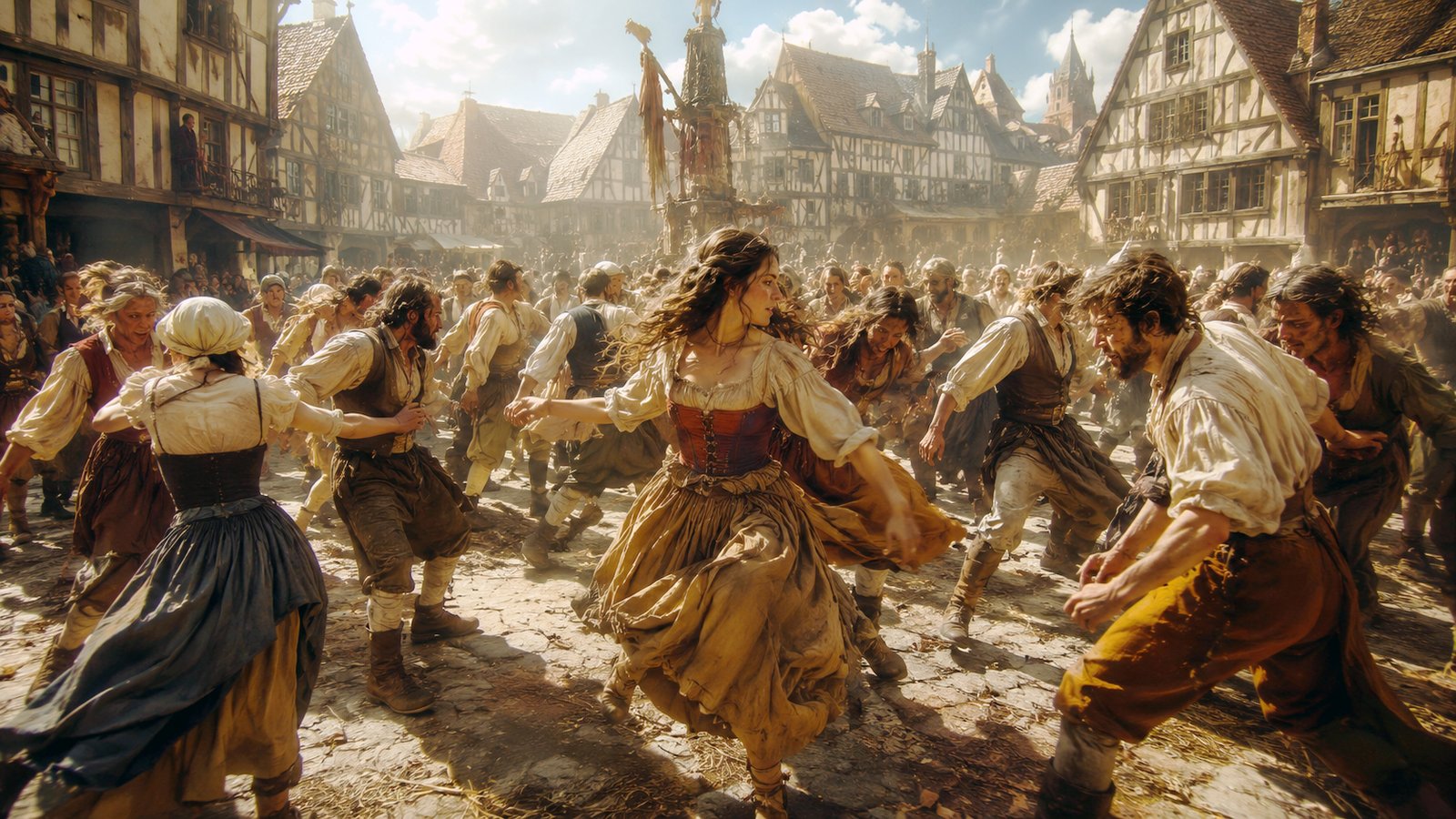
On a hot July day in 1518, on a narrow cobbled street in Strasbourg, a woman named Frau Troffea stepped out of her half-timbered home and began to dance. There was no music. No festival. No reason anyone could see. She just started moving — twisting, twirling, swaying — alone in the street, in the sweltering summer heat.
Her husband begged her to stop. She didn’t. She danced for hours, until she finally collapsed from exhaustion. Then she rested, stood up, and danced again. And again, the next day, on swollen and bloodied feet. Within a week, more than thirty of her neighbors had joined her. Within a month, the dancing crowd was as many as 400 people strong — and some of them, according to the chronicles, were beginning to die.
This is the dancing plague of 1518, one of the strangest, most unsettling, and best-documented mass events in all of European history. People danced until they dropped, and nobody — not then, not now — has ever fully explained why.
One Woman, One Street, Then a City

The story of the dancing plague of 1518 begins, by almost every account, with that single woman. Frau Troffea (sometimes recorded as Trauffea) emerged onto the street outside her home on or around July 14, 1518, and began the silent, frenzied dance that would spark a citywide phenomenon.
What makes it so eerie is how ordinary it looked at first, and how fast it spread. Onlookers may have assumed she was being quirky or having a religious moment. But she didn’t stop. As the days passed and her dancing continued without rest, worry curdled into alarm — and then, inexplicably, others began to join her. First, a few. Then dozens. By August, contemporary estimates put the number of afflicted dancers somewhere between 50 and 400.
These were not joyful revelers. Eyewitness and chronicle accounts describe people dancing past the point of injury — leaping, hopping, and spinning for days on end, their feet bleeding, their bodies clearly exhausted, yet seemingly unable to stop. Strasbourg, then a free city within the Holy Roman Empire (today part of France), found itself at the center of a slow-motion catastrophe nobody understood.
The Cure That Made It Worse

Here’s where the dancing plague of 1518 takes a turn that sounds almost like dark comedy. The city’s civic and religious authorities, alarmed by the swelling crowd of dancers, sat down to decide what to do — and arrived at one of the worst medical decisions in recorded history.
Their theory: the afflicted had “hot blood,” and the only way to cure them was to let them dance it out of their systems. So instead of stopping the dancing, the authorities encouraged it. They cleared guildhalls. They built a wooden stage near the busy horse market. They hired professional dancers and musicians — pipes, drums, horns — to keep the rhythm going, believing that more dancing was the path back to health.
Predictably, this did not help. Surrounding the exhausted, dehydrated dancers with live music and a stage in the middle of a heat wave only intensified and prolonged the epidemic. The “cure” poured fuel on the fire.
When that failed, the authorities switched strategies entirely. They turned from medicine to religion. In September 1518, the remaining dancers were loaded up and taken to a shrine dedicated to Saint Vitus — the patron saint long associated with such dancing afflictions, which were sometimes called “St. Vitus’s Dance.” There, the dancers were given red shoes, led in penance, and prayed over. And then, about as mysteriously as it had begun, the dancing plague of 1518 faded away.
So What Actually Caused It?

For five centuries, historians, physicians, and scientists have argued over what could possibly make hundreds of people dance themselves into the ground. There’s no settled answer — but there are three serious contenders.
Theory one: ergot poisoning. The most popular “scientific” explanation points to ergot, a toxic mold that grows on damp rye and other grains. Ergot contains compounds chemically related to LSD, and poisoning from it — known as ergotism — can cause violent spasms, convulsions, hallucinations, and a burning sensation in the limbs. Strasbourg in 1518 had endured wet conditions and poor harvests, so contaminated grain is plausible. The problem? Ergotism typically cuts off blood flow to the limbs, causing gangrene and making coordinated movement nearly impossible — the opposite of dancing for days. Most experts now consider ergot an unlikely sole cause.
Theory two: mass psychogenic illness. The leading modern explanation, championed by historian John Waller, is that the dancing plague of 1518 was a case of mass psychogenic illness — sometimes bluntly called mass hysteria. Under this view, the dancing was an involuntary, trance-like response to extreme collective stress. And 1518 Strasbourg had stress in abundance: years of famine and failed harvests, soaring grain prices, outbreaks of smallpox and syphilis, and waves of religious anxiety in the early years of the Reformation. Add a deeply held regional belief — that an angry Saint Vitus could curse people with uncontrollable dancing — and you have a population primed to fall, unconsciously, into exactly the affliction they most feared.
Theory three: religious ritual or cult. A minority of researchers have suggested the dancers belonged to a religious sect, performing the dancing deliberately as a form of trance worship or protest against social and religious authority. Most historians find this less convincing than the mass-stress explanation, given how clearly distressed and involuntary the dancers appear in the records.
The honest scorecard: ergot can’t explain sustained dancing, the cult theory can’t explain the visible suffering, and mass psychogenic illness — while the best fit — can never be proven across five centuries. The truest answer remains: we don’t fully know.
The Part Everyone Gets Wrong

Here’s the detail that almost every viral retelling skips, and it’s worth slowing down for. The famous, chilling claim — that people literally “danced themselves to death,” with up to fifteen dying per day — is genuinely disputed.
Some later accounts do report dancers dropping dead from heart attacks, strokes, exhaustion, and heatstroke. But here’s the catch: the surviving official records from the city of Strasbourg at the time don’t actually mention any deaths at all. The most dramatic death tolls come from sources written later, or from secondhand retellings, not from the contemporary civic documents. Modern historians remain split on whether anyone truly died, and if so, how many.
This doesn’t make the dancing plague of 1518 fake — it’s one of the most thoroughly documented strange events of the medieval and early-modern world, with at least six independent chronicle accounts. It just means the most shareable version of the story — bodies dropping in the streets by the dozen — rests on shakier evidence than the basic, astonishing fact that hundreds of people really did dance uncontrollably for weeks. The reality is strange enough without the embellishment.
Why It Still Haunts Us

The dancing plague of 1518 endures because it pokes at something genuinely unsettling: the idea that the human mind, under enough collective pressure, can hijack the body completely — and that it can spread from person to person like a contagion, without a single germ involved.
It wasn’t a one-off, either. Outbreaks of “dancing mania,” or choreomania, had flared across medieval Europe before, particularly in the Rhine and Alsace regions. The 1518 event is simply the largest and best-recorded. And mass psychogenic illness hasn’t vanished into history — modern outbreaks of unexplained collective fainting, twitching, and illness still occur in schools, factories, and communities under stress, baffling doctors who can find no physical cause. The dancers of Strasbourg were not a medieval freak show. They may have been an extreme example of something the human nervous system is always quietly capable of.
That’s the lasting power of the dancing plague of 1518. It’s not a story about strange people in a strange century. It’s a story about how thin the line is between a calm crowd and a contagion of the mind — and how, under the right pressure, an ordinary woman can step into the street, start to dance, and pull an entire city in after her.
Fascinated by history’s most baffling mysteries? Read our breakdowns of [the Voynich Manuscript, the book nobody can read] and [what science finally figured out about the Dyatlov Pass incident].
FAQ Section (add at bottom of post)
What was the dancing plague of 1518? It was a real event in Strasbourg (then part of the Holy Roman Empire, now in France) in which somewhere between 50 and 400 people danced uncontrollably and seemingly involuntarily in the streets for weeks, from July to September 1518. It is one of history’s best-documented cases of mass dancing mania.
Did people really die in the dancing plague of 1518? This is disputed. Some later accounts claim dancers died of exhaustion, heart attacks, and strokes — even up to fifteen a day — but the contemporary official records of Strasbourg do not mention any deaths. Historians remain divided on whether there were fatalities.
What caused the dancing plague of 1518? There’s no definitive answer. The leading theory is mass psychogenic illness (mass hysteria) triggered by extreme stress — famine, disease, and religious fear. Other theories include ergot poisoning from moldy rye and, less plausibly, a deliberate religious cult.
Who started the dancing plague? According to contemporary accounts, it began with a single woman named Frau Troffea, who stepped into a Strasbourg street around July 14, 1518, and began dancing with no music or apparent reason, continuing for days until others joined her.
How did the dancing plague end? After a failed attempt to “cure” the dancers by encouraging more dancing, authorities took the remaining dancers to a shrine of Saint Vitus in September 1518 for religious healing. The phenomenon faded around the same time, ending about as mysteriously as it began.
Reference – britannica.com
nationalgeographic.com
publicdomainreview.org
AI Image Generated by Grok.com and lovart.ai
Click this link to read our important and interesting articles as soon as they are published!