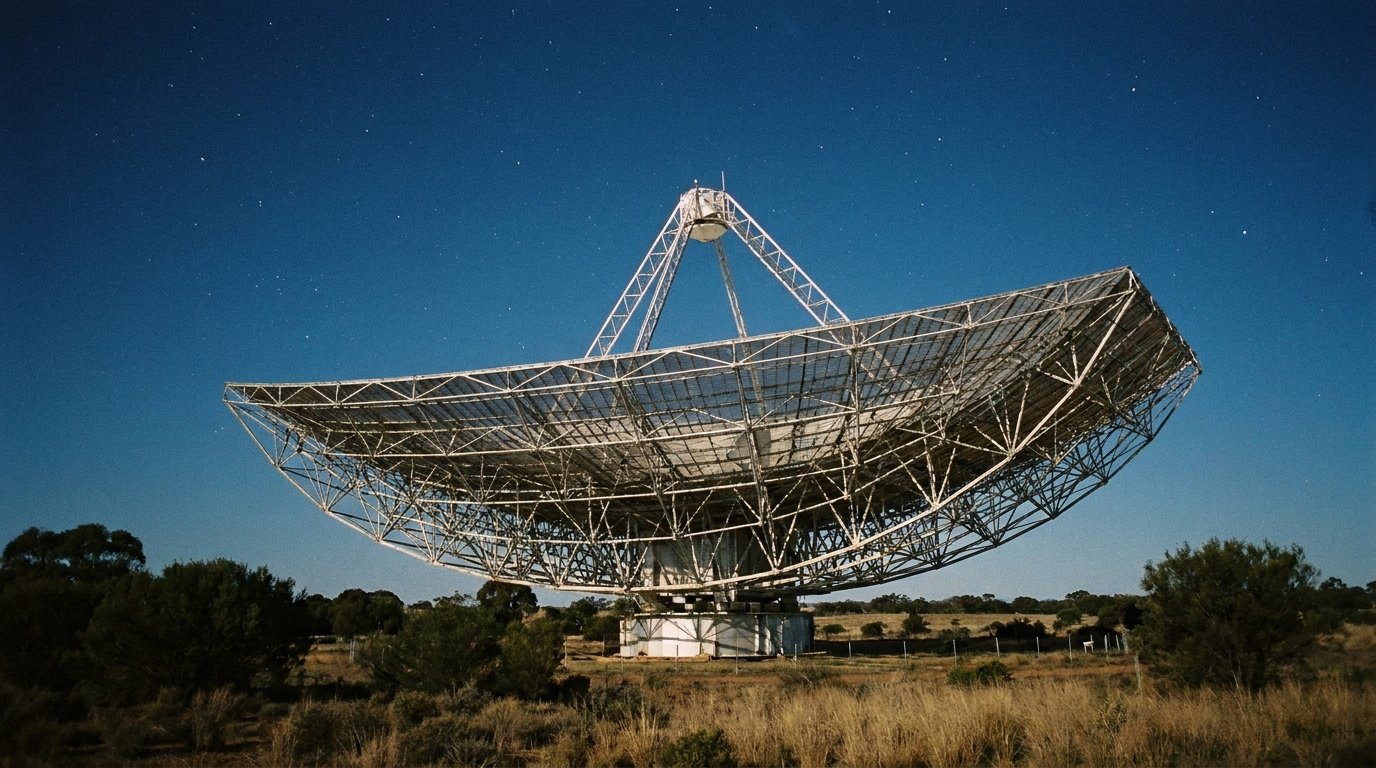
It’s a warm August night in 1977, and a radio telescope in Ohio is slowly sweeping across a patch of sky. Inside a small control room, a stack of computer printouts is feeding out of a machine, one line of characters at a time. Most lines look like noise. Then one line stops a man in his tracks. He grabs a red pen, circles a string of letters and numbers, and writes a single word in the margin: “Wow!”
That printout, and the 72 seconds of radio energy behind it, became one of the most famous puzzles in astronomy. The Wow! signal has never been detected again, despite decades of searching. Nobody has been able to explain it with confidence, and nobody has been able to rule out every possibility either.
Why does a single strange burst from 1977 still matter? Because it sits right at the edge of what we know. It reminds us how much of the universe we haven’t checked yet, and how a single unexplained result can teach more than a thousand expected ones.
So let’s walk through what happened that night, why astronomers still talk about it, and what it can teach anyone who has ever stared at a pile of data and wondered whether they’d found something real.
A Pen, a Printout, and a Single Word

The telescope was called Big Ear, a large, flat-bottomed radio instrument operated by Ohio State University. Its design was unusual. It didn’t move the way a dish does. Instead, the sky drifted past it as the Earth turned, and the telescope recorded whatever passed through its fixed beam.
On August 15, 1977, the instrument was part of a search for radio signals that might come from other civilizations. Astronomer Jerry Ehman was reviewing the overnight data, which came out as a long sheet of numbers. Each character represented signal strength in a small time slice. Most were ordinary background values, the kind of random fluctuation you’d expect from the sky and the electronics.

One sequence was different. It rose from background levels to a peak and then faded, as if something had drifted through the beam and left. The sequence read 6EQUJ5 in the code the system used. Ehman circled it, wrote “Wow!” next to it, and the nickname stuck.
I find this detail more human than any technical explanation. A scientist, late at night, reads a long list of numbers and feels his pulse jump. Most of the job is slow and careful. Every so often, the data gives you a moment you can’t forget.
What a Signal Like This Actually Looks Like
Radio astronomers often look for signals near a frequency called the hydrogen line, around 1420 megahertz. Hydrogen is the most common element in the universe, and it naturally emits radio waves at this frequency. Because it’s such a familiar fingerprint of space, many researchers have long thought it would be a logical place for another civilization to send a signal, if one existed.
Think of it like tuning a car radio to a station everyone knows. Most of the time you hear static, but if you’re looking for a broadcast, the familiar frequency is a sensible place to start. The Wow! signal appeared close to that frequency, which is part of why it caught so much attention.

What made it unusual was its shape. It was narrow in frequency, meaning it didn’t spread across a wide range the way many natural sources and interference tend to. It also seemed to appear and fade in a pattern consistent with a source passing through the telescope’s beam. Those features made it more intriguing than random noise, though not conclusive on their own.
Here’s where I’d encourage a little caution. A strong, narrow signal sounds like a message. In practice, radio data contains many kinds of signals that look unusual at first glance, from satellites and aircraft to electrical equipment and reflections. The hard part is not finding a strange blip. It’s proving that nothing ordinary could have produced it.
Why It Still Haunts Astronomers
The Wow! signal’s most frustrating feature is that it never returned. Ohio State and other teams searched the same region of sky again, and later surveys looked at many nearby targets. Some attempts used larger or more sensitive telescopes. None produced a repeat detection of that particular pattern.

That silence has fueled plenty of theories, and most have been hard to test. One of the more widely discussed explanations came in 2017, when researchers Robert Gray and Jim Marvel proposed that a hydrogen cloud around the comet 266P/Christensen could have produced a similar signal when the comet was in the right position. The proposal was a plausible natural explanation, but it remains a hypothesis rather than a confirmed answer, and the comet’s location in 1977 has been debated.
Other ideas have included terrestrial interference, reflections from spacecraft, and sources that drifted through the beam briefly. Each explanation fits some features of the data and struggles with others. That’s the uncomfortable middle ground astronomers still occupy: the signal isn’t proven to be natural, and it isn’t proven to be artificial.
The emotional pull is strong. A single, unrepeatable event can feel like a locked door. Every new observation becomes a chance to peek through the crack, and every null result is a reminder that the door stayed shut. That tension is why the Wow! signal still gets discussed at conferences, in classrooms, and in the late-night arguments of amateur sky watchers.
A Lesson for Anyone Working on a Long Search
You don’t need a radio telescope to know what it’s like to chase a single unexplained result. Picture a remote data analyst in Melbourne who notices a strange spike in her company’s sales records one Tuesday. The spike is large, but it doesn’t repeat. She could spend weeks searching for the cause, chasing every possible explanation, or she could decide the spike isn’t worth more time.
The astronomers’ approach offers a useful middle path. They record the anomaly carefully, note the conditions around it, and keep a clear log of what they checked. Then they decide what would count as a repeat, and they look again under similar conditions. If the signal doesn’t return, they stop claiming more than the evidence supports.
A few habits can help when you’re handling a puzzling result in your own work:
- Record the context immediately. Note the date, time, data source, and any changes to the system. Memory fades faster than you expect.
- Write down what would prove the result wrong. If you can’t name a test that could fail, you’re not yet doing analysis.
- Rule out the boring explanations first. Check interference, errors, duplicates, and recent changes before assuming something new is happening.
- Give the anomaly a fixed follow-up window. Decide in advance how long you’ll investigate, so curiosity doesn’t quietly eat your whole week.
None of these steps guarantee a breakthrough. They do make your findings easier to trust, whether you’re a student, a freelancer with a client dataset, or a team lead reviewing a dashboard.
The Myth That It Was Proof of Aliens
The most common version of the Wow! signal story goes like this: a radio telescope picked up a clear message from another civilization, scientists saw it, and then the message vanished. It’s a compelling narrative, and it has spread widely online.

The evidence doesn’t support that conclusion. The signal was a single, strong, unexplained detection in one set of observations. It was not decoded, it contained no recognizable message, and no one has shown that it came from another civilization. Scientists treat it as an open question, not as confirmed contact.
It’s also worth separating two ideas. One is that the signal is unexplained. That’s true. The other is that the signal is artificial. That hasn’t been demonstrated. Good science keeps those claims apart, and that’s the version worth sharing.
I’ll admit the alien version appealed to me too when I first read about it. It’s a better story. But the more accurate account is the one that keeps the question open, and that’s where the most interesting science lives.
Frequently Asked Questions
What was the Wow! signal?
It was a strong, narrow-band radio signal detected on August 15, 1977, by the Big Ear radio telescope at Ohio State University. It lasted about 72 seconds in the data and has never been confirmed to repeat.
Has the Wow! signal ever been explained?
No single explanation is accepted as definitive. Proposals include natural sources, such as a comet’s hydrogen cloud, and various forms of interference. Each has supporters and critics, and the debate is still active.
Could the Wow! signal have come from aliens?
That possibility can’t be ruled out, but there’s no evidence that confirms it. Most researchers treat the signal as an unexplained detection rather than proof of another civilization.
Can I learn more about the search for signals from space?
Yes. The SETI Institute at https://www.seti.org shares research and educational material about the search for extraterrestrial intelligence. Check the site for current programs and updates, since research priorities and findings can change.
Final Thoughts
The Wow! signal lasted barely over a minute, but it has kept astronomers thinking for nearly fifty years. It isn’t a proven message from the stars, and it isn’t a closed case either. It’s a reminder that the universe still holds moments we can’t explain, and that the most valuable thing a scientist can do with one is to write it down carefully and keep looking.

That mindset applies beyond the sky. Whenever you find something unexpected in your own work, resist the urge to make it a grand story or to dismiss it outright. Record it, test it, and be honest about what you still don’t know.
So if this story made you curious, take a few minutes this week to look at one unusual result in your own life or work and write down what you’d need to see to explain it. Then share this article with someone who loves a good mystery, or explore more stories on wikimess.com, where the familiar tales often get a closer look.