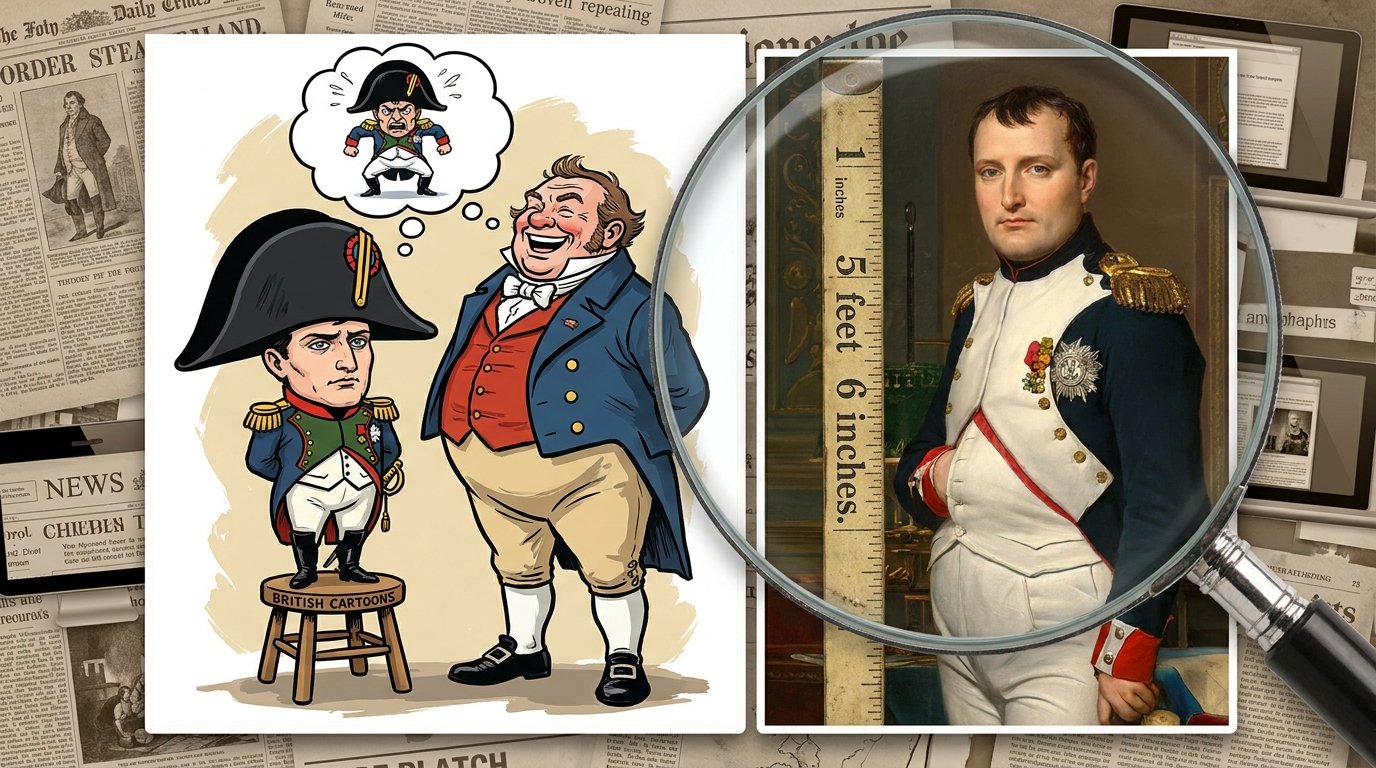
Picture Napoleon Bonaparte and you probably see a small, scowling man with one hand tucked into his coat, glaring up at taller rivals. That image has shaped jokes, school lessons and even an everyday phrase, the “Napoleon complex.” There is one problem. The best evidence we have says he was about average height for a Frenchman of his time.
So where did the idea come from? This guide explains why Napoleon wasn’t short, what the sources say about his height, how a measuring mix-up helped start the myth, and how a British cartoonist turned it into a belief that has lasted two centuries. It is written for curious readers, students and anyone who wants a simple way to check a famous “fact” before repeating it.
What Is the “Little Napoleon” Myth?

The myth is the belief that Napoleon Bonaparte (1769–1821) was unusually small, and that his ambition, temper and wars were a way of making up for it. Put simply: he was not short for his era, and the “short” story grew out of a measurement mix-up and wartime satire.
Here is where the numbers come from. After Napoleon died on Saint Helena in 1821, his body was measured by a French physician at five feet two inches. To English ears that sounds tiny, but French units were different. The old French inch, the pouce, was longer than the English inch: about 2.7 cm against 2.5 cm, according to Aspects of History, while National Geographic puts the ratio at roughly 1.06. Converted properly, the figure lands at around 5 feet 6 to 5 feet 7 inches, or roughly 168 to 170 cm. That is an estimate, because published conversions vary by about an inch.
Think of it like reading a distance in kilometres as if it were miles. The number looks the same, but the meaning is completely different.
Myth versus evidence:
- Myth: He measured 5 ft 2 in. Evidence: That was in French units, which convert to about 5 ft 6 to 7 in.
- Myth: His soldiers called him “little” because he was tiny. Evidence: Le petit caporal was an affectionate nickname from his own troops.
- Myth: The French spread the story. Evidence: British cartoons and print culture did most of the work.
Evidence note: More than one observer put Napoleon at about five foot six, and the autopsy figure fits once the French units are converted (National Geographic, “Was Napoleon even short?”).
Why the Napoleon Height Myth Matters Today

This is more than trivia.Napoleon wasn’t short It shows how one conversion error, one catchy nickname and one gifted cartoonist can overwrite the record for 200 years. It also matters because “Napoleon complex” still appears in everyday speech, as if it were a proven fact about short men and about Napoleon himself. Separating what we know from what we repeat is a useful habit for any history reader.
- Fact: Napoleon’s height at death was recorded in French units as five feet two inches, and the French pouce was longer than the English inch (Aspects of History; National Geographic).
- Estimate: The modern equivalent is about 5 ft 6 to 5 ft 7 in. The average Frenchman of the period is often put at around 5 ft 5 in by popular history sources. Treat that as approximate, because good height data from that era is limited.
- What is still uncertain: Nobody can measure him again, and sources differ by an inch or so. Some popular articles also claim Gillray was state-funded or that Napoleon pressured publishers to stop the cartoons. These claims are widely repeated but less firmly documented, so treat them as unverified.
There is a strategic angle too. When the British Museum staged an exhibition on Napoleon in 2015, reporting on it noted that mocking him as “Little Boney” helped reduce the sense of threat he posed (The Local France). Ridicule was a way to cope with fear.Napoleon wasn’t short
The Evidence: How a Tall Tale Was Built – Napoleon wasn’t short
1. The measurement and the unit mix-up

Napoleon died on 5 May 1821. The post-mortem was carried out by French doctors, and popular accounts name Francesco Antommarchi as the physician. The reported height of five feet two inches was perfectly normal in French measures. The trouble began when it travelled into English print without conversion. A reader in London saw the English-sounding number and pictured a small man, and the smaller figure suited British newspapers just fine.
2. What eyewitnesses and averages say
We do not have to rely on the autopsy alone. An English captain who saw Napoleon in 1815 described him as strongly built and about five feet seven inches tall (Aspects of History). Popular summaries place the average Frenchman of the era at roughly five feet five. On those numbers Napoleon was average or a touch above, not tiny.
3. “Le Petit Caporal”: a nickname of affection

His soldiers began calling him le petit caporal, “the little corporal,” around the time of the Battle of Lodi in May 1796, when he led the army in Italy. In French, petit can be a warm, familiar word, much like calling a friend “little buddy.” It signalled closeness, not size. Once the phrase crossed the Channel, British pamphleteers and cartoonists read it literally.
4. James Gillray and “Little Boney”
James Gillray (1756–1815) was one of Britain’s sharpest caricaturists, and he never met Napoleon. In 1803, as relations broke down, he produced prints such as “German Nonchalence, or the Vexation of Little Boney,” held in the British Museum’s collection. Later that year came “Maniac Raving’s, or Little Boney in a Strong Fit,” inspired by a real incident in March 1803 when Napoleon lost his temper with the British ambassador, Lord Whitworth, in front of other diplomats (Una McIlvenna, History.com). Gillray drew him as a tantrum-throwing child in oversized boots. In 1805 his “Plumb-pudding in danger” showed a tall William Pitt and a small Napoleon carving up the globe.
5. Why the image stuck

Several things kept the myth alive. Napoleon was usually surrounded by his Imperial Guard, a hand-picked group of tall, broad soldiers who made anyone beside them look smaller. British cartoonists kept going, and in 1812 William Elmes showed “General Frost” shaving a stranded Little Boney. Later writers then invented a psychological label, the “Napoleon complex.” Sources such as National Geographic note there is no historical evidence that Napoleon acted as he did because of insecurity about his height.Napoleon wasn’t short
Common Mistakes to Avoid
- Mistake 1: Reading old units as modern ones. A French “five feet two” is not an English “five feet two.” Fix: Whenever a historical measurement appears, ask which system it uses and convert it before drawing a conclusion.
- Mistake 2: Taking a nickname literally. “The Little Corporal” sounds like a size description. Fix: Look for who used the nickname, when and why. Here it was soldiers showing affection.
- Mistake 3: Treating a cartoon as a portrait. Caricature exaggerates on purpose. Fix: Check a cartoon against paintings, written descriptions and records before trusting its proportions.
- Mistake 4: Repeating the “Napoleon complex” as settled science. It is a popular label built on the myth. Fix: Say “the popular idea” unless you can cite research that supports it.
- Mistake 5: Trusting one catchy source. Viral history posts often copy each other, and some mix solid facts with weak claims. Fix: Cross-check at least two reliable sources, preferably museum, university or major publisher pages.
Useful Tips
- Start with the primary record. Search a museum catalogue, such as the British Museum’s online collection, to see the original cartoons and their dates.
- Use a free converter. Search for a “French pouce to cm” conversion table the next time a pre-metric measurement confuses you.
- Ask who benefits. Wartime propaganda is rarely neutral. Ask who made an image and what they wanted readers to feel.
- Track your sources. Jot down the title, author, date and link of every claim you plan to repeat, so you can recheck it later.
- Learn more from trusted institutions. The National Geographic history archive and the British Museum collection pages are good starting points for further reading.
Frequently Asked Questions
How tall was Napoleon, really? About 5 ft 6 to 5 ft 7 in (roughly 168 to 170 cm) in modern measurements, which was average or slightly above for a Frenchman of his time. The “5 ft 2 in” figure was in French units.Napoleon wasn’t short.
Why did the British call him “Little Boney”? “Boney” was a mocking short form of Bonaparte, and “little” made him look childish and less threatening. Cartoonists, especially James Gillray, popularised it from 1803.
Did Napoleon’s own soldiers think he was short? No evidence suggests that. They called him le petit caporal as a friendly nickname after the Italian campaign of 1796, a sign of closeness rather than a comment on his height.
Is the “Napoleon complex” real? The phrase is widely used, but it grew out of the height myth. Historical sources find no evidence that Napoleon behaved aggressively because he felt insecure about his size.
Who was James Gillray? A British caricaturist (1756–1815) who helped shape the modern political cartoon. He never met Napoleon but drew him repeatedly during the wars of the early 1800s.
Final Thoughts
Three points are worth remembering. First, Napoleon’s recorded height was in French units, and once converted he was roughly 5 ft 6 to 5 ft 7 in, close to average. Second, le petit caporal was an affectionate soldiers’ nickname, not a measurement. Third, British satire, led by James Gillray, did the rest. Some details, such as exact average heights and the influence of state funding, remain uncertain, and it is fair to say so. Napoleon wasn’t short

Your next practical step is simple: the next time a surprising “fact” about the past goes viral, check the units, the date and the original source before sharing it. For more stories where the legend and the record part ways, read our piece on 10 historical mysteries historians still can’t fully explain or the story of Greek Fire, the lost Byzantine weapon.
Explore more in our History section: https://wikimess.com/history/