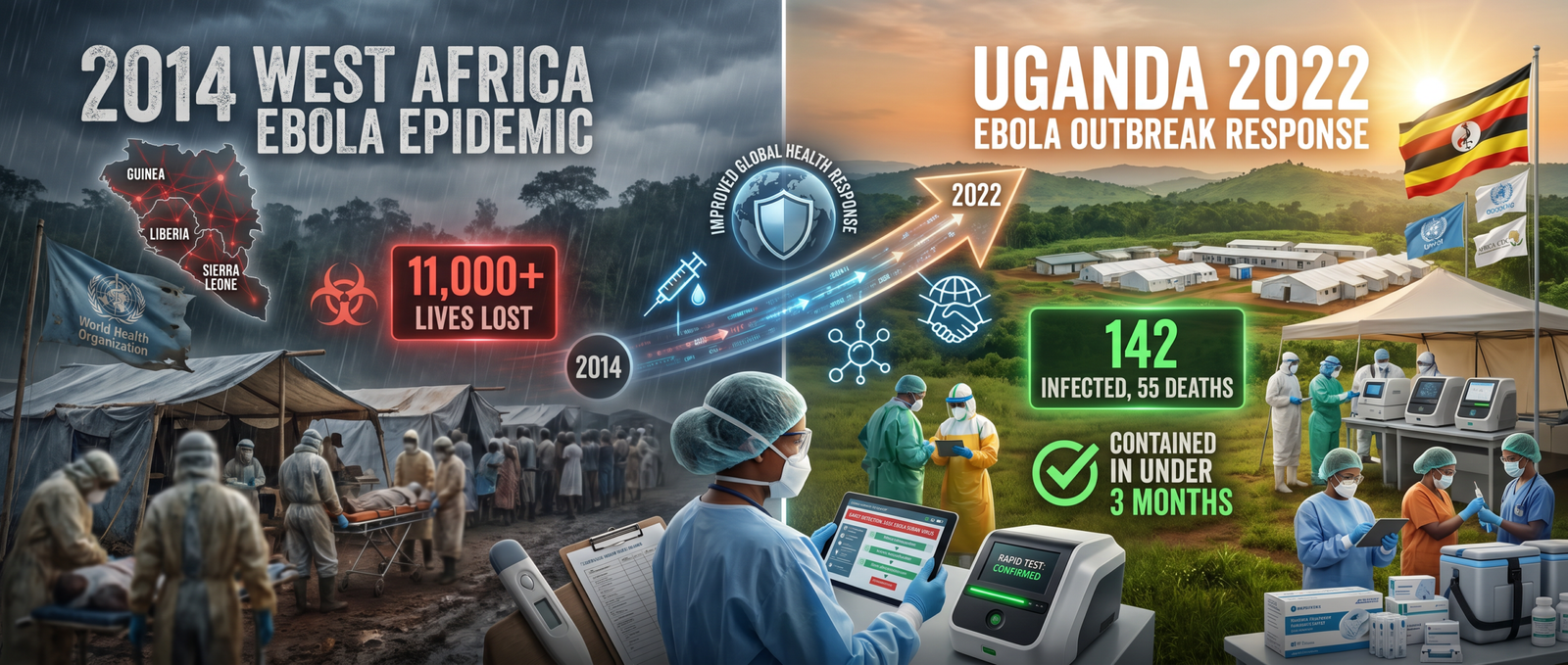
In September 2022, a Ugandan nurse developed a fever that wouldn’t break. Within days, doctors confirmed what Africa’s health authorities dread most: Ebola. The outbreak that followed infected 142 people and killed 55 — contained in under three months, a testament to how far the global response has come since 2014’s catastrophic West African epidemic claimed over 11,000 lives.

Ebola virus disease (EVD) remains one of the deadliest pathogens known to medicine. Yet survival rates have climbed significantly with better treatment, faster detection, and a now-approved vaccine. Here’s what the science tells us about how Ebola starts, who’s most at risk, which countries have faced it, and what recovery actually looks like.
How Ebola Spreads: From Bats to Humans

Ebola doesn’t appear out of nowhere. It follows a predictable pathway that begins in the wild.
Fruit bats — particularly species in the Pteropodidae family — are the virus’s natural reservoir. They carry Ebola without becoming sick, shedding it in saliva, feces, and urine. The jump to humans, known as zoonotic spillover, typically occurs when people hunt, butcher, or consume infected wildlife including primates, antelopes, and bats.
Once in a human host, the virus spreads through direct contact with blood or body fluids from an infected person. It does not spread through air like the flu. Transmission routes include:
- Touching an infected person’s blood, vomit, or sweat
- Unsafe burial practices (washing or touching the deceased)
- Reused needles in under-resourced healthcare settings
- Sexual contact (the virus can persist in semen for six months or more)
Healthcare facilities without strict infection control protocols become amplification points. During the 2014–2016 West African crisis, hospitals became some of the most dangerous places to be.
Ebola Symptoms: A Week-by-Week Breakdown

Ebola’s incubation period — the time between exposure and first symptoms — ranges from 2 to 21 days, with an average of 8 to 10 days. During this window, the person is not contagious.
Days 2–5: Sudden onset
Symptoms arrive abruptly: high fever above 38.3°C, severe fatigue, muscle and joint pain, and intense headache. At this stage, Ebola is almost indistinguishable from malaria or typhoid — a diagnostic challenge that contributes to delayed isolation.
Days 5–7: Rash and gastrointestinal symptoms
A maculopapular rash spreads across the body. Vomiting and diarrhea begin, often severe enough to cause dangerous fluid loss within hours.
Days 7–10: Hemorrhagic phase
In severe cases, bleeding from the gums, eyes, and nose develops alongside abdominal pain. Kidney and liver function deteriorate. Viral load peaks. This is the most contagious and most lethal phase.
Days 10–14: Crisis point
Most deaths occur here. Multi-organ failure, hemorrhagic shock, and cardiovascular collapse are the primary causes. Patients who survive this window have a substantially better prognosis.
Day 14+: Recovery or death
Survivors see fever subside and organ function gradually stabilize. The road to full physical recovery, however, takes months.
Who Is Most at Risk? Age and Vulnerability

Ebola’s case fatality rate (CFR) is not uniform. Age, health status, and access to care all shift the odds significantly.
Children under 5 deteriorate rapidly due to immature immune systems and severe dehydration. Mortality in this group runs 40–50%.
Adults over 60 face the highest rates — 50 to 70% — driven by pre-existing conditions and slower immune response.
Pregnant women face near-certain death. The virus crosses the placental barrier, miscarriage occurs in almost all cases, and hemorrhage risk is extreme.
Healthcare workers account for 10–15% of cases in most outbreaks, often exposed to high viral loads before protective protocols are established. During the 2014–2016 epidemic, more than 900 healthcare workers were infected and over 500 died.
Immunocompromised individuals — those living with HIV/AIDS, undergoing chemotherapy, or on immunosuppressants — face sharply reduced capacity to mount a defense.
Middle-aged adults in good health, treated early, have the best survival odds — approximately 60–70% with proper medical care.
Ebola Outbreak Countries: Where the Virus Has Struck

Africa (Primary Burden)
The Democratic Republic of Congo has recorded more than 10 outbreaks since the virus was first identified in 1976 near the Ebola River — giving the disease its name. Uganda, Sudan, and Sierra Leone have each experienced significant events.
The 2014–2016 West African epidemic was the largest in history:
- Guinea: 3,814 cases, 2,544 deaths — the epicenter where it began
- Sierra Leone: 14,124 cases, 3,956 deaths — highest total case count
- Liberia: 10,678 cases, 4,810 deaths — highest death toll
The 2018–2020 DRC outbreak — 3,481 cases and 2,299 deaths — unfolded in an active conflict zone, complicating every aspect of the response.
Outside Africa
Cases have reached Europe and North America through healthcare workers and aid volunteers, but large outbreaks have not taken hold:
- United States (2014–2015): Four cases, one death — a Liberian national who traveled to Dallas after becoming infected
- Spain, UK, Italy (2014–2015): One case each, all healthcare workers, all recovered
- Germany (2009): One case from a lab accident, resulted in one death
Robust healthcare infrastructure and rapid containment explain why transmission did not escalate in high-income countries.
Death Rate: Why Mortality Varies Dramatically

Historical Ebola case fatality rates range from 25% to 88% — a striking variation explained by several factors.
Virus species matters. The Zaire strain has caused CFRs as high as 88% (1976). The Bundibugyo strain typically runs lower, around 25–50%.
Medical access is decisive. Patients who receive IV fluid replacement, organ support, and antiviral therapy (where available) survive at rates of 60–70%. Without any medical care, survival drops to 5–15%.
Timing of hospitalization is critical. Patients admitted on day one of symptoms have roughly 50% survival. Those admitted by day seven face a survival rate closer to 25%.
Recent approved treatments have changed the picture. The antiviral monoclonal antibody therapies REGN-EB3 (Inmazeb) and mAb114 (Ebanga), both approved by the FDA in 2020, demonstrated survival rates above 70% in clinical trials when given early.
Recovery: What Surviving Ebola Actually Looks Like

Surviving Ebola is not the end of the ordeal. It is the beginning of a long rehabilitation.
Hospital discharge typically occurs 4–5 weeks after admission, once the patient has been fever-free for 48 hours, can eat independently, and tests PCR-negative for the virus.
Physical recovery over 6–12 months involves a predictable pattern: extreme fatigue persisting for weeks, temporary hair loss, joint and muscle pain affecting up to 90% of survivors, and in some cases vision problems or hearing loss. Most survivors regain near-full strength by months four to six.
Post-Ebola Syndrome affects an estimated 30–50% of survivors — a cluster of chronic symptoms including polyarthritis, uveitis (eye inflammation), neurological effects, and persistent fatigue. Left untreated, uveitis can cause permanent blindness.
The Psychological Toll on Survivors

The mental health burden is often as severe as the physical one. Studies from the 2014–2016 epidemic found PTSD in 40–60% of survivors and depression in 35–50%.
Stigmatization compounds the trauma. Survivors have been shunned from communities, barred from returning to work, and isolated from family — even after posing no risk of transmission. Comprehensive survivor programs, combining physical rehabilitation with psychological support and anti-stigma community education, significantly improve long-term outcomes.
Prevention and the Vaccine Breakthrough

The rVSV-ZEBOV vaccine (ERVEBO), approved by the FDA in 2019 and the European Medicines Agency in 2019, has proven highly effective against the Zaire strain. A ring vaccination strategy — immunizing the close contacts of confirmed cases — was central to controlling the 2018–2020 DRC outbreak despite active conflict.
Healthcare workers in endemic regions are now prioritized for vaccination. Community immunization campaigns in outbreak zones have further reduced transmission.
Personal protection during outbreaks remains essential: avoiding affected areas, strict hand hygiene, no contact with ill individuals or those recently deceased, and safe burial practices enforced by trained teams.
Reference – www.who.int
www.cdc.gov
AI Image Generated by ChatGPT and lovart.ai
Click this link to read our important and interesting articles as soon as they are published!