Artemis II: Returning Humans to the Moon’s Orbit
A New Dawn in Human Space Exploration
Fifty years after Apollo 17 lifted off from the lunar surface—the last time humans walked on the Moon—humanity stands on the precipice of a new era. Artemis II isn’t just another space mission; it’s humanity’s next giant leap—not to land, but to return, to witness, and to prepare. This historic flight will carry four astronauts beyond low Earth orbit for the first time since 1972, soaring around the Moon aboard NASA’s revolutionary Orion spacecraft. As we gaze at the same celestial body that inspired generations of dreamers, scientists, and explorers, Artemis II represents more than technological achievement—it embodies our enduring curiosity, our collaborative spirit, and our unwavering commitment to pushing the boundaries of what’s possible. This mission is the vital bridge between past triumphs and future frontiers, reconnecting us with the Moon not as visitors, but as thoughtful, prepared stewards ready to establish a sustainable presence.

The Artemis Program: Building on Apollo’s Legacy
The Artemis program is NASA’s bold vision to return humans to the Moon—not just to plant flags and leave footprints, but to learn how to live and work there sustainably. While Apollo was a monumental sprint driven by Cold War competition, Artemis is a strategic marathon focused on long-term exploration. Named after Apollo’s twin sister in Greek mythology—the goddess of the Moon—Artemis honors our lunar heritage while charting a distinctly modern course. The program leverages decades of technological advancement, international partnerships, and commercial innovation. Its foundational goals are clear: land the first woman and the first person of color on the lunar surface (Artemis III), establish the Gateway—a small space station orbiting the Moon—and create the infrastructure needed for sustained lunar operations. Crucially, Artemis serves as a proving ground for Mars. The deep-space environment, radiation management, life-support systems, and operational experience gained around the Moon are irreplaceable rehearsals for the much longer journey to the Red Planet. Artemis II is the first crewed test of this entire architecture—the moment theory becomes reality.

Meet the Pioneering Crew: Firsts That Inspire
Artemis II carries a crew whose very composition signifies a profound evolution in human spaceflight. Commander Reid Wiseman, a veteran NASA astronaut with extensive International Space Station experience, leads the mission. Joining him is Pilot Victor Glover, who will make history as the first person of color to travel to lunar orbit—a milestone representing decades of progress in diversity and inclusion within space exploration.
Mission Specialists Christina Koch and Jeremy Hansen complete the quartet. Koch holds the record for the longest single spaceflight by a woman (328 days) and was part of the first all-female spacewalk. Her expertise in space-based science and operations is invaluable. Hansen, an astronaut from the Canadian Space Agency, represents the critical international dimension of Artemis.

His participation underscores Canada’s contribution of the advanced robotics system for the Lunar Gateway. Together, these four individuals embody a new chapter: one where lunar exploration is not the domain of a select few, but a shared human endeavor, reflecting the full spectrum of our global community. Their journey will inspire countless young people—especially girls and children of color—to see themselves among the stars.
Technical Milestones: Orion, SLS, and the Lunar Flyby
The success of Artemis II rests on two extraordinary pieces of engineering: the Space Launch System (SLS) rocket and the Orion spacecraft. The SLS is the most powerful rocket ever built, capable of generating 8.8 million pounds of thrust at liftoff—15% more than the Saturn V that powered Apollo. It’s designed specifically for deep-space missions, combining proven shuttle technology with cutting-edge innovations for unprecedented reliability and capability. Riding atop the SLS is Orion, a next-generation spacecraft built for the rigors of interplanetary travel. Unlike Apollo’s capsule, Orion features a larger habitable volume, advanced life-support systems that recycle air and water, and sophisticated radiation shielding to protect its crew during the extended journey beyond Earth’s protective magnetosphere.
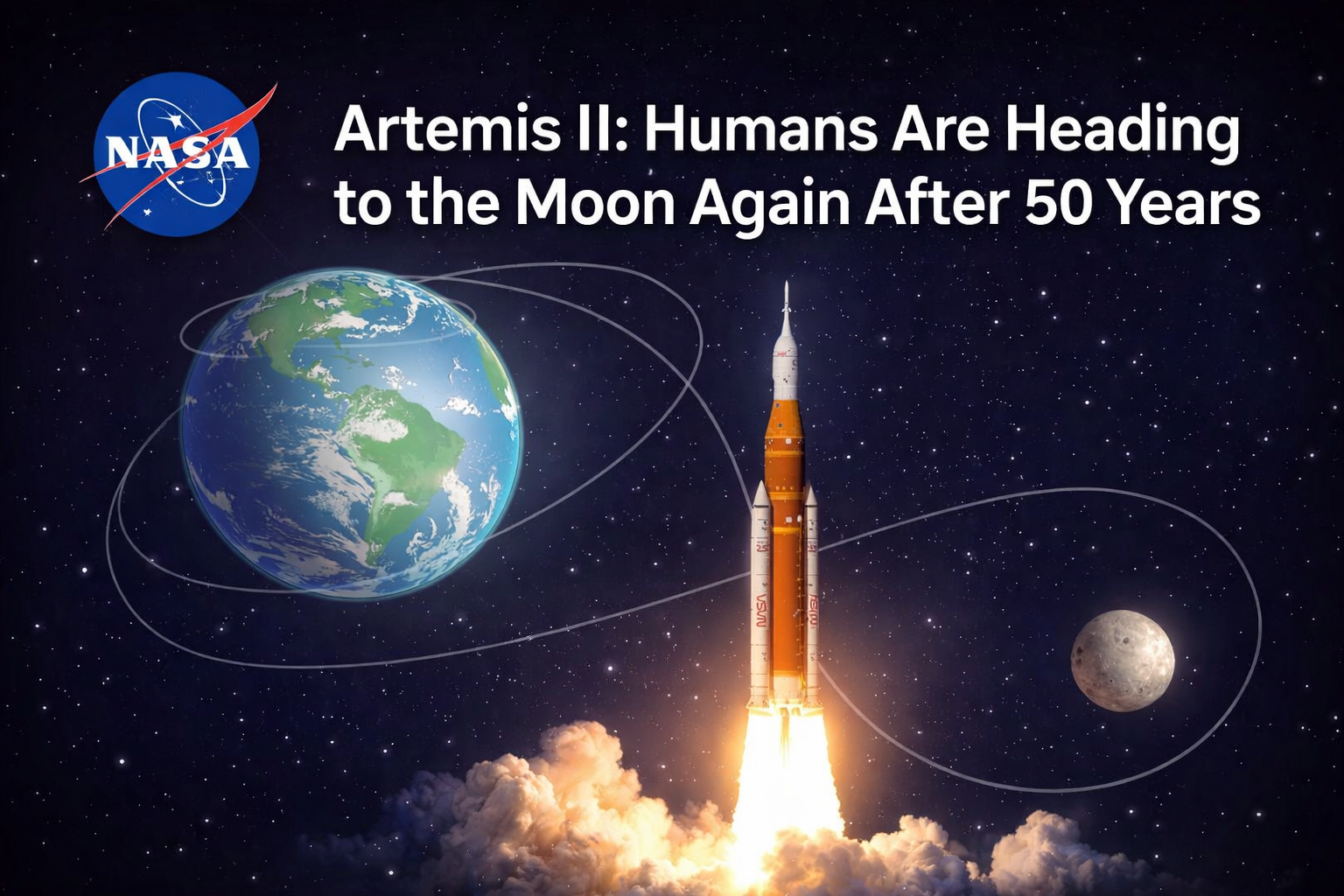
Artemis II’s primary objective is a daring lunar flyby. After launching from Kennedy Space Center, the spacecraft will travel approximately 4,000 miles beyond the Moon—the farthest any human-rated vehicle has ever flown—before using the Moon’s gravity to slingshot back toward Earth. This “free-return trajectory” is a safety feature, ensuring that if propulsion systems fail, the spacecraft will naturally loop back to Earth. During the roughly 10-day mission, the crew will conduct rigorous tests of Orion’s systems, perform scientific observations of the Moon and deep space, and capture breathtaking imagery that will captivate the world.
Paving the Way: From Artemis II to the Lunar Surface and Beyond
Video Credits Nasa Facebook page.
Artemis II is the indispensable foundation upon which the entire Artemis architecture is built. Its success validates the integrated performance of the SLS, Orion, ground systems, and mission operations—all under real, crewed conditions. Every data point gathered—from thermal performance in deep space to communication latency over vast distances—directly informs the design and execution of Artemis III, the historic lunar landing mission scheduled for late 2026.
The lessons learned about crew health, spacecraft navigation, and emergency protocols are non-negotiable prerequisites for safely landing astronauts on the lunar South Pole. Furthermore, Artemis II serves as the ultimate dress rehearsal for the complex ballet of rendezvous and docking required to assemble and utilize the Lunar Gateway. This small station will act as a staging post for surface missions and a hub for scientific research. The technologies and operational confidence gained on Artemis II are also directly transferable to Mars. The ability to manage a multi-week deep-space mission, navigate autonomously far from Earth, and ensure crew well-being in high-radiation environments are precisely the challenges that must be mastered before embarking on the six-to-nine-month voyage to Mars. Artemis II is not an endpoint; it is the critical first step on a staircase leading to the Moon’s surface, the lunar orbiting station, and ultimately, the shores of another planet.
The Power of Partnership: Why International Collaboration Matters

The story of Artemis II cannot be told without acknowledging its truly global nature. While NASA leads the program, Artemis is fundamentally a coalition effort. Canada’s contribution of the Canadarm3 robotic arm for the Gateway is a cornerstone of the mission’s architecture. The European Space Agency (ESA) provides the crucial European Service Module for Orion, which supplies power, propulsion, thermal control, and life support—essentially serving as the spacecraft’s “backpack.” Japan’s JAXA and other international partners are contributing critical technologies and scientific instruments.
This collaboration is not merely diplomatic; it is a strategic necessity. The scale and cost of deep-space exploration are immense, and no single nation possesses all the expertise or resources required. By pooling knowledge, sharing risks, and building shared infrastructure like the Gateway, the Artemis program creates a framework for peaceful, sustainable, and equitable exploration. It transforms space from a potential arena of competition into a unifying platform for humanity—a place where nations work together not despite their differences, but because of the shared, profound wonder of exploring the cosmos. Artemis II, carrying an international crew on an internationally built spacecraft, is the most powerful symbol yet of this new paradigm.
As Artemis II soars toward the Moon, it carries more than four astronauts; it carries the hopes, curiosity, and collective ingenuity of our species. It reminds us that our greatest achievements are born not from isolation, but from unity—from the shared belief that looking up, reaching out, and venturing forth is fundamental to who we are. The Moon, once a distant dream, is now a destination—and Artemis II is the first step back home, and forward to everything that comes next.
Reference – https://www.nasa.gov
https://www.facebook.com/NASA/
Image Credits
AI Image Generated by chatgpt and Nasa Facebook page.
Click this link to read our important and interesting articles as soon as they are published!