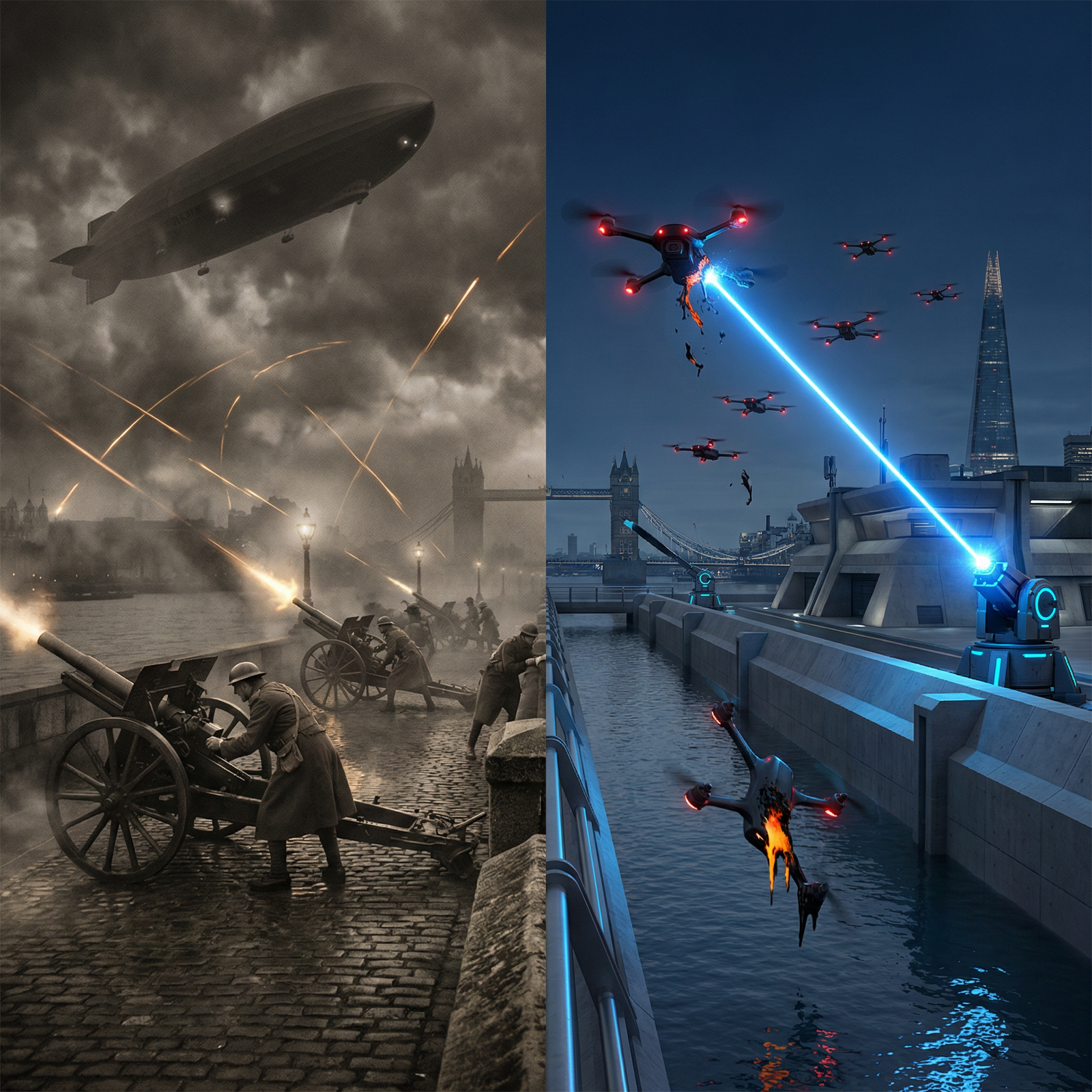
The year is 1915. A cold wind sweeps across the Thames as the citizens of London look up, not in wonder, but in terror. A massive, cigar-shaped shadow—a German Zeppelin—drifts silently through the clouds. Below, desperate soldiers crank manual wheels on modified field guns, firing blindly into the dark. Thousands of shells scream upward, yet the giant remains untouched. This was the birth of air defense: a frantic, low-probability “numbers game” where the sky was filled with more hope than precision, like a Shield.
Fast forward to 2026. A swarm of explosive drones buzzes toward a military outpost. There is no thunderous boom of artillery, no trail of missile smoke. Instead, there is a hum of electricity and a silent, invisible flash. In a microsecond, the lead drone’s wing melts into molten plastic. It falls like a stone. This is the Iron Beam, and the “numbers game” has just been replaced by the speed of light Shield.
The “Kill Chain”: How a Modern Shield Works
To understand how we reached light speed, we must understand the “Kill Chain.” Modern air defense relies on the Four Eyes analogy to ensure a target is destroyed before it touches the ground:

- Detect (The Eyes): High-frequency radar pulses scan the horizon. When waves bounce off an object, the system “sees” it.
- Identify (The Brain): Computers analyze the radar return. Is it a bird? A commercial Boeing 737? Or an enemy cruise missile? This is the IFF (Identification Friend or Foe) stage.
- Target (The Lock): The system calculates a “fire solution.” It predicts where the target will be in five seconds and locks its sensors onto that precise point.
- Engage (The Fire): The command is sent. A missile is launched, or a laser is fired, to intercept the threat.
A Century of Evolution: From Steel to Silicon
1. The Era of Steel Rain (1914–1945)


In the beginning, air defense was “Anti-Aircraft Artillery” (AAA). The most terrifying of these was the German 8.8cm Flak, manufactured by Krupp.
- The Tech: It relied on “shrapnel.” Gunners didn’t try to hit the plane; they filled a specific “box” of air with exploding metal fragments.
- The Reality: It was incredibly inefficient. During WWII, it took an average of 3,000 to 16,000 shells to bring down a single B-17 bomber. It was a war of industrial attrition.
2. The Rocket Revolution (1950s–1980s)

The Jet Age made guns obsolete. Planes now flew faster than the speed of sound.
- S-75 Dvina (USSR/Almaz-Antey): The “Guideline” missile changed history in 1960 when it swatted a U.S. U-2 spy plane out of the stratosphere.
- MIM-3 Nike Ajax (USA/Western Electric): America’s first operational SAM. It used three separate radars to “hand-hold” the missile all the way to the target.
- The Tech: Early guided missiles used vacuum-tube computers and radio commands. They were massive, clunky, but deadly.3. The Digital Wall (1990s–2010s)

Computers shrank, and radars became “Phased Arrays”—stationary panels that could track 100 targets at once without moving an inch.
- MIM-104 Patriot (USA/Raytheon): Famous for the 1991 Gulf War, it evolved into the PAC-3, which uses “Hit-to-Kill” technology. It doesn’t explode near a missile; it physically rams it like a high-speed car crash.
- S-400 Triumf (Russia/Almaz-Antey): Often called the “Patriot on Steroids,” it can fire four different types of missiles to cover everything from low-flying drones to high-altitude ballistic threats.
The Comprehensive Air Defense Comparison
| System | Country / Company | Range | Primary Target | Est. Success Rate |
| S-500 Prometheus | Russia / Almaz-Antey | ~600 km | ICBMs, Hypersonic missiles, Satellites | High (Theoretical) |
| S-400 Triumf | Russia / Almaz-Antey | ~400 km | Stealth Jets, Cruise missiles, AWACS | 70%–85% |
| THAAD | USA / Lockheed Martin | ~200 km | Short to Intermediate Ballistic Missiles | 100% (Test record) |
| MIM-104 Patriot | USA / Raytheon | ~160 km | Tactical Ballistic Missiles, Fixed-wing Jets | 60%–80%* |
| SAMP/T (Mamba) | France & Italy / Eurosam | ~150 km | Tactical Ballistic Missiles, Jets | 90% (Tactical fire) |
| HQ-9B | China / CASIC | ~300 km | Aircraft, Cruise missiles | ~90% (vs Aircraft) |
| NASAMS | Norway & USA / Kongsberg & Raytheon | ~30-50 km | Cruise missiles, UAVs | 90% – 100% |
| Iron Dome | Israel / Rafael | ~70 km | Artillery rockets, Mortars, Drones | 90% – 95% |
| Iron Beam | Israel / Rafael | ~7 km | Drones, Mortars, Rocket swarms | Near 100% |
The Climax: Iron Beam and the Silent Revolution

We have reached the ultimate limit of physics. Developed by Israel’s Rafael Advanced Defense Systems, the Iron Beam is a 100kW High-Energy Laser. It represents a paradigm shift for two reasons: Physics and Finance.
- The Physics: A missile travels at Mach 4 ($1,360$ m/s). A laser travels at the speed of light ($299,792,458$ m/s). There is no “leading” the target. If you can see it, you can hit it.
- The Finance: This is the “Iron Beam’s” real victory. An Iron Dome interceptor missile costs roughly $50,000. If an enemy fires 1,000 cheap $500 rockets, the defender goes bankrupt. An Iron Beam shot costs about $2—the price of the electricity used to fire it.
With an “Unlimited Magazine,” the Iron Beam never runs out of ammo as long as the generator is running. It is the perfect answer to the modern threat of “drone swarms.”
Is the Shield Finally Stronger than the Sword?

For 100 years, the “Sword” (the attacker) had the advantage. It was always cheaper to build a bomb than to build a system to stop it. But as we move from shrapnel to light speed, the “Shield” is finally catching up. The Iron Beam doesn’t just destroy a target; it destroys the economic logic of attacking.
As we look to the future, the sky may once again be silent—not because the threats are gone, but because the invisible shield is finally complete.
Click this link to read our important and interesting articles as soon as they are published!