An international team of physicists has identified how tiny imperfections and lattice vibrations inside a quantum material can be harnessed to convert ambient energy into usable electrical power, a finding that could clear the way for a new class of battery-free electronic devices.
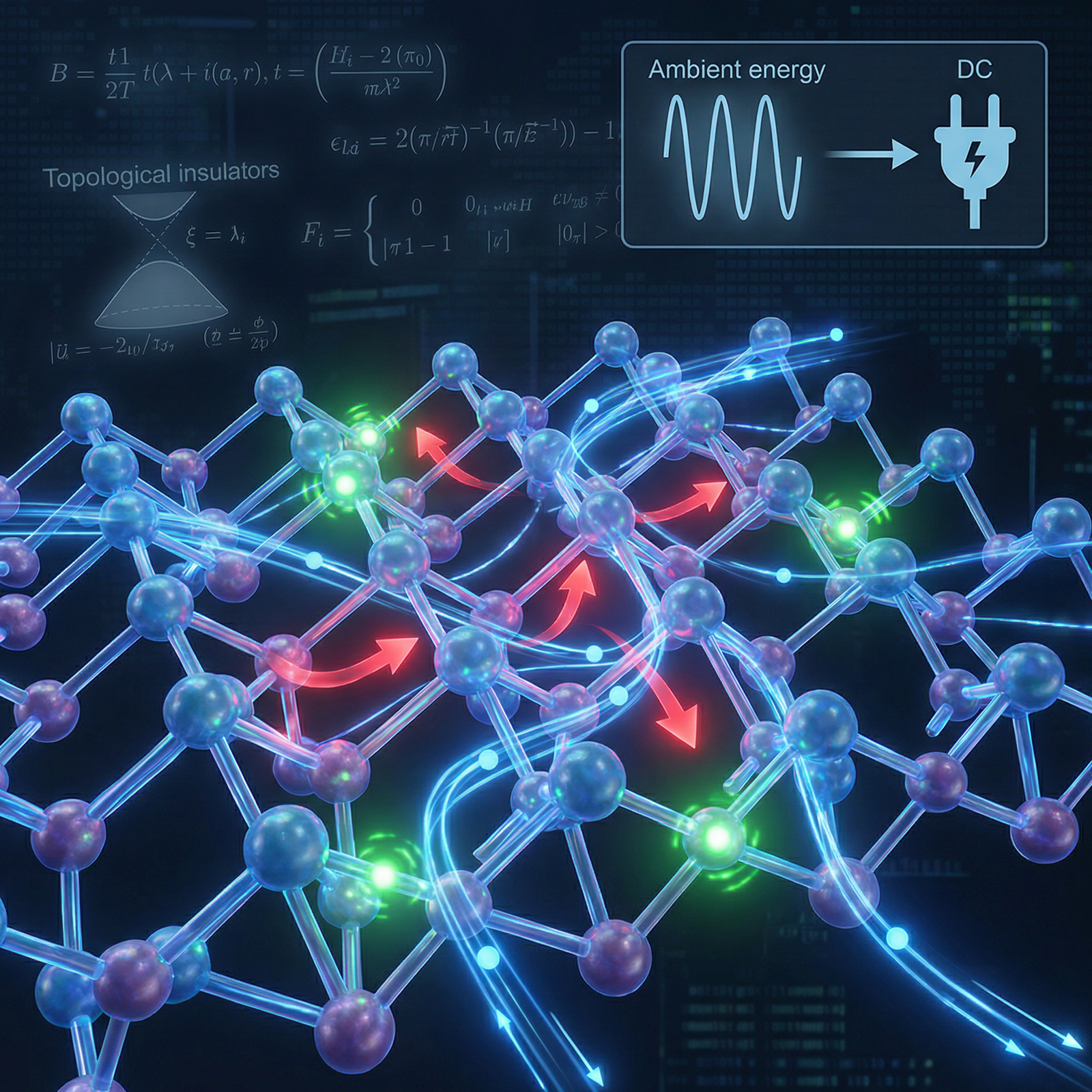
The study, published February 24 in the journal Newton, details the mechanisms governing the nonlinear Hall effect (NLHE) in bismuth telluride, a well-known topological insulator. The research was led by Professor Dongchen Qi from the Queensland University of Technology (QUT) School of Chemistry and Physics in Australia and Professor Xiao Renshaw Wang from Nanyang Technological University in Singapore.
How the Effect Works


Unlike the classical Hall effect, which requires a magnetic field, the NLHE generates a voltage perpendicular to an applied alternating current without one. That property allows alternating electrical signals — the kind emitted by wireless networks and other ambient energy sources — to be converted directly into direct current, sidestepping the need for traditional diodes or other bulky rectifying components.
“This effect allows us to convert alternating signals straight into direct current, which is what’s needed to power electronic devices,” Professor Qi said. “In principle, it means sensors or chips that could operate without batteries, drawing energy from their environment.”
The team found that the NLHE in bismuth telluride remains stable at room temperature, a critical requirement for any practical device application. They also discovered that temperature acts as a kind of tuning dial: at low temperatures, structural imperfections — defects scattered throughout the crystal — dominate the material’s electrical response. As the temperature rises, natural vibrations of the crystal lattice take over, causing the generated voltage to flip direction.
From Abstract Physics to Practical Devices
Unraveling the competition between these two scattering mechanisms — static defects and dynamic lattice vibrations — is central to the paper’s contribution. By mapping how each factor influences the NLHE at different temperatures, the researchers have given device engineers a roadmap for tuning the material’s behavior to suit specific applications.
“Once you understand what’s happening inside the material, you can design devices to take advantage of it,” Professor Qi said. “That’s when quantum effects stop being abstract and start becoming useful.”
The potential applications span self-powered sensors, wearable health monitors, and ultra-fast components for next-generation wireless networks. Earlier work has already demonstrated that bismuth telluride can function as a broadband quantum rectifier across frequencies from Wi-Fi bands to those used in emerging 5G technology, and Harvard researchers have separately shown that nonlinear Hall effects in antiferromagnetic materials can harvest wireless electromagnetic energy with roughly 40 percent conversion efficiency without any optimization.
What Comes Next

The new findings add to a growing body of research suggesting that topological quantum materials could underpin a generation of electronics that draw power from ambient radio waves, heat, or vibration rather than stored chemical energy. Whether these laboratory demonstrations translate into commercial devices will depend on scaling production of high-quality topological materials and engineering efficient antenna and circuit designs — challenges that remain open but, as the researchers argue, are now grounded in a clearer understanding of the underlying physics.
Click this link to read our important and interesting articles as soon as they are published!