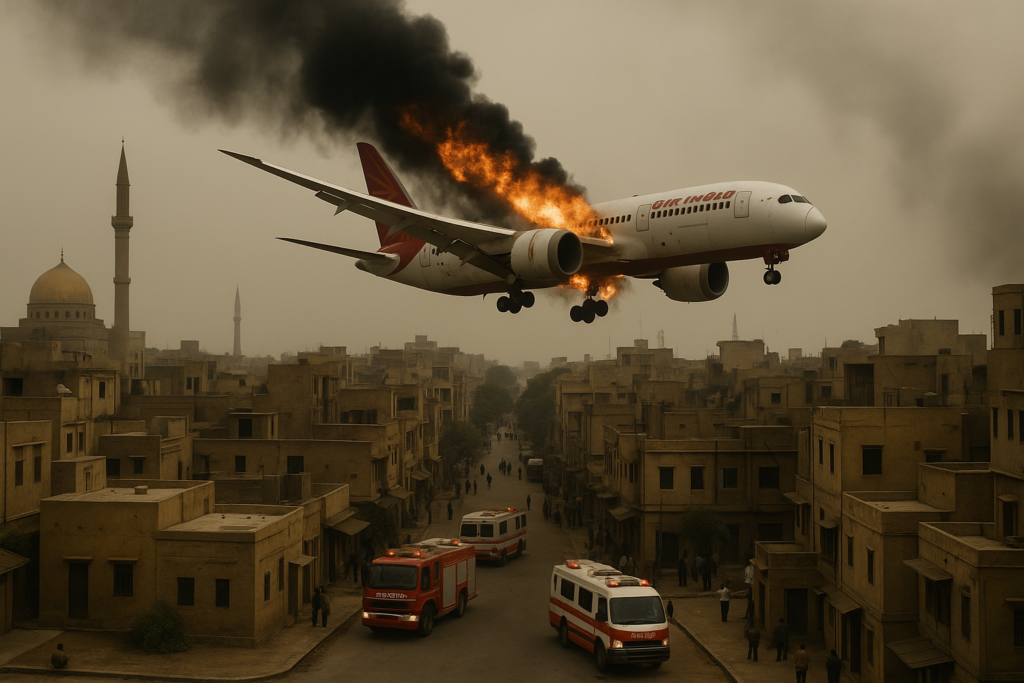
Tragedy Strikes Ahmedabad: The Unfolding Story of Air India Flight AI 171
The vibrant hum of a Thursday afternoon in Ahmedabad, India, was shattered by a deafening roar, a sudden explosion, and then the chilling silence that only precedes immense tragedy. On June 12, 2025, Air India Flight AI 171, a Boeing 787-8 Dreamliner bound for London Gatwick, crashed moments after takeoff from Sardar Vallabhbhai Patel International Airport. What began as a routine journey for 242 individuals aboard quickly devolved into a catastrophic event, sending shockwaves across India and around the globe. This is the unfolding story of a devastating aviation disaster, its immediate aftermath, and the somber questions it leaves in its wake.
A Routine Departure Turns Catastrophic
At precisely 1:38 PM Indian Standard Time, Air India Flight AI 171, tail number VT-ANB, began its ascent from Ahmedabad, carrying 230 passengers and 12 crew members. Among them were 169 Indian nationals, 53 British citizens, 7 Portuguese, and 1 Canadian, all with their own stories, hopes, and destinations. The Dreamliner, a modern marvel of aviation technology, was piloted by Captain Sumeet Sabharwal, an experienced aviator with 8,200 flight hours, and First Officer Clive Kundar, who had 1,100 hours under his belt.
The initial moments of the flight seemed unremarkable. However, within less than a minute of takeoff, as the aircraft climbed to a mere 625-825 feet, air traffic controllers reportedly received a “Mayday” call from the cockpit, signaling a dire emergency. Following this distress call, communication with the aircraft abruptly ceased. Eyewitnesses on the ground described seeing the plane struggle, failing to gain altitude before its trajectory became erratic, leading to its terrifying descent into the densely populated Meghani Nagar area, perilously close to the airport perimeter. The very routine of a daily flight had, in an instant, turned into a horrifying spectacle of fire and destruction.
Ahmedabad Crash Site: A Scene of Utter Devastation
The impact of the large aircraft striking a residential area was nothing short of apocalyptic. Initial reports, tragically confirmed by later visuals, indicated that a significant portion of the aircraft, including potentially its fuselage, crashed directly onto the resident doctors’ hostel of the BJ Medical College. Videos circulated online showed parts of the plane embedded in the hostel’s roof, a chilling testament to the force of the impact. The area was immediately engulfed in a massive inferno, fueled by the aircraft’s full load of jet fuel. Thick, black smoke billowed hundreds of feet into the sky, visible for miles around, signaling the gravity of the situation.
The scene on the ground was one of utter devastation and chaos. Residential buildings were reduced to rubble, and homes were incinerated. Eyewitnesses spoke of a terrifying roar, followed by an explosion that shook the ground. The immediate aftermath was marked by screams, panic, and the desperate cries of those caught in the disaster. Firefighters, ambulances, and police units were dispatched almost immediately, but the sheer scale of the destruction made initial rescue efforts incredibly challenging. The intense heat from the blaze, the unstable structures, and the presence of aircraft debris hampered rapid access to all affected areas.
The Grim Search for Survivors and Casualties
As emergency services flooded the crash site, the focus quickly shifted from containment to search and rescue. Six teams from the National Disaster Response Force (NDRF) were deployed, working alongside local fire brigades and police. The grim task of sifting through the wreckage began, with rescuers battling the remnants of the fire and the threat of collapsing structures.
Tragically, early reports from the ground painted a somber picture regarding casualties. Reuters, citing rescue workers, reported that over 30 bodies had already been recovered from one building alone, with more individuals feared trapped inside. India’s Health Minister and other senior officials rushed to the civil hospital where injured individuals were being transported, underscoring the severity of the human cost. While an official death toll is yet to be confirmed, statements from officials hinting at “many” fatalities, coupled with the heartbreaking visuals of charred remains at the site, suggest a significant loss of life. The very real possibility of casualties among the residents of Meghani Nagar, particularly those in the medical college hostel, added another layer of tragedy to the already devastating event.
Initial Theories and the Start of Investigations
The immediate question on everyone’s mind was: what caused this catastrophic crash? While official investigations by the Directorate General of Civil Aviation (DGCA) are just beginning, and the crucial black boxes (flight data recorder and cockpit voice recorder) will provide definitive answers, aviation experts and officials have put forth several preliminary theories based on the available information.
The fact that the aircraft crashed within minutes of takeoff and at a very low altitude (625-825 feet) is a key factor. Initial analyses suggest possibilities such as:
- Catastrophic Failure to Gain Lift: The aircraft may have experienced a critical failure that prevented it from generating sufficient lift to become airborne safely or maintain altitude.
- Loss of Thrust/Engine Failure: A sudden and complete loss of power from one or more engines could have led to the rapid descent. The “Mayday” call often indicates such a critical system failure.
- Bird Strike: While less common for such a massive aircraft to be completely brought down, a large bird strike or multiple bird strikes at a critical phase of flight (takeoff) could severely damage engines or control surfaces.
- Engineering Fault: Air India had reportedly undertaken refurbishing work on the aircraft recently. Some officials are speculating about a potential underlying engineering fault that manifested during the critical takeoff phase.
- Collision with a Boundary Wall: Some preliminary reports suggested the aircraft may have struck the airport’s boundary wall before crashing into the residential area, which could have exacerbated the damage and led to its final trajectory.
The DGCA has swiftly deployed a team to the crash site to commence their thorough investigation, which will involve analyzing wreckage, interviewing witnesses, and most importantly, recovering and decoding the data from the flight recorders.
Global Response and the Human Toll
The news of the Air India Dreamliner crash reverberated globally, eliciting widespread shock and sympathy. Indian Prime Minister Narendra Modi expressed his profound distress, calling the incident “unimaginably tragic” and confirming discussions with ministers on the unfolding situation. British Prime Minister Keir Starmer conveyed his heartbreak, noting the likely presence of many British nationals on board, and stated that he was being kept constantly updated. Buckingham Palace also confirmed that King Charles III had been informed of the tragedy.

Aviation authorities and airlines worldwide closely monitored the situation. Air India, in a statement on X (formerly Twitter), confirmed the involvement of Flight AI 171 in an accident and pledged to provide further updates as information was confirmed. Both Air India and the UK’s Foreign Office established helpline numbers for concerned family members, a poignant reminder of the human lives caught in this disaster. The Ahmedabad airport was immediately closed, with all flight operations temporarily suspended, causing significant disruption to air travel in the region. The broader impact was also seen in financial markets, with Boeing’s stock price dropping by 7% in pre-market trading, reflecting the gravity of the incident for the aviation industry.
A Tragic First for the Dreamliner
Perhaps one of the most striking aspects of this tragedy is its historical significance for the aviation community. According to the Aviation Safety Network database, the Air India Flight AI 171 crash marks the first-ever fatal crash involving a Boeing 787 Dreamliner. Since its introduction, the Dreamliner has been touted as a highly advanced and safe aircraft. This incident will undoubtedly lead to intense scrutiny of the aircraft’s design, maintenance, and operational procedures, even as investigations are in their infancy.
The 787 has faced challenges in the past, including issues with batteries and engines, but none had resulted in a fatal accident. This makes the Ahmedabad crash a pivotal moment, demanding an exhaustive inquiry to ascertain the precise cause and prevent any recurrence. The aviation industry, with its paramount focus on safety, will be watching closely as the investigation unfolds.
The Long Road to Recovery
As the sun began to set over Ahmedabad on that fateful Thursday, the smoke from the crash site slowly began to dissipate, revealing the full extent of the devastation. The immediate priority remains search, rescue, and recovery, a harrowing process for the first responders and a heart-wrenching wait for the families of those onboard. Beyond the immediate aftermath, there will be the painstaking task of identifying victims, providing support to the bereaved, and reconstructing the events that led to this catastrophe.
The Air India Flight AI 171 crash is a stark reminder of the inherent risks, however rare, associated with air travel and the immense power of human and mechanical failures. The story is far from over, but its initial chapters are already etched in the annals of aviation history, a testament to a day when a routine flight became an unimaginable nightmare for all those involved. The world watches, grieves, and waits for answers, hoping that from this profound tragedy, lessons will be learned to make the skies safer for tomorrow.
Source – NDTV
Click this link to read our important and interesting articles as soon as they are published!
wikimess.com